
A2 · Choosing a preset
JoonHo Lee
2026-05-10
Source:vignettes/a2-choosing-a-preset.Rmd
a2-choosing-a-preset.RmdAbstract
For researchers who know they need a multisite or meta-analytic simulation but do not yet know which preset matches their study. This vignette is a scannable decision table over the nine built-in presets — read down the rows, find your scenario, lift the call. You leave with the preset name that fits, the source citation behind it, the override pattern for adapting it to a local design, and a provenance string suitable for a methods appendix.
1. The problem with picking parameters by feel
A multisite simulation has roughly a dozen knobs that interact: , , , the latent G shape, the dependence target, the engine. Pick them one at a time and the realized design rarely matches what you intended — the implied informativeness is too high, the heterogeneity ratio is too narrow, the shrinkage flag fires unexpectedly. A preset packages a defensible combination tied to a published reference or a documented benchmark. You start there, then override the one or two fields your study departs on.
The package ships nine presets across two front doors. Seven are
site-size-driven (sampling variance comes from generated
,
used with sim_multisite());
two are direct-precision (sampling variance is set through
,
used with sim_meta()). The rest
of this vignette is a table you read down to find the row that matches
your scenario, plus the override pattern for adapting it.
2. What a preset locks for you
Every preset returns a multisitedgp_design with all four
generative layers already filled in. The constructor below shows what
the nine presets fix at the parameters that drive the headline
diagnostics — the paradigm and engine, the site count
,
the between-site SD
,
the latent G shape, the site-size mean (the site-size-driven
path, Paradigm A in the package’s underlying blueprint) or the
pair (the direct-precision path, Paradigm B in the same
blueprint), and the citation that anchors the choice.
preset_objects <- list(
  education_small        = preset_education_small(),
  education_modest       = preset_education_modest(),
  education_substantial  = preset_education_substantial(),
  jebs_paper             = preset_jebs_paper(),
  jebs_strict            = preset_jebs_strict(),
  walters_2024           = preset_walters_2024(),
  twin_towers            = preset_twin_towers(),
  meta_modest            = preset_meta_modest(),
  small_area_estimation  = preset_small_area_estimation()
)

preset_summary <- data.frame(
  preset      = names(preset_objects),
  paradigm    = vapply(preset_objects, `[[`, character(1), "paradigm"),
  engine      = vapply(preset_objects, `[[`, character(1), "engine"),
  J           = vapply(preset_objects, `[[`, integer(1),   "J"),
  sigma_tau   = vapply(preset_objects, `[[`, numeric(1),   "sigma_tau"),
  true_dist   = vapply(preset_objects, `[[`, character(1), "true_dist"),
  nj_mean     = vapply(preset_objects, function(p) p$nj_mean %||% NA_real_, numeric(1)),
  I           = vapply(preset_objects, function(p) p$I       %||% NA_real_, numeric(1)),
  R           = vapply(preset_objects, function(p) p$R       %||% NA_real_, numeric(1)),
  row.names   = NULL,
  stringsAsFactors = FALSE
)
preset_summary
#>                  preset  paradigm    engine    J sigma_tau true_dist nj_mean
#> 1       education_small site_size A2_modern   50     0.050  Gaussian      40
#> 2      education_modest site_size A2_modern   50     0.200  Gaussian      50
#> 3 education_substantial site_size A2_modern  100     0.300  Gaussian      80
#> 4            jebs_paper site_size A1_legacy   50     0.200   Mixture      40
#> 5           jebs_strict site_size A1_legacy  100     0.150   Mixture      80
#> 6          walters_2024 site_size A2_modern   46     0.197  Gaussian     240
#> 7           twin_towers site_size A2_modern 1000     2.000   Mixture     100
#> 8           meta_modest    direct A2_modern   50     0.200  Gaussian      50
#> 9 small_area_estimation    direct A2_modern   30     0.200  Gaussian      50
#>     I   R
#> 1  NA 1.0
#> 2  NA 1.0
#> 3  NA 1.0
#> 4  NA 1.0
#> 5  NA 1.0
#> 6  NA 1.0
#> 7  NA 1.0
#> 8 0.3 1.5
#> 9 0.2 3.0
Read across a row as the locked design. The two direct-precision
presets at the bottom carry the active
pair that drives their sampling-variance distribution; their
nj_mean field surfaces the constructor default and is not
used at simulation time. The seven site-size presets above them carry
the active nj_mean (and the implicit cv,
nj_min, R2 settings printed by the design
object itself); their
entries surface constructor defaults and are not used — realized
and
fall out of the site-size distribution and the chosen
at simulation time.
The two engines you see — A1_legacy and
A2_modern — produce identical numerical results on the
standardized residual scale; the difference is internal plumbing. The
two JEBS presets pin A1_legacy because the published JEBS
results were generated under that engine and the parity check on the
JEBS table requires it. Everything else uses A2_modern. See
Margin and SE models for the
engine discussion.
3. The decision rubric
Read this table down, top to bottom, until a row describes your study. The recommended preset is the call to lift; the locked parameters column is what that preset will fix for you; the source column is the published reference behind the calibration; the override column is the field most studies need to change first.
| Scenario | Preset | Locked: J / sigma_tau / paradigm | Source | Most common override |
|---|---|---|---|---|
| Education trial, small effects (~0.05) on the standardized scale | preset_education_small() |
J = 50 / 0.05 / site-size | Weiss et al. (2017) |
J, nj_mean
|
| Education trial, modest effects (~0.20) — typical RCT scale | preset_education_modest() |
J = 50 / 0.20 / site-size | Weiss et al. (2017) |
J, sigma_tau
|
| Education trial, substantial effects (~0.30), large J | preset_education_substantial() |
J = 100 / 0.30 / site-size | Weiss et al. (2017) | nj_mean |
| Reproduce the JEBS paper design (mixture-shape latent effects) | preset_jebs_paper() |
J = 50 / 0.20 / site-size | Lee et al. (2025) | (none — verbatim) |
| JEBS strict parity grid (validation / benchmarking) | preset_jebs_strict() |
J = 100 / 0.15 / site-size | Lee et al. (2025) | (none — verbatim) |
| Replicate the Walters Handbook chapter calibration | preset_walters_2024() |
J = 46 / 0.197 / site-size; locks , | Walters (2024) | R2 |
| Large-J / extreme heterogeneity stress test | preset_twin_towers() |
J = 1000 / 2.0 / site-size | Package-curated | J |
| Meta-analysis warm-up (direct-precision path) | preset_meta_modest() |
J = 50 / 0.20 / direct; locks , | Package-curated |
I, R
|
| Small-area-estimation prior calibration | preset_small_area_estimation() |
J = 30 / 0.20 / direct; locks , | Package-curated |
I, R
|
Three reading rules.
First — the paradigm column is the most consequential entry.
If you plan to call sim_multisite(), you need a row whose
paradigm is site-size. If you plan to call
sim_meta(), you need direct. Mixing them produces
an immediate front-door error (Section 7).
Second — source tells you what published number you are
inheriting. The three education presets share Weiss et al. (2017) as
their sigma-tau anchor (Weiss et al.,
2017). The two JEBS presets implement the simulation design from
Lee et al. (2025).
preset_walters_2024() reproduces the calibration in the
Handbook of Labor Economics, volume 5 chapter by Walters (2024). The remaining three presets are
package-curated rather than paper-anchored and carry no external
citation.
Third — override is the field most studies change first. Education presets retain but adjust to match the local sample of schools; the Walters preset retains and but adjusts the covariate . JEBS rows show no override because their value is reproducing the published number exactly — change a JEBS field and the preset name no longer applies.
A compact tree view (alternative)
Readers who prefer branching to tabular logic can walk the same rubric as a four-question tree:
Q1 paradigm
├── multisite trial -> Q2 calibration source
│   ├── JEBS paper        -> Q3 grid
│   │   ├── paper-grid    -> preset_jebs_paper()
│   │   └── strict-grid   -> preset_jebs_strict()
│   ├── Walters Handbook  -> preset_walters_2024()
│   ├── Education applied -> Q4 effect-size scale
│   │   ├── small  ~0.05  -> preset_education_small()
│   │   ├── modest ~0.20  -> preset_education_modest()
│   │   └── subst. ~0.30  -> preset_education_substantial()
│   └── stress test       -> preset_twin_towers()
└── meta-analysis     -> Q5 special requirements
    ├── methods warm-up   -> preset_meta_modest()
    └── small-area prior  -> preset_small_area_estimation()
If a reviewer asks why a particular preset, you trace four nodes through this tree and you have your answer.
When to override versus pick a different row
If you find yourself overriding more than two fields, you are in a
different row. Move to the row whose locked parameters are closest to
your design, then override at most one or two. The presets are not
fragile — every preset accepts named overrides through ...
— but their defensibility comes from the published anchor.
Overriding the sigma-tau of a Weiss-anchored preset to 0.40 silently
breaks the anchor. Pick preset_education_substantial()
instead and tune from there.
4. Override patterns
Overrides are flat, named arguments forwarded to the underlying multisitedgp_design()
constructor. Anything you do not name is left at the preset default.
local_design <- preset_education_modest(
  J          = 20L,
  nj_mean    = 60,
  sigma_tau  = 0.25
)

local_design
#> <multisitedgp_design>
#> Paradigm: site_size    Engine: A2_modern    Framing: superpopulation
#> J: 20    Seed: NULL (active RNG)    Lifecycle: experimental
#>
#> [ Layer 1: G-effects ]
#>   true_dist:  Gaussian
#>   tau:        0
#>   sigma_tau:  0.25
#>   formula:    NULL
#>   beta:       NULL
#>   g_fn:       NULL
#>
#> [ Layer 2: Margin (Paradigm A) ]
#>   nj_mean:    60
#>   cv:         0.5
#>   nj_min:     10
#>   p:          0.5
#>   R2:         0
#>   var_outcome: 1
#>
#> [ Layer 3: Dependence ]
#>   method:        none
#>   rank_corr:     0
#>   pearson_corr:  0
#>   hybrid_init:   copula
#>   hybrid_polish: hill_climb
#>   dependence_fn: NULL
#>
#> [ Layer 4: Observation ]
#>   obs_fn: NULL
#>
#> Use sim_multisite(design) or sim_meta(design) to simulate.
Three things to read off the printed object. The header shows
moved from the preset default 50 to 20. The Layer 1
moved from 0.20 to 0.25 — a modest tune-up to match a local pilot. In
Layer 2 (Margin), nj_mean moved from 50 to 60. Every
unnamed field — cv = 0.5, nj_min = 10, the
dependence settings, the observation hook — survives untouched from the
preset.
Now simulate from the override design and check that the realized diagnostics still pass:
local_dat <- sim_multisite(local_design, seed = 2027L)
summary(local_dat)
#> multisiteDGP simulation diagnostics
#> ------------------------------------------------------------
#> A. Realized vs Intended
#>    I (informativeness):         0.396  (target N/A)  N/A   [no target]
#>    R (SE heterogeneity):        4.714  (target N/A)  N/A   [no target]
#>    sigma_tau:                   0.273  (target 0.250)  WARN  [rel=9.1%]
#>    GM(se^2):                    0.095  (target N/A)  N/A   [no target]
#>
#> B. Dependence
#>    rank_corr residual:         -0.103  (target 0.000)  PASS  [delta=-0.103]
#>    rank_corr marginal:         -0.103  (target N/A)  N/A   [residual target rows only; no finite target; status not assigned]
#>    pearson_corr residual:      -0.124  (target 0.000)  FAIL  [delta=-0.124]
#>    pearson_corr marginal:      -0.124  (target N/A)  N/A   [residual target rows only; no finite target; status not assigned]
#>
#> C. G shape fit
#>    KS distance D_J:             0.200  (target 0.000)  PASS  [p=0.832]
#>    Bhattacharyya BC:            0.441  (target 1.000)  FAIL  [rel=-55.9%]
#>    Q-Q residual:                0.460  (target 0.000)  N/A   [delta=0.460]
#>
#> D. Operational feasibility
#>    mean shrinkage S:            0.401  (target N/A)  PASS  [no target]
#>    avg MOE (95%):               0.623  (target N/A)  WARN  [no target]
#>    feasibility_index:           8.016  (target N/A)  WARN  [no target]
#> ------------------------------------------------------------
#> Overall: 3 PASS, 3 WARN, 2 FAIL.
#> Provenance: multisiteDGP 0.1.1 | paradigm=site_size | seed=2027 | canonical_hash=e4d3e7cabb623cf3 | design_hash=8f8485997bc6a366 | hash_algo=xxhash64 | R=4.6.0 | hooks=none
The realized landed at 0.273 against the target 0.250 (WARN, percent relative drift — small-J sampling noise, not a design error). The dependence diagnostic on the rank scale passes at against target zero. Operational feasibility flags WARN because leaves the effective per-site sample size near 8 — expected for the small-J override.
The general override rules:
- One field at a time first. Bump , re-render, check the diagnostics. Only move on if the realized values look right.
-
Re-render
summary()after every override. A field move can push a previously-passing diagnostic into WARN. -
Document the override in your provenance string.
The
canonical_hash()andprovenance_string()carry the override into the methods appendix automatically — you do not need to spell out the field changes in prose.
5. Visual comparison across presets
A scannable table loses one piece of context: how the realized site effects actually look across presets. The plot below pulls three presets covering the heterogeneity range — small (Weiss low end), modest (JEBS / Weiss middle), and substantial (Weiss upper, large J) — and overlays their distributions on a common axis.
ggplot2::ggplot(
  compare_df,
  ggplot2::aes(x = factor(preset, levels = c("education_small",
                                             "education_modest",
                                             "education_substantial")),
               y = tau_hat)
) +
  ggplot2::geom_jitter(width = 0.18, alpha = 0.55, size = 1.4) +
  ggplot2::geom_hline(
    data    = unique(compare_df[, c("preset", "sigma_tau")]),
    mapping = ggplot2::aes(yintercept = sigma_tau),
    linetype = "dashed", color = "grey45"
  ) +
  ggplot2::geom_hline(
    data    = unique(compare_df[, c("preset", "sigma_tau")]),
    mapping = ggplot2::aes(yintercept = -sigma_tau),
    linetype = "dashed", color = "grey45"
  ) +
  ggplot2::labs(
    x        = NULL,
    y        = expression(hat(tau)[j]),
    title    = "Site-effect spread across three education presets",
    subtitle = "Dashed lines mark each preset's sigma_tau target"
  ) +
  ggplot2::theme_minimal(base_size = 11)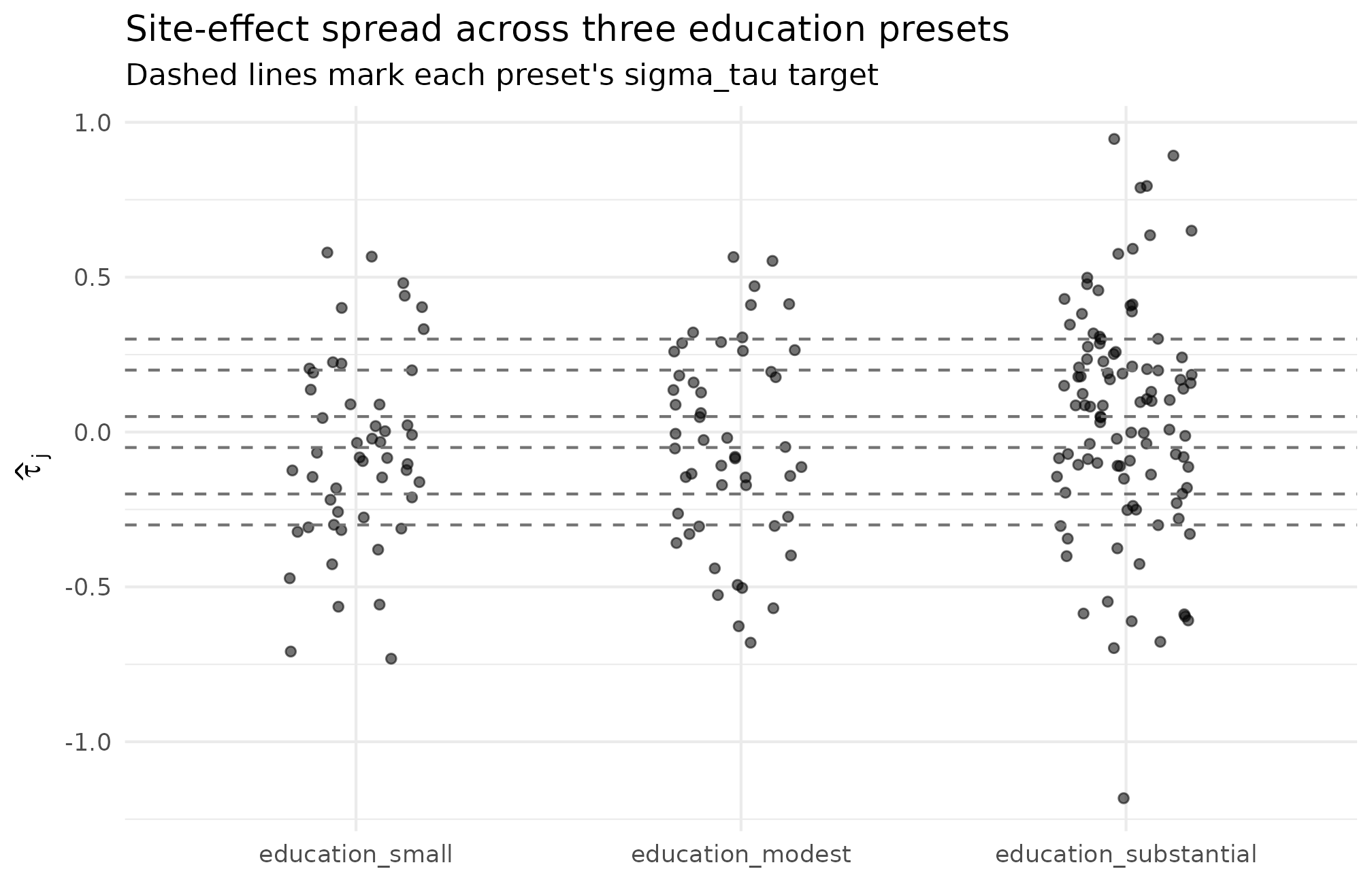
Realized observed estimates across three Weiss-anchored presets at seed = 1L. Vertical spread widens as the preset’s sigma_tau grows (0.05, 0.20, 0.30 — left to right). The fixed sigma_tau anchor of each preset is the dashed reference line. The small-effects column’s cloud nearly collapses to zero because the latent SD is small relative to sampling error; the substantial column’s cloud is widest, with J = 100 narrowing each site’s bar and pulling the cloud closer to its dashed band.
What to read off this plot, in this order.
- Vertical spread. The substantial-effects column should be visibly wider than the modest and small columns; that is the ladder you locked in by choosing one preset over another.
- Bar density at the dashed lines. Roughly two-thirds of the site dots should fall inside each preset’s band — the empirical rule for an SD-scale parameter.
-
The small column collapsing. When
,
latent variation is dominated by sampling noise; the dots scatter widely
relative to the dashed band. That is the calibration warning
preset_education_small()is meant to make explicit, not a bug in the preset.
6. Diagnostic per preset — funnel for
preset_jebs_paper()
The visual contract for an individual preset is its funnel plot.
Below is the funnel for preset_jebs_paper() — the
rank-correlation target is zero, so a symmetric scatter top-to-bottom is
the expected signature. If the cloud tilts, the design has accidentally
induced precision–effect dependence and the rank-correlation diagnostic
in Group B will flip from PASS to FAIL.
dat_jebs <- sim_multisite(preset_jebs_paper(), seed = 1L)
plot_funnel(dat_jebs, caption = FALSE) +
  ggplot2::labs(
    title    = "preset_jebs_paper() — funnel diagnostic",
    subtitle = "Symmetric cloud confirms rho_S target = 0"
  )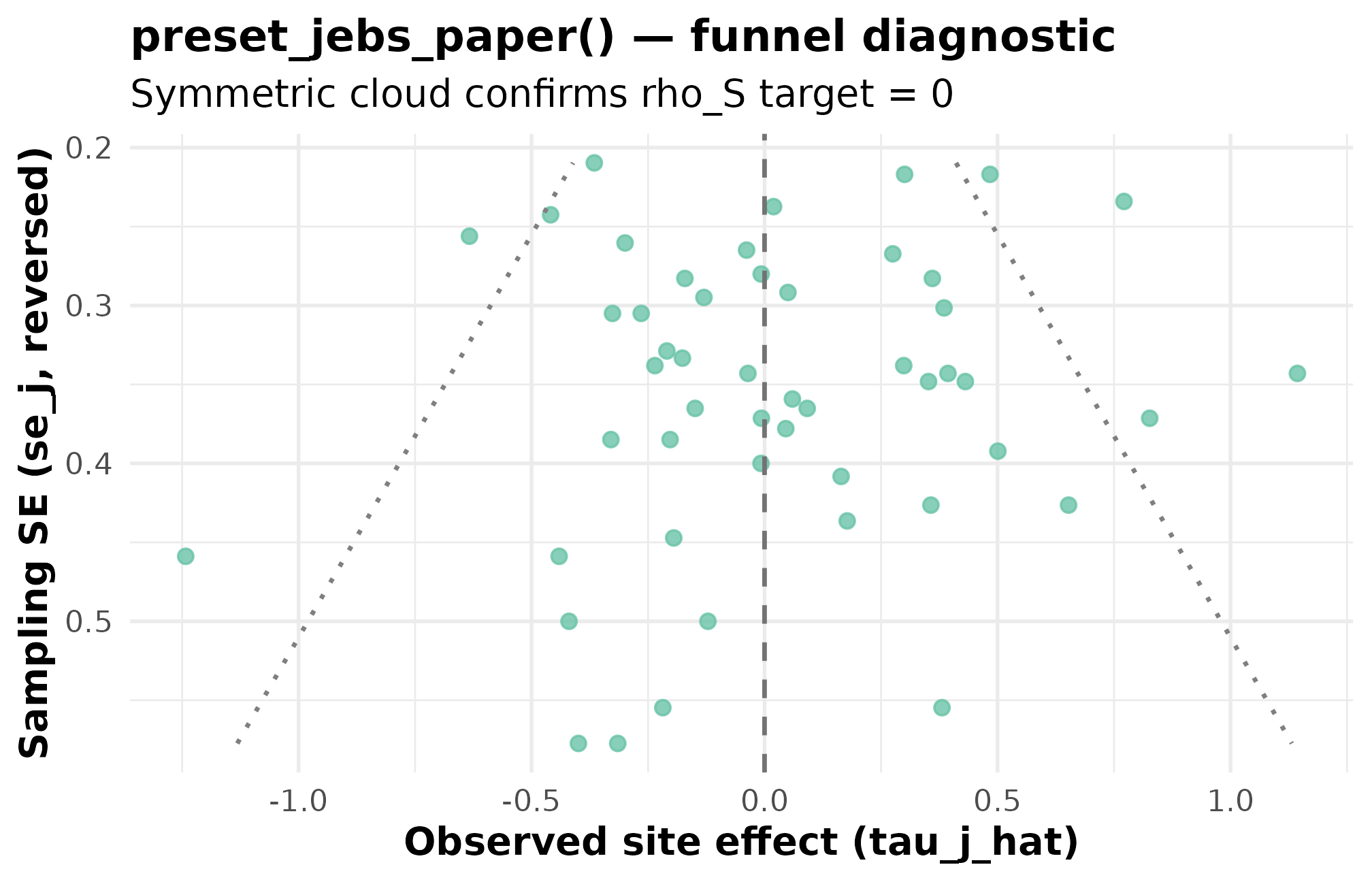
Funnel plot for preset_jebs_paper() at seed = 1L. Standard error on the x-axis (smaller = more precise); observed estimate on the y-axis. The cloud tapers as SE shrinks because the design generates SE from site sizes — the funnel signature of the site-size-driven path. Symmetry top-to-bottom confirms the rank-correlation target rho_S = 0 (PASS at -0.193, well within sampling tolerance for J = 50).
The same visual contract applies to every site-size preset; only the
spread and the funnel-mouth width change. For
preset_education_small() the cloud is narrower vertically;
for preset_twin_towers() it is enormous (J = 1000,
).
The diagnostic question — “is the cloud symmetric around zero” — stays
identical. See Diagnostics in
practice for the full four-group rubric.
7. Wrong-door checks
Front doors are intentionally strict. A site-size preset belongs to
sim_multisite(),
and a direct-precision preset belongs to sim_meta(). Mixing
them produces a clean error rather than a silent miscalculation.
tryCatch(
  sim_meta(preset_education_modest(), seed = 1L),
  error = function(e) conditionMessage(e)
)
#> [1] "\033[1m\033[22m\033[31m✖\033[39m `sim_meta()` requires `paradigm = \"direct\"`.\n\033[36mℹ\033[39m Got `design$paradigm = \"site_size\"`.\n→ Use `sim_multisite()` for site-size designs."
Read the error: the wrapper says it requires
paradigm = "direct", notes the design carried
paradigm = "site_size", and points you to the right front
door. Reverse the example and the same guard fires the other way.
The second wrong-door check is a calibration FAIL inside a preset
that the user picked at the wrong scale. If Maya picks
preset_education_small()
()
for a study whose real heterogeneity is closer to 0.20, the simulation
runs without error — but the diagnostics catch it.
small_dat <- sim_multisite(preset_education_small(), seed = 1L)
summary(small_dat)
#> multisiteDGP simulation diagnostics
#> ------------------------------------------------------------
#> A. Realized vs Intended
#>    I (informativeness):         0.021  (target N/A)  N/A   [no target]
#>    R (SE heterogeneity):       12.125  (target N/A)  N/A   [no target]
#>    sigma_tau:                   0.042  (target 0.050)  FAIL  [rel=-16.9%]
#>    GM(se^2):                    0.116  (target N/A)  N/A   [no target]
#>
#> B. Dependence
#>    rank_corr residual:          0.261  (target 0.000)  PASS  [delta=0.261]
#>    rank_corr marginal:          0.261  (target N/A)  N/A   [residual target rows only; no finite target; status not assigned]
#>    pearson_corr residual:       0.386  (target 0.000)  FAIL  [delta=0.386]
#>    pearson_corr marginal:       0.386  (target N/A)  N/A   [residual target rows only; no finite target; status not assigned]
#>
#> C. G shape fit
#>    KS distance D_J:             0.140  (target 0.000)  PASS  [p=0.717]
#>    Bhattacharyya BC:            0.801  (target 1.000)  WARN  [rel=-19.9%]
#>    Q-Q residual:                0.731  (target 0.000)  N/A   [delta=0.731]
#>
#> D. Operational feasibility
#>    mean shrinkage S:            0.024  (target N/A)  FAIL  [no target]
#>    avg MOE (95%):               0.697  (target N/A)  FAIL  [no target]
#>    feasibility_index:           1.188  (target N/A)  FAIL  [no target]
#> ------------------------------------------------------------
#> Overall: 2 PASS, 1 WARN, 5 FAIL.
#> Provenance: multisiteDGP 0.1.1 | paradigm=site_size | seed=1 | canonical_hash=209d790e83aa6976 | design_hash=caae328a59a97738 | hash_algo=xxhash64 | R=4.6.0 | hooks=none
Read the diagnostics. The realized
comes in at 0.042 against a target of 0.050 — that is a FAIL, even
though the small-J
()
sampling noise is the dominant cause. The implied operational
feasibility flag at the bottom (mean shrinkage, average MOE, feasibility
index) fires a red status because the latent signal is small relative to
sampling error. The simulation ran cleanly — it is the design
that is wrong for this scenario. Switch to
preset_education_modest() and the same diagnostics return
to PASS or WARN territory at appropriate magnitudes.
8. Defending the choice
Once a preset is selected and any overrides are applied, the provenance string carries the choice and the seed into the methods appendix in one line.
chosen_dat <- sim_multisite(preset_jebs_paper(), seed = 1L)
provenance_string(chosen_dat)
#> [1] "multisiteDGP 0.1.1 | paradigm=site_size | seed=1 | canonical_hash=b29561b47a40332d | design_hash=cddffb66364a11ee | hash_algo=xxhash64 | R=4.6.0 | hooks=none"
The string contains the package version, the paradigm, the seed, the canonical hash of the simulation, the design hash, the hashing algorithm, the R version, and any active hooks. Pasting this into a methods appendix gives a reviewer the exact contract: identical package version + identical seed + identical preset → identical canonical hash → byte-identical simulation. The hash itself is the short anchor:
canonical_hash(chosen_dat)
#> [1] "b29561b47a40332d"
Cite the source for the chosen preset in prose. For
preset_jebs_paper() and preset_jebs_strict()
cite Lee et al. (2025); for
preset_walters_2024() cite Walters
(2024); for the three education presets cite Weiss et al. (2017). The three remaining presets
are package-curated and carry no external citation; describe each by
role (“a stress-test preset for J = 1000 with extreme heterogeneity”; “a
meta-analysis warm-up at the direct-precision front door”; “a
small-area-estimation prior calibration”) rather than naming a
paper.
A reviewer-ready methods-appendix line ties it all together:
Simulation generated with multisiteDGP (version 0.1.0, Lee 2025) using
preset_education_modest(J = 20L, nj_mean = 60, sigma_tau = 0.25), seed = 2027L, canonical hash 4f9399b626d1c71f.
Three lines, every load-bearing claim grounded in either a citation or a hash.
9. Where to next
- A1 · Getting started — if you have not already run a first simulation end-to-end, start there.
- Diagnostics in practice — the four diagnostic groups and the plots that go with each.
-
Covariates and
precision dependence — for the
R2override onpreset_walters_2024()and how precision–effect dependence enters Layer 3. - Calibrating to real data — when you have observed point estimates and SEs you want the simulator to match.
- Cookbook — recipe walkthroughs for downstream analysis on a fitted preset.
For methodology — the formal two-stage DGP, the G-distribution catalog, the site-size-driven and direct-precision paths — start with The two-stage DGP and read M2 / M3 / M4 in order.
References
The three education presets inherit their
ladder from Weiss et al. (2017). The two
JEBS presets reproduce the simulation design in Lee et al. (2025).
preset_walters_2024() is calibrated to the Handbook chapter
Walters (2024). The remaining three
presets — preset_meta_modest(),
preset_small_area_estimation(),
preset_twin_towers() — are package-curated and carry no
published anchor at this writing.
Acknowledgments
This research was supported by the Institute of Education Sciences, U.S. Department of Education, through Grant R305D240078 to the University of Alabama. The opinions expressed are those of the authors and do not represent views of the Institute or the U.S. Department of Education.
Session info
#> R version 4.6.0 (2026-04-24)
#> Platform: x86_64-pc-linux-gnu
#> Running under: Ubuntu 24.04.4 LTS
#>
#> Matrix products: default
#> BLAS:   /usr/lib/x86_64-linux-gnu/openblas-pthread/libblas.so.3
#> LAPACK: /usr/lib/x86_64-linux-gnu/openblas-pthread/libopenblasp-r0.3.26.so;  LAPACK version 3.12.0
#>
#> locale:
#>  [1] LC_CTYPE=C.UTF-8       LC_NUMERIC=C           LC_TIME=C.UTF-8
#>  [4] LC_COLLATE=C.UTF-8     LC_MONETARY=C.UTF-8    LC_MESSAGES=C.UTF-8
#>  [7] LC_PAPER=C.UTF-8       LC_NAME=C              LC_ADDRESS=C
#> [10] LC_TELEPHONE=C         LC_MEASUREMENT=C.UTF-8 LC_IDENTIFICATION=C
#>
#> time zone: UTC
#> tzcode source: system (glibc)
#>
#> attached base packages:
#> [1] stats     graphics  grDevices utils     datasets  methods   base
#>
#> other attached packages:
#> [1] ggplot2_4.0.3      multisiteDGP_0.1.1
#>
#> loaded via a namespace (and not attached):
#>  [1] gtable_0.3.6       jsonlite_2.0.0     dplyr_1.2.1        compiler_4.6.0
#>  [5] tidyselect_1.2.1   nleqslv_3.3.7      jquerylib_0.1.4    systemfonts_1.3.2
#>  [9] scales_1.4.0       textshaping_1.0.5  yaml_2.3.12        fastmap_1.2.0
#> [13] R6_2.6.1           labeling_0.4.3     generics_0.1.4     knitr_1.51
#> [17] tibble_3.3.1       desc_1.4.3         bslib_0.10.0       pillar_1.11.1
#> [21] RColorBrewer_1.1-3 rlang_1.2.0        cachem_1.1.0       xfun_0.57
#> [25] fs_2.1.0           sass_0.4.10        S7_0.2.2           cli_3.6.6
#> [29] pkgdown_2.2.0      withr_3.0.2        magrittr_2.0.5     digest_0.6.39
#> [33] grid_4.6.0         lifecycle_1.0.5    vctrs_0.7.3        evaluate_1.0.5
#> [37] glue_1.8.1         farver_2.1.2       ragg_1.5.2         rmarkdown_2.31
#> [41] tools_4.6.0        pkgconfig_2.0.3    htmltools_0.5.9