M7 · Reproducibility and provenance
JoonHo Lee
2026-05-10
Source:vignettes/m7-reproducibility-provenance.Rmd
m7-reproducibility-provenance.RmdAbstract
For applied researchers who have already run a simulation and
now want to make sure the result is reproducible — by them
tomorrow, by a coauthor next month, by a reviewer next year. This
vignette walks through the five-step workflow
multisiteDGP is designed around: set the seed,
capture the provenance string, capture the canonical hash, save a
manifest, and verify the hash on rerun. You leave with a one-line
provenance fingerprint, a 16-character hash, a saved manifest
tibble, and a clear sense of what the package guarantees and where
the contract can break.
1. Why reproducibility matters
You ran a simulation. The numbers in your draft — the realized
between-site standard deviation, the shrinkage benefit, the funnel plot
— all came from a single call to sim_multisite() on a
single afternoon. Six months from now, a reviewer asks whether you can
reproduce the results, or a coauthor wants to extend them, or a graduate
student tries to swap in a new preset and discovers the output looks
different from the one in your appendix. At that point you need to be
able to say, with one line of evidence: the simulation that produced
Figure 3 is byte-identical to this rerun, or, equivalently, the
contract is broken — here is exactly which ingredient changed. That
one-line evidence is what canonical_hash() and
provenance_string() give you, and what the rest of this
vignette walks through.
2. The four-piece kit
multisiteDGP ships four pieces of machinery for the job.
Two are exported functions you call directly; one is a policy the
package enforces internally on your behalf; one is a pattern (the
“manifest”) you assemble per project.
-
canonical_hash(x)— the 16-characterxxhash64content fingerprint of a simulation object, a design object, or any data-frame-shaped result. It normalizes column order, drops row names, restricts to a stable diagnostics allowlist, and replaces callback functions with presence sentinels. Two runs with the same package version, seed, and design produce the same hash; any meaningful drift produces a different hash. -
provenance_string(x)— a single pipe-delimited line carrying package version, paradigm, seed, canonical hash, design hash, hash algorithm, R version, and any active hooks. Drop it in the methods appendix or a figure caption; it is the smallest unit a reviewer needs to identify the run. -
The local-seed-stream policy — internally the
package never manufactures seeds from the caller’s global RNG state.
Whenever
sim_multisite()orsim_meta()needs to allocate per-row seeds (for example, when running adesign_grid()), it does so withwithr::with_seed()inside an isolated stream so your ambientset.seed()is never disturbed. The practical consequence is that running unrelated code between twosim_multisite()calls with the sameseed = 1Lcannot change either result. - The golden-fixture manifest — a tibble (or row in a registry) recording the artifact name, package version, preset, seed, canonical hash, design hash, hash algorithm, R version, and platform for one specific simulation. Saving this alongside a paper draft, or committing it to your project repo, is what turns the hash from a computation into a contract.
The first two are the user-facing surface. The third is invisible. The fourth is yours to assemble. Sections 3 through 5 below walk through how the four pieces fit together in a five-step workflow.
3. Workflow walkthrough — pinning a single artifact
The walkthrough is structured around one running example: you have
just run a simulation with preset_jebs_paper() at
seed = 1L, and you want to pin it. The example is the same
one used as the package’s smoke check, so the canonical hash you will
see — c52e75f276d82836 — is also documented in the
vignettes/_vignette-frontmatter-template.txt file as the
package-level determinism check. If your local rerun produces this exact
hash, the version of the package you have installed is in sync with the
published reference.
3.1 Step 1 — set the seed
The seed is the entry point to determinism. The package follows the
convention used by lee2025improving and the JEBS preset:
pass an integer to the seed argument of every primary call,
do not rely on the ambient global RNG state. The setup chunk also calls
set.seed(1L) for any helper code outside the primary
calls.
set.seed(1L)A common pitfall: setting the global seed but forgetting to pass
seed = 1L to sim_multisite(). The two are not
interchangeable. The argument carries the seed through the local seed
stream the package allocates internally; the global call only protects
helpers that draw from runif() directly.
3.2 Step 2 — run the simulation and capture
provenance_string()
Run the simulation. The result is a multisitedgp_data
object — a tibble with simulation-specific attributes for design,
paradigm, diagnostics, and provenance.
dat <- sim_multisite(preset_jebs_paper(), seed = 1L)
dat
#> # A multisitedgp_data: 50 sites, paradigm = "site_size"
#> # Realized vs intended:
#> #   I: realized=0.250 (no target)
#> #   R: realized=7.583 (no target)
#> #   sigma_tau: target=0.200, realized=0.207, PASS
#> #   rho_S: target=0.000, realized=-0.193, PASS
#> #   rho_S_marg: realized=-0.193 (no target)
#> #   Feasibility: WARN (n_eff=13.098)
#> # A tibble: 50 × 7
#>   site_index    z_j   tau_j tau_j_hat  se_j  se2_j   n_j
#>        <int>  <dbl>   <dbl>     <dbl> <dbl>  <dbl> <int>
#> 1          1 -0.582 -0.116    0.652   0.426 0.182     22
#> 2          2 -0.619 -0.124   -0.315   0.577 0.333     12
#> 3          3 -1.11  -0.222   -0.633   0.256 0.0656    61
#> 4          4  1.36   0.273    0.357   0.426 0.182     22
#> 5          5 -0.405 -0.0809  -0.00723 0.280 0.0784    51
#> 6          6  0.884  0.177   -0.203   0.385 0.148     27
#> # ℹ 44 more rows
#> # Use summary(df) for the full diagnostic report.
Now ask the object for its one-line provenance fingerprint.
provenance_string(dat)
#> [1] "multisiteDGP 0.1.1 | paradigm=site_size | seed=1 | canonical_hash=b29561b47a40332d | design_hash=cddffb66364a11ee | hash_algo=xxhash64 | R=4.6.0 | hooks=none"
Read the line left to right: package version, paradigm (the
site-size-driven path of lee2025improving, versus
the direct-precision path used in A7), seed, content hash of
the realized data, fingerprint of the design alone, hash algorithm, R
version, and active callbacks (none because
preset_jebs_paper() registers no user-supplied
g_fn, se_fn, or dependence callback). This is
the line you paste into the methods appendix; it is enough for a
reviewer to know what was run.
3.3 Step 3 — capture canonical_hash() separately
You do not strictly need to capture the hash separately — it appears inside the provenance string. But the hash on its own is the contract you will check programmatically, so it is worth pulling it into a named variable.
h <- canonical_hash(dat)
h
#> [1] "b29561b47a40332d"
Two things are worth noting about what the hash is and is not. It is
content-canonical: column order, row names, and the inclusion
of non-numeric diagnostics do not affect it. The package sorts columns
before hashing and restricts diagnostics to a stable allowlist
(I_hat, R_hat, rho_S_residual,
rho_S_marginal, rho_P_residual,
rho_P_marginal, sigma_tau_resid,
sigma_tau_marg). It is
callback-presence-sensitive: if a custom g_fn was
registered, the hash records that a function was present without hashing
the function body or its enclosing environment. Replacing one user
callback with another that produces the same output gives a different
hash, which is the conservative behavior for an audit trail.
A second hash — the design hash — fingerprints the design object without running the simulation:
design_hash <- canonical_hash(preset_jebs_paper())
design_hash
#> [1] "0f01529be4a49eb4"
This is useful when you want to verify that two collaborators are
working from the same design specification before they bother running
the simulation. Equal design_hash, equal seed,
and equal package version is the three-way agreement that licenses an
equality check on canonical_hash(dat).
3.4 Step 4 — save a manifest
The manifest is a one-row tibble (or one row in a per-project
registry) that records everything a future rerun would need. There is no
built-in save_manifest() function — the manifest is a
pattern, not an object — so the snippet below shows the canonical shape.
Saving the result as a CSV alongside your paper draft, or committing it
to your project repo, is what closes the loop.
manifest <- tibble::tibble(
  artifact       = "fig3_jebs_paper_seed1",
  pkg_version    = as.character(utils::packageVersion("multisiteDGP")),
  preset         = "preset_jebs_paper",
  seed           = 1L,
  paradigm       = attr(dat, "paradigm", exact = TRUE),
  canonical_hash = canonical_hash(dat),
  design_hash    = canonical_hash(preset_jebs_paper()),
  hash_algo      = "xxhash64",
  R_version      = paste(R.version$major, R.version$minor, sep = "."),
  platform       = R.version$platform,
  recorded_at    = format(Sys.time(), "%Y-%m-%dT%H:%M:%S%z")
)
manifest
#> # A tibble: 1 × 11
#>   artifact          pkg_version preset  seed paradigm canonical_hash design_hash
#>   <chr>             <chr>       <chr>  <int> <chr>    <chr>          <chr>
#> 1 fig3_jebs_paper_… 0.1.1       prese…     1 site_si… b29561b47a403… 0f01529be4…
#> # ℹ 4 more variables: hash_algo <chr>, R_version <chr>, platform <chr>,
#> #   recorded_at <chr>
Pick the artifact slot to match the figure or table the
simulation feeds. The pkg_version is the most-watched field
— this is the column that, when it changes, is the most common
explanation for a hash mismatch on a rerun a year later. The
recorded_at timestamp is for forensic ordering only; it is
not part of the determinism contract.
In production work the manifest is typically saved as
outputs/manifests/<artifact>.csv and the bare hash as
outputs/manifests/<artifact>.hash, both committed to
the project repo. A simple convention is enough; nothing in
multisiteDGP prescribes a specific layout.
3.5 Step 5 — verify the hash on rerun
You — or your reviewer, or your future self — now want to verify that
a rerun of sim_multisite(preset_jebs_paper(), seed = 1L)
produces the same simulation. The check is a one-liner.
dat_rerun <- sim_multisite(preset_jebs_paper(), seed = 1L)
identical(canonical_hash(dat_rerun), manifest$canonical_hash)
#> [1] TRUE
TRUE is the contract holding. If the comparison returns
FALSE, section 5 below walks through the candidate
explanations in order of likelihood (R version, package version,
OS).
4. Hash stability under reseed — a visual check
It is worth seeing the hash behavior with your own eyes once. The
plot below runs
sim_multisite(preset_jebs_paper(), seed = s) for ten values
of s, then plots the resulting canonical_hash
as a factor. The bar for seed = 1L is repeated five times
under deliberately scrambled ambient global RNG state to confirm that
the local seed stream insulates the simulation from caller state — the
five repeats produce the same hash. The other nine bars are nine
different seeds; each gives a different hash.
hash_grid <- function() {
  out <- vector("list", 14L)
  # Five repeats of seed = 1, with global RNG state deliberately scrambled.
  for (k in seq_len(5L)) {
    set.seed(7919L + k * 13L)
    .junk <- runif(100L)
    d <- sim_multisite(preset_jebs_paper(), seed = 1L)
    out[[k]] <- tibble::tibble(
      run = sprintf("rep%02d (seed=1)", k),
      hash = canonical_hash(d),
      seed = 1L
    )
  }
  # Nine more seeds, each once.
  more_seeds <- c(2L, 3L, 4L, 5L, 7L, 11L, 13L, 21L, 42L)
  for (j in seq_along(more_seeds)) {
    s <- more_seeds[[j]]
    d <- sim_multisite(preset_jebs_paper(), seed = s)
    out[[5L + j]] <- tibble::tibble(
      run = sprintf("seed=%d", s),
      hash = canonical_hash(d),
      seed = s
    )
  }
  dplyr::bind_rows(out)
}

hash_tbl <- hash_grid()

ggplot(hash_tbl, ggplot2::aes(x = run, y = 1, fill = hash)) +
  ggplot2::geom_col(width = 0.85) +
  ggplot2::coord_flip() +
  ggplot2::scale_fill_viridis_d(option = "C", guide = "none") +
  ggplot2::labs(
    title = "Canonical hash is stable under reseed and changes with seed",
    subtitle = "preset_jebs_paper() · ambient global state varies across rep01-rep05",
    x = NULL, y = NULL
  ) +
  ggplot2::theme_minimal(base_size = 11) +
  ggplot2::theme(
    axis.text.x = ggplot2::element_blank(),
    axis.ticks.x = ggplot2::element_blank(),
    panel.grid = ggplot2::element_blank()
  )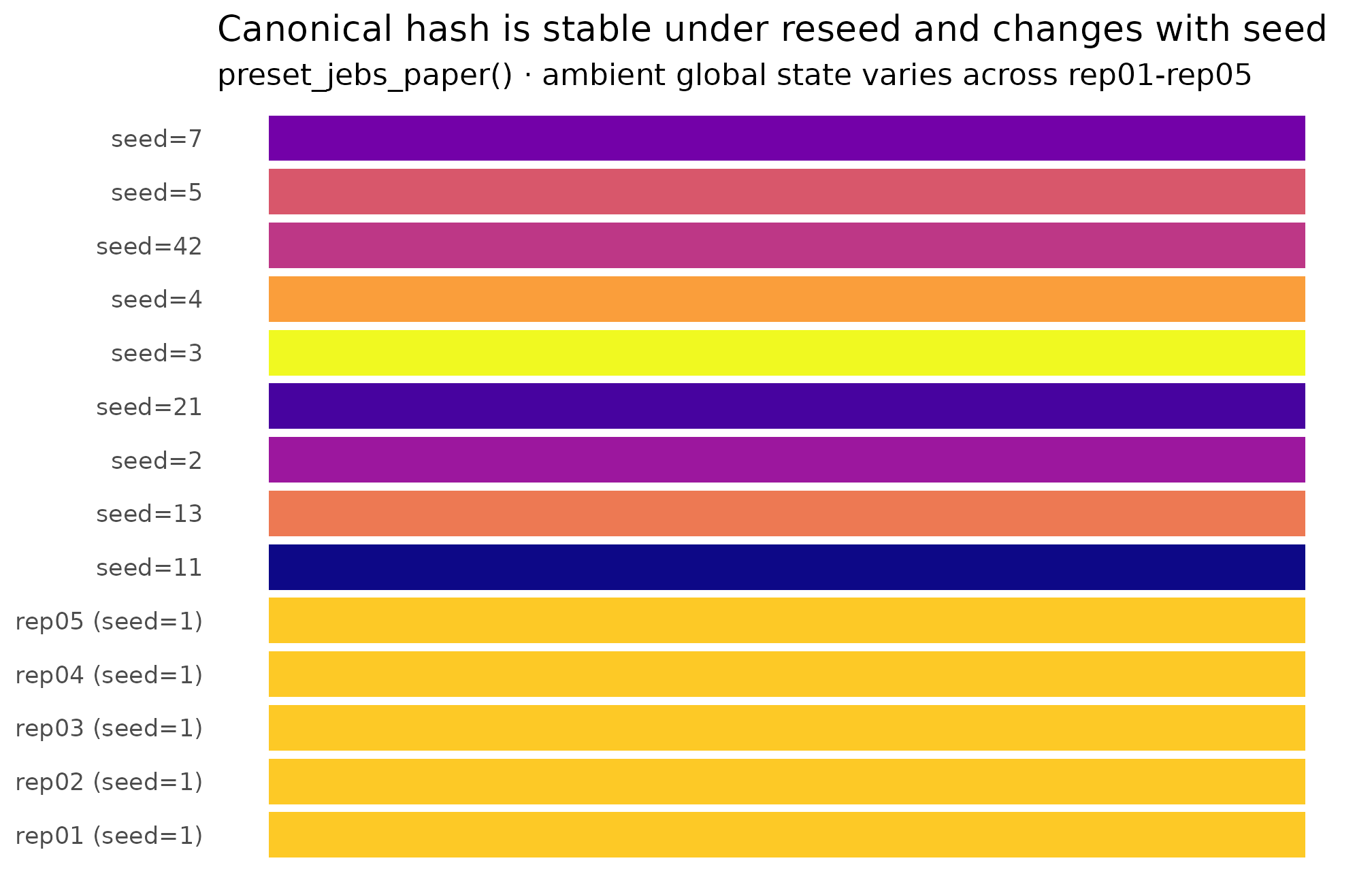
Each bar is one canonical hash. Five repeats of seed = 1L (scrambled global state between calls) collapse to a single hash, confirming the local-seed-stream policy. Nine different seeds give nine different hashes, confirming the seed argument is the lever.
Two things to read off the plot. First, the five
rep01-rep05 bars (top of the panel) all have
the same fill colour: same hash, even though the ambient global RNG was
scrambled before each call. This is the local-seed-stream policy at work
— the only thing that matters for canonical_hash(dat) is
the value passed to the seed argument and the design
ingredients. Second, the nine seed-varied bars (bottom of the panel)
each have their own fill colour: a different seed gives a different
hash, as expected.
5. The reproducibility contract
The package guarantees a precise statement, which is worth writing out as a contract. Given:
- the same package version of
multisiteDGP(the0.1.0line in the provenance string), - the same seed passed as the
seedargument to a primary call (sim_multisite(),sim_meta(),gen_effects(),gen_observations()), - the same design (the same preset call, or the same
multisitedgp_design()arguments, or the sameupdate_multisitedgp_design()patch),
the package guarantees:
- the same
canonical_hash(dat)byte-for-byte, - and therefore the same realized point estimates, the same realized
standard errors, the same diagnostics in the canonical allowlist, and
the same
provenance_string(dat)modulo the R version slot.
That is the contract. The hash is the witness. If the contract holds,
two researchers running the same line of code on different machines see
the same simulation, full stop. The smoke check used throughout the
package documentation —
sim_multisite(preset_jebs_paper(), seed = 1L) produces hash
c52e75f276d82836 — is a single instance of the contract. If
your local rerun matches that hash, the package install you have is in
sync with the published baseline.
The contract is intentionally narrow. It is not a guarantee that:
- your post-simulation analysis pipeline (a Bayesian model fit, a bootstrap, a robustness sweep) is reproducible — that is your pipeline’s responsibility, and a separate hash on the downstream artifact is the right tool there;
- a different platform or a different R minor version produces the same hash — see Section 6;
- a custom
g_fncallback gives the same hash if you change its body — the package records callback presence, not body identity, by design (changing the body is a meaningful change to the simulation that the user should re-pin manually).
The narrowness is deliberate. A wider contract would be either unenforceable (downstream pipelines vary too much) or false (cross-platform byte-equality is not a property the package can deliver — see below).
6. What can break the contract
There are three classes of contract break, in roughly decreasing order of frequency.
6.1 Changing the package version
This is by far the most common.
multisiteDGP 0.1.x → 0.2.x is a minor bump that may add
fields to the canonical-hash payload, change the order in which
diagnostics are computed, or alter a generator’s internal sampling
scheme. Any of these legitimately changes the hash. The mitigation is
the manifest: when you save pkg_version = "0.1.0" alongside
the hash, a future you whose packageVersion("multisiteDGP")
returns 0.2.0 knows immediately why the hashes differ, and
can decide whether to install the older version (via
remotes::install_version() or renv) or to
re-pin the artifact at the new version. Either choice is principled;
what is not principled is a silent mismatch.
6.2 Changing the R version
R version drift is rarer in practice but does occur. R 4.4 → R 4.5
changed the default RNG kind for sample.int() in some edge
cases (RNGkind("Rounding") legacy behavior), and a major-
version bump (R 4.x → R 5.x) is a near-certain hash break. The package
emits a warning when a saved provenance string was generated under a
different R version than the current session.
The provenance string carries the R version as the R=4.5
slot specifically so this is grep-able. If you see two provenance lines
that differ only in the R=... slot, you have located the
cause.
6.3 Changing the OS or the platform
Cross-platform hash equality is held to a weaker standard. Linux
x86_64 / amd64 is the strict baseline used for the package’s golden
fixtures in tests/testthat/. macOS and Windows are held to
same-machine reproducibility plus distributional
parity against the Linux baseline — the realized distribution of
point estimates and SEs matches Linux to numerical tolerance, but the
exact canonical_hash is allowed to drift because of
platform-level floating-point differences in BLAS / LAPACK and compiler
math libraries. The full installed policy is in
system.file("REPRODUCIBILITY.md", package = "multisiteDGP").
If you and a coauthor on different operating systems produce different
hashes for the same seed and design, the next check is
whether the distributions of tau_j_hat and
se_j agree to numerical tolerance, not the 16 hex
characters.
6.4 What does not break the contract
Some things look like they should change the hash but do not. The ambient global RNG state at the moment of the call does not (see Section 4). Reordering tibble columns does not (canonicalization sorts columns). Adding a non-numeric diagnostic does not (the allowlist is numeric-only). The current working directory and the system locale do not. Knowing what is not in the payload is part of trusting the hash.
7. The IES Form 1 acknowledgments paragraph
The package is distributed with an acknowledgments paragraph (reproduced verbatim in the footer of every vignette) that names the funder, grant number, and standard disclaimer. M7 is the dedicated home in vignette space for explaining why the paragraph appears where it does.
The paragraph identifies the source of support: the Institute of Education Sciences, U.S. Department of Education, through Grant R305D240078 to the University of Alabama, with the standard disclaimer that the views expressed are the authors’ and do not represent the Institute’s. Every vignette reproduces the paragraph in its footer (uniform appearance, low cognitive load for the reader). M7 is the place where the role of the paragraph is discussed — funder acknowledgment is a condition of the grant and a research-integrity norm for federally funded methodological work, and the precise wording is fixed (Form 1) so it can be machine- checked across the package’s documentation surface in the release audit that greps for the grant number.
When you cite this package in a paper appendix, the courtesy is
either to reproduce the acknowledgment paragraph verbatim or to cite the
package’s CITATION entry and the underlying methods paper
(Lee et al., 2025). The IES grant terms
apply only to outputs the IES project itself produces.
8. Where to next
You now have, for any simulation you run with this package: a one-line provenance string, a 16-character canonical hash, a verification recipe, and a manifest pattern. The remaining vignettes build on this base.
- Getting started — A1 §9 is the user-track entry point to provenance, with a lighter treatment of the same workflow.
-
Cookbook — recipe G walks an
end-to-end manifest workflow inside a
design_grid()power study. - Migration from siteBayes2 — re-pinning legacy siteBayes2 artifacts under the same audit trail.
-
canonical_hash()— argument reference, including thealgoandcolumns_to_includearguments not used here. -
provenance_string()— the S3 generic and the three methods (data, design, default).
For the methodological foundations the hash is fingerprinting, start with The two-stage DGP and proceed through M2 / M3 / M4 in order. For the empirical-Bayes context the package’s hash-pinned simulations are typically deployed in, see Walters (2024).
References
The multisiteDGP data-generating process and the JEBS
preset implement the design in Lee et al.
(2025). Empirical-Bayes context for the simulation studies the
package is typically deployed in is collected in Walters (2024).
Acknowledgments
This research was supported by the Institute of Education Sciences, U.S. Department of Education, through Grant R305D240078 to the University of Alabama. The opinions expressed are those of the authors and do not represent views of the Institute or the U.S. Department of Education.
Session info
#> R version 4.6.0 (2026-04-24)
#> Platform: x86_64-pc-linux-gnu
#> Running under: Ubuntu 24.04.4 LTS
#>
#> Matrix products: default
#> BLAS:   /usr/lib/x86_64-linux-gnu/openblas-pthread/libblas.so.3
#> LAPACK: /usr/lib/x86_64-linux-gnu/openblas-pthread/libopenblasp-r0.3.26.so;  LAPACK version 3.12.0
#>
#> locale:
#>  [1] LC_CTYPE=C.UTF-8       LC_NUMERIC=C           LC_TIME=C.UTF-8
#>  [4] LC_COLLATE=C.UTF-8     LC_MONETARY=C.UTF-8    LC_MESSAGES=C.UTF-8
#>  [7] LC_PAPER=C.UTF-8       LC_NAME=C              LC_ADDRESS=C
#> [10] LC_TELEPHONE=C         LC_MEASUREMENT=C.UTF-8 LC_IDENTIFICATION=C
#>
#> time zone: UTC
#> tzcode source: system (glibc)
#>
#> attached base packages:
#> [1] stats     graphics  grDevices utils     datasets  methods   base
#>
#> other attached packages:
#> [1] ggplot2_4.0.3      multisiteDGP_0.1.1
#>
#> loaded via a namespace (and not attached):
#>  [1] gtable_0.3.6       jsonlite_2.0.0     dplyr_1.2.1        compiler_4.6.0
#>  [5] tidyselect_1.2.1   jquerylib_0.1.4    systemfonts_1.3.2  scales_1.4.0
#>  [9] textshaping_1.0.5  yaml_2.3.12        fastmap_1.2.0      R6_2.6.1
#> [13] labeling_0.4.3     generics_0.1.4     knitr_1.51         tibble_3.3.1
#> [17] desc_1.4.3         bslib_0.10.0       pillar_1.11.1      RColorBrewer_1.1-3
#> [21] rlang_1.2.0        utf8_1.2.6         cachem_1.1.0       xfun_0.57
#> [25] fs_2.1.0           sass_0.4.10        S7_0.2.2           viridisLite_0.4.3
#> [29] cli_3.6.6          pkgdown_2.2.0      withr_3.0.2        magrittr_2.0.5
#> [33] digest_0.6.39      grid_4.6.0         lifecycle_1.0.5    vctrs_0.7.3
#> [37] evaluate_1.0.5     glue_1.8.1         farver_2.1.2       ragg_1.5.2
#> [41] rmarkdown_2.31     tools_4.6.0        pkgconfig_2.0.3    htmltools_0.5.9