
M5 · Custom G distributions
JoonHo Lee
2026-05-10
Source:vignettes/m5-custom-g-distributions.Rmd
m5-custom-g-distributions.RmdAbstract
For methodologists who need a latent site-effect distribution
outside the eight-shape catalog — a horseshoe residual, a
deconvolution draw from a sister study, an externally fitted
Dirichlet process mixture. The user-callback path threads a custom
shape through multisiteDGP under one of two
conventions: A returns standardized residuals (the package owns
the location-scale wrapper), B returns response-scale effects (the
callback owns the marginal). You leave with a worked example per
convention, the audit recipe that catches contract violations, and
the bridge pattern for routing a DPM draw into the package.
1. The problem — when the catalog runs out
The eight built-in distributions documented in M2: G-distribution catalog and standardization cover most applied shapes: Gaussian, Student-, skew-normal, asymmetric Laplace, two-component mixture, point-mass-plus-slab, the user-callback escape hatch, and the deferred DPM stub. The case for this vignette is the residual one: you want a shape the catalog does not have. Common triggers are a horseshoe-style residual with both a sharp peak and heavy tails, a finite mixture with three or more components, an empirical residual distribution deconvolved from a sister trial, or a nonparametric draw from a Dirichlet process mixture fit elsewhere.
The package routes all of these through the same entry point —
true_dist = "User" plus a g_fn callback —
under two conventions for what the callback returns. Convention A is the
recommended path: the callback returns standardized residuals
with mean 0 and variance 1, and the package applies
to produce
.
Convention B is the escape hatch: the callback returns
directly, and the package skips the wrapper. The split exists because
some shapes — point-mass slabs in particular — are awkward to
standardize, and a callback that builds the slab on the response scale
is cleaner than forcing a unit-variance reframe. The factorization
follows Lee et al. (2025).
2. Convention A — the standardized residual callback
Convention A is the default. The callback signature is
function(J, ...) and the return contract is two-line: a
finite numeric vector of length J, with empirical mean near
0 and variance near 1. The package applies the location-scale
wrapper
so the user’s
scales the shape directly — without the double-scaling pitfall the
JEBS-paper-era package siteBayes2 had. Layer 1
returns a tibble with site_index, z_j, and
tau_j columns; downstream code reads
off the result the same way as for any built-in shape.
The example callback below mixes two beta densities to produce an asymmetric residual the catalog’s skew-normal cannot reproduce: half the sites draw from a on (right-skewed, mode near 0.2), the other half draw the negative of a . The centering and SD-scaling step at the end is the user’s responsibility under Convention A.
beta_diff_g <- function(J, ...) {
  flip <- stats::rbinom(J, 1, 0.5)
  raw  <- ifelse(
    flip == 1,
    stats::rbeta(J, 2, 5),
    -stats::rbeta(J, 5, 2)
  )
  (raw - mean(raw)) / stats::sd(raw)
}
The Layer-1 generator gen_effects_user()
accepts the callback and returns the standard tibble. With
tau = 0.30 and sigma_tau = 0.20, the wrapper
math is the same as for the catalog shapes; the realized marginal
moments match the design inputs exactly within Layer 1.
set.seed(1L)
eff_a <- gen_effects_user(
  J         = 200L,
  tau       = 0.30,
  sigma_tau = 0.20,
  g_fn      = beta_diff_g,
  g_returns = "standardized",
  audit_g   = TRUE
)
print(eff_a, n = 4)
#> # A tibble: 200 × 3
#>   site_index    z_j  tau_j
#>        <int>  <dbl>  <dbl>
#> 1          1 -1.07  0.0867
#> 2          2 -0.878 0.124
#> 3          3  0.632 0.426
#> 4          4  0.971 0.494
#> # ℹ 196 more rows
data.frame(
  mean_z_j   = mean(eff_a$z_j),
  var_z_j    = stats::var(eff_a$z_j),
  mean_tau_j = mean(eff_a$tau_j),
  sd_tau_j   = stats::sd(eff_a$tau_j)
)
#>        mean_z_j var_z_j mean_tau_j sd_tau_j
#> 1 -4.824158e-17       1        0.3      0.2
Three things to read off. First, the z_j column has mean
0 and variance 1 exactly — the callback’s empirical standardization
((x - mean(x)) / sd(x)) forces equality on the realized
sample. Second, tau_j = tau + sigma_tau * z_j holds
row-by-row, so the response-scale mean is exactly
and the SD is exactly
.
Third, the audit pass (Section 4) is silent — what you want on a
callback that meets the contract.
The same callback drops into a full design. multisitedgp_design()
accepts true_dist = "User" plus g_fn, and sim_multisite()
produces the multisite tibble with site sizes, sampling variances, and
diagnostics.
design_a <- multisitedgp_design(
  J         = 60L,
  true_dist = "User",
  g_fn      = beta_diff_g,
  sigma_tau = 0.20
)
dat_a <- sim_multisite(design_a, seed = 1L)
print(dat_a, n = 4)
#> # A multisitedgp_data: 60 sites, paradigm = "site_size"
#> # Realized vs intended:
#> #   I: realized=0.295 (no target)
#> #   R: realized=9.200 (no target)
#> #   sigma_tau: target=0.200, realized=0.200, PASS
#> #   rho_S: target=0.000, realized=0.128, PASS
#> #   rho_S_marg: realized=0.128 (no target)
#> #   Feasibility: WARN (n_eff=18.470)
#> # A tibble: 60 × 7
#>   site_index    z_j  tau_j tau_j_hat  se_j  se2_j   n_j
#>        <int>  <dbl>  <dbl>     <dbl> <dbl>  <dbl> <int>
#> 1          1 -1.22  -0.245     0.796 0.577 0.333     12
#> 2          2 -1.04  -0.208    -0.294 0.258 0.0667    60
#> 3          3  1.08   0.217    -0.229 0.277 0.0769    52
#> 4          4  0.910  0.182     0.257 0.378 0.143     28
#> # ℹ 56 more rows
#> # Use summary(df) for the full diagnostic report.
data.frame(
  realized_sigma_tau = stats::sd(dat_a$tau_j),
  informativeness    = informativeness(dat_a),
  feasibility        = feasibility_index(dat_a, warn = FALSE)
)
#>   realized_sigma_tau informativeness feasibility
#> 1                0.2        0.295294    18.46984
The diagnostic block prints
sigma_tau: target=0.200, realized=0.200 — the user-callback
path preserves the same target-vs-realized discipline as every catalog
shape, because Convention A’s contract is what makes that comparison
meaningful. The custom shape is fully threaded through the downstream
diagnostic surface.
3. Convention B — the raw final effects callback
Convention B is the escape hatch. The callback returns response-scale directly, and the package skips the location-scale wrapper. Reach for it when standardization is awkward — the canonical case is a point-mass-plus-slab where the user wants to keep the slab on the response scale, rather than algebraically re-deriving the slab parameters under the unit-variance reframe.
Under Convention B the package back-derives z_j for
provenance using the inverse wrapper
so downstream Layer 2 / 3 / 4 code still has a z_j
column. The back-derived
is no longer guaranteed unit-variance — the empirical variance reflects
whatever the callback produced — and the audit pass is a no-op under
g_returns = "raw".
The example callback below builds a sparse-effects shape: 40% of
sites are exactly null
(),
the rest draw from a Gaussian slab with response-scale SD 0.30. This is
a point-mass-plus-slab in spirit, but slab_sd is the
response-scale SD the user thinks in.
sparse_g <- function(J, pi0 = 0.4, slab_sd = 0.30, ...) {
  null_mask <- stats::rbinom(J, 1, pi0)
  ifelse(
    null_mask == 1,
    0,
    stats::rnorm(J, mean = 0, sd = slab_sd)
  )
}
The Layer-1 call passes g_returns = "raw" and
audit_g = FALSE. Slab parameters travel through
g_args. tau and sigma_tau are
still required — Convention B uses them only for back-derived
z_j, but the back-derivation still needs them.
set.seed(1L)
eff_b <- gen_effects_user(
  J         = 200L,
  tau       = 0.30,
  sigma_tau = 0.20,
  g_fn      = sparse_g,
  g_returns = "raw",
  g_args    = list(pi0 = 0.4, slab_sd = 0.30),
  audit_g   = FALSE
)
print(eff_b, n = 4)
#> # A tibble: 200 × 3
#>   site_index   z_j   tau_j
#>        <int> <dbl>   <dbl>
#> 1          1 -2.43 -0.186
#> 2          2 -1.44  0.0126
#> 3          3 -2.87 -0.273
#> 4          4 -1.5   0
#> # ℹ 196 more rows
data.frame(
  fraction_exact_zero = mean(eff_b$tau_j == 0),
  mean_tau_j          = mean(eff_b$tau_j),
  sd_tau_j            = stats::sd(eff_b$tau_j),
  var_z_j_back        = stats::var(eff_b$z_j)
)
#>   fraction_exact_zero  mean_tau_j  sd_tau_j var_z_j_back
#> 1               0.415 0.003787866 0.2341826     1.371037
Three differences from Convention A. First, about 40% of the
tau_j entries are exactly 0 (realized 0.415 — the spike
portion of the spike-and-slab). Second, the response-scale SD is
whatever the callback produced (around 0.234), not the design’s
sigma_tau = 0.20; Convention B does not enforce a
target-vs-realized match on the SD. Third, back-derived z_j
does not have unit variance — the value above 1 reflects the
un-standardized slab plus spike, divided by sigma_tau. The
trade-off: the callback owns the marginal, and the package’s
standardization guarantee no longer applies.
Reach for Convention B when the response-scale interpretation matters
more than the unit-variance one — sparse slabs, finite mixtures with
response-scale component means, calibrated empirical distributions where
the moments are the deliverable. The catalog-side analog is gen_effects_pmslab(),
which applies an internal
rescaling to keep the residual unit-variance — clean for the diagnostic
block, less natural when the user wants the slab on the response
scale.
4. audit_g — what it actually checks
With audit_g = TRUE (default), the package draws an
extra
-site
sample from the callback in a side RNG stream that does not disturb the
caller’s seed, computes the empirical mean and variance, and warns if
either deviates from the contract by more than 0.1 in absolute terms.
The threshold is loose by design — at
samples sampling fluctuation around the mean is
,
so a 0.1 deviation is several hundred SEs and only real violations fire.
The audit does not abort, does not modify the draw, and is a no-op under
Convention B.
A violating callback triggers a structured warning with three lines: a summary, the realized audit moments, and a fix hint. The example below uses a callback that returns draws — wrong on both moments.
bad_g <- function(J, ...) stats::rnorm(J, mean = 0.5, sd = 1.5)

set.seed(1L)
out_bad <- gen_effects_user(
  J       = 100L,
  g_fn    = bad_g,
  audit_g = TRUE
)
#> Warning: ! `g_fn` audit suggests the standardized residual contract may be violated.
#> ℹ Audit mean = 0.496; audit variance = 2.266.
#> → Return mean-zero, unit-variance draws or use `g_returns = "raw"`.
The warning reports the violation summary, the realized audit moments
(here roughly 0.50 and 2.27), and the fix hint
Return mean-zero, unit-variance draws or use g_returns = "raw".
The function still returns the tibble — the audit reports, the run
proceeds.
To inspect the audit moments programmatically without relying on the
warning channel, the manual version is straightforward: run the callback
at
,
compute the moments, confirm finiteness and the length contract. The
example below is equivalent to what audit_g = TRUE does
internally.
manual_audit_g <- function(g_fn, J = 1e5L, ...) {
  z <- g_fn(J, ...)
  data.frame(
    n_returned   = length(z),
    length_match = length(z) == J,
    all_finite   = all(is.finite(z)),
    audit_mean   = mean(z),
    audit_var    = stats::var(z),
    contract_ok  = abs(mean(z)) < 0.1 && abs(stats::var(z) - 1) < 0.1
  )
}
set.seed(1L)
manual_audit_g(beta_diff_g)
#>   n_returned length_match all_finite    audit_mean audit_var contract_ok
#> 1     100000         TRUE       TRUE -4.719479e-17         1        TRUE
manual_audit_g(bad_g)
#>   n_returned length_match all_finite audit_mean audit_var contract_ok
#> 1     100000         TRUE       TRUE  0.4961045  2.247011       FALSE
The first row reports contract_ok = TRUE for
beta_diff_g: mean and variance both inside the 0.1
tolerance. The second row reports contract_ok = FALSE for
bad_g: variance over 2, mean near 0.5, both far outside
tolerance. The internal audit call uses
withr::with_preserve_seed(), so audit_g = TRUE
and audit_g = FALSE produce the same z_j draw
— the package determinism smoke check (hash
c52e75f276d82836 for
sim_multisite(preset_jebs_paper(), seed = 1L)) is
independent of whether the audit runs.
5. The DPM bridge
The catalog’s eighth shape, true_dist = "DPM", is a
deferred placeholder. Calling it without a g_fn raises an
actionable error.
gen_effects(J = 50L, true_dist = "DPM")
#> Error in `.abort_multisitedgp()`:
#> ✖ `true_dist = "DPM"` is not implemented in multisiteDGP v1.
#> ℹ Built-in Dirichlet Process Mixture sampling is deferred to v2 or a sibling
#>   package.
#> → Use `true_dist = "User"` with a custom `g_fn`, or pass `g_fn` as an explicit
#>   DPM bridge.
The error message names the canonical fix on the third line: use
true_dist = "User" with a custom g_fn, or pass
an explicit DPM bridge through gen_effects_dpm(). The
package never silently falls back to Gaussian.
When you actually need DPM-distributed latent effects, the bridge
pattern is short. Fit a DPM offline (with dirichletprocess,
or a JAGS / Stan posterior), draw a sample of standardized residuals,
wrap them in a Convention A callback. The fit is the expense — minutes
to hours depending on
,
base measure, and concentration — and is not amortized inside
multisiteDGP. The illustration below uses a deterministic
three-atom mixture in place of a real DPM fit. For a real fit, replace
the closure body with a sample() over the DPM’s posterior
atoms weighted by cluster weights, then standardize.
fake_dpm_atoms   <- c(-1.5, 0, 1.2)
fake_dpm_weights <- c(0.3, 0.4, 0.3)
fake_dpm_atom_sd <- 0.30

fake_dpm_g <- function(J, atoms = fake_dpm_atoms,
                       weights = fake_dpm_weights,
                       atom_sd = fake_dpm_atom_sd, ...) {
  idx <- sample(seq_along(atoms), J, replace = TRUE, prob = weights)
  raw <- stats::rnorm(J, mean = atoms[idx], sd = atom_sd)
  (raw - mean(raw)) / stats::sd(raw)
}
gen_effects_dpm()
accepts the bridge through g_fn and routes internally to
gen_effects_user(). Convention A / B selection, the audit,
and back-derivation are identical — the function exists to give the
bridge a named entry point that matches the true_dist
string.
set.seed(1L)
bridged <- gen_effects_dpm(
  J         = 200L,
  tau       = 0.30,
  sigma_tau = 0.20,
  g_fn      = fake_dpm_g,
  audit_g   = TRUE
)
print(bridged, n = 4)
#> # A tibble: 200 × 3
#>   site_index     z_j  tau_j
#>        <int>   <dbl>  <dbl>
#> 1          1 -0.0951 0.281
#> 2          2  0.0868 0.317
#> 3          3  0.923  0.485
#> 4          4 -1.25   0.0492
#> # ℹ 196 more rows
data.frame(
  mean_z_j   = mean(bridged$z_j),
  var_z_j    = stats::var(bridged$z_j),
  mean_tau_j = mean(bridged$tau_j),
  sd_tau_j   = stats::sd(bridged$tau_j)
)
#>       mean_z_j var_z_j mean_tau_j sd_tau_j
#> 1 1.044304e-17       1        0.3      0.2
The bridged residual hits the unit-variance contract exactly, the response-scale moments match the design inputs, and the audit is silent. From the pipeline’s perspective this reads as a catalog shape — diagnostic block, precision marginal, and adapters all consume the bridged tibble the same way as a Gaussian draw.
The bridge has two costs beyond compute. First, it does not
introspect the DPM’s structure: the diagnostic block reads moments and
order statistics off the residual draw, not posterior cluster weights.
If your inference target is the DPM’s cluster structure rather than the
realized
it implies, fit the DPM in its native package and use
multisiteDGP only for the simulation-design wrapper.
Second, the empirical standardization in the closure forces the realized
draw to unit-variance exactly but does not guarantee the population
variance of the underlying DPM is 1; for the simulation-design surface
this distinction is mostly cosmetic.
6. Two contrasting plots
The convention contrast is easiest to read off the residual densities. Convention A’s standardized residual has a clean unit-variance interpretation that compares directly with the catalog shapes; Convention B’s response-scale draw lives on the user’s parameterization, with a spike-and-slab signature the catalog’s standardized parameterization would have to algebraically reframe.
df_a <- tibble::tibble(z = eff_a$z_j)
df_ref <- tibble::tibble(
  z = seq(-4, 4, length.out = 400),
  d = stats::dnorm(seq(-4, 4, length.out = 400))
)
ggplot(df_a, aes(x = z)) +
  geom_density(fill = "#1B4965", colour = "#1B4965", alpha = 0.40) +
  geom_line(data = df_ref, aes(x = z, y = d),
            linetype = "dashed", colour = "grey40", linewidth = 0.6) +
  geom_vline(xintercept = 0, linetype = "dotted", colour = "grey50") +
  labs(
    x        = expression(z[j]~"  (standardized residual)"),
    y        = "density",
    title    = "Convention A — standardized residual from beta_diff_g",
    subtitle = "User callback returns z_j with mean 0 and variance 1; package owns the wrapper."
  ) +
  theme_minimal(base_size = 11) +
  theme(panel.grid.minor = element_blank())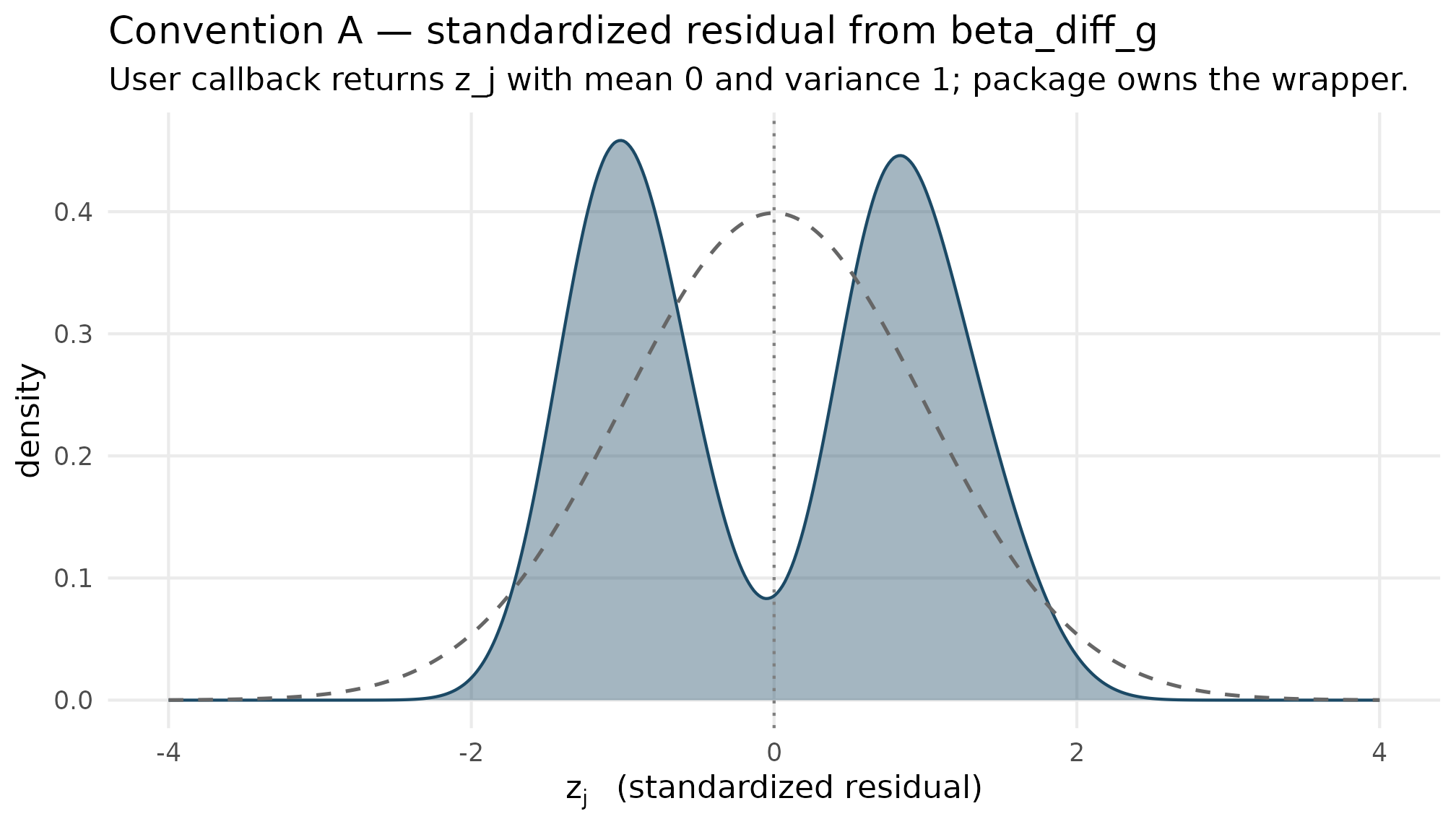
Convention A residual density (blue) over a Gaussian reference (grey dashed). The custom shape is bimodal — the two beta components produce peaks near z = -1 and z = +1 — with thinner tails than Gaussian. Key read: the residual is unit-variance by construction, so the package’s wrapper applied tau + sigma_tau * z_j to produce tau_j the same way it does for any catalog shape.
df_b <- tibble::tibble(tau_j = eff_b$tau_j)
ggplot(df_b, aes(x = tau_j)) +
  geom_histogram(bins = 35, fill = "#62929E",
                 colour = "white", alpha = 0.85) +
  geom_vline(xintercept = 0,    linetype = "dashed", colour = "grey20") +
  geom_vline(xintercept = 0.30, linetype = "dashed", colour = "#1B4965") +
  labs(
    x        = expression(tau[j]~"  (response-scale effect)"),
    y        = "count",
    title    = "Convention B — raw response-scale draw from sparse_g",
    subtitle = "User callback returns tau_j directly; spike at zero, slab around tau = 0.30."
  ) +
  theme_minimal(base_size = 11) +
  theme(panel.grid.minor = element_blank())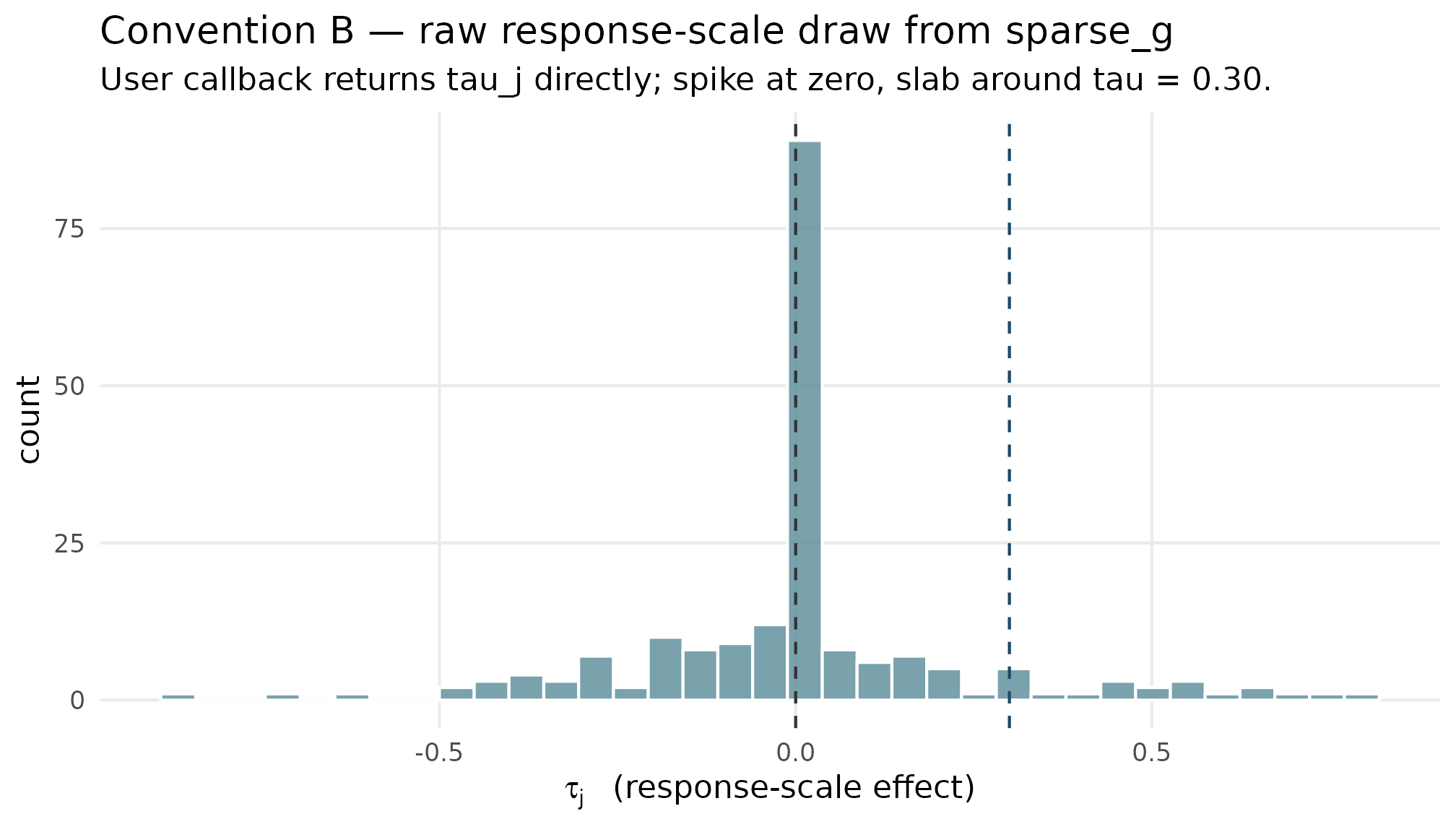
Convention B response-scale tau_j histogram from sparse_g. The exact-zero spike captures about 40 percent of sites (the pi0 weight); the slab portion is Gaussian with SD 0.30 around zero. Dashed lines mark tau and zero. Key read: the callback owns the marginal — the wrapper is bypassed, the spike sits exactly at zero rather than at tau, and the cross-site SD is whatever the slab plus spike produce, not the design’s sigma_tau.
The two plots carry the convention contrast. Convention A lives on the standardized-residual axis, where every shape — catalog or callback — is comparable by construction. Convention B lives on the response scale, where the spike at zero is the substantive feature and the marginal is owned by the callback.
7. Where to next
If, while writing your callback, the shape starts looking like a catalog entry, prefer the catalog. The eight built-in shapes have closed-form unit-variance derivations (where possible) and are exercised at in the test suite — realized variance lands within of 1. A custom callback only matches that guarantee if the standardization step does, and the catalog’s closed-form path is one less moving part to audit. Substantive triggers for the catalog side:
- Symmetric heavy tails —
Student-
(
gen_effects_studentt()); the closed-form rescaler is exact. - One-sided skew — skew-normal (
gen_effects_skewn()) with the Azzalini slant (Azzalini, 1985). - Skew with a sharper peak — asymmetric Laplace (
gen_effects_ald()) with the Yu-Zhang quantile (Yu & Zhang, 2005). - Two latent classes — two-component mixture (
gen_effects_mixture()). - A fraction of sites exactly null — point-mass-plus-slab (
gen_effects_pmslab()), whose rescaling keeps the residual unit-variance and the diagnostic block clean.
The user-callback path is the right tool when none of these match. Three motifs commonly trigger it: horseshoe-style residuals (sharp peak with very heavy tails — neither Student- nor ALD captures both), finite mixtures with three or more components, and empirical distributions extracted from a sister study by deconvolution or DPM posterior draws (Lee et al., 2025; Walters, 2024). For the first two, Convention A is the path; for the third, the DPM bridge from Section 5. Sibling vignettes for deeper context: M1: The two-stage DGP (formal specification of the four generative layers — the callback operates inside Layer 1), M2: G-distribution catalog and standardization (the eight built-in shapes and the unit-variance discipline the callback inherits), A8: Cookbook (short walkthroughs that mix custom callbacks with the rest of the design surface), and A5: Calibrating to real data (when calibration against an observed precision distribution suggests a shape outside the catalog).
References
The factorization with a unit-variance standardized residual and the empirical-Bayes context for site-effect estimation are from Lee et al. (2025) and Walters (2024). The catalog parameterizations cross-referenced in the closing pointer are Azzalini (1985) for the skew-normal slant and Yu & Zhang (2005) for the asymmetric Laplace quantile.
Acknowledgments
This research was supported by the Institute of Education Sciences, U.S. Department of Education, through Grant R305D240078 to the University of Alabama. The opinions expressed are those of the authors and do not represent views of the Institute or the U.S. Department of Education.
Session info
#> R version 4.6.0 (2026-04-24)
#> Platform: x86_64-pc-linux-gnu
#> Running under: Ubuntu 24.04.4 LTS
#>
#> Matrix products: default
#> BLAS:   /usr/lib/x86_64-linux-gnu/openblas-pthread/libblas.so.3
#> LAPACK: /usr/lib/x86_64-linux-gnu/openblas-pthread/libopenblasp-r0.3.26.so;  LAPACK version 3.12.0
#>
#> locale:
#>  [1] LC_CTYPE=C.UTF-8       LC_NUMERIC=C           LC_TIME=C.UTF-8
#>  [4] LC_COLLATE=C.UTF-8     LC_MONETARY=C.UTF-8    LC_MESSAGES=C.UTF-8
#>  [7] LC_PAPER=C.UTF-8       LC_NAME=C              LC_ADDRESS=C
#> [10] LC_TELEPHONE=C         LC_MEASUREMENT=C.UTF-8 LC_IDENTIFICATION=C
#>
#> time zone: UTC
#> tzcode source: system (glibc)
#>
#> attached base packages:
#> [1] stats     graphics  grDevices utils     datasets  methods   base
#>
#> other attached packages:
#> [1] ggplot2_4.0.3      multisiteDGP_0.1.1
#>
#> loaded via a namespace (and not attached):
#>  [1] gtable_0.3.6       jsonlite_2.0.0     dplyr_1.2.1        compiler_4.6.0
#>  [5] tidyselect_1.2.1   nleqslv_3.3.7      jquerylib_0.1.4    systemfonts_1.3.2
#>  [9] scales_1.4.0       textshaping_1.0.5  yaml_2.3.12        fastmap_1.2.0
#> [13] R6_2.6.1           labeling_0.4.3     generics_0.1.4     knitr_1.51
#> [17] tibble_3.3.1       desc_1.4.3         bslib_0.10.0       pillar_1.11.1
#> [21] RColorBrewer_1.1-3 rlang_1.2.0        cachem_1.1.0       xfun_0.57
#> [25] fs_2.1.0           sass_0.4.10        S7_0.2.2           cli_3.6.6
#> [29] pkgdown_2.2.0      withr_3.0.2        magrittr_2.0.5     digest_0.6.39
#> [33] grid_4.6.0         lifecycle_1.0.5    vctrs_0.7.3        evaluate_1.0.5
#> [37] glue_1.8.1         farver_2.1.2       ragg_1.5.2         rmarkdown_2.31
#> [41] tools_4.6.0        pkgconfig_2.0.3    htmltools_0.5.9