M6 · Adapters and downstream packages
JoonHo Lee
2026-05-10
Source:vignettes/m6-adapters-downstream.Rmd
m6-adapters-downstream.RmdAbstract
For analysts who simulate with multisiteDGP and then fit, plot,
or power-analyze with a downstream package — metafor,
baggr, or multisitepower. Adapters strip
the package’s S3 class and rename the canonical effect, SE, and
site columns to the target ecosystem’s convention; numerical
values are not transformed. You leave with the formal contract,
the three built-in rename maps, the round-trip invariant, the
reserved-name guard, and acceptance criteria for adding a fourth
adapter.
1. The adapter contract
A multisitedgp_data object carries seven canonical
columns (site_index, z_j, tau_j,
tau_j_hat, se_j, se2_j,
n_j), an S3 class, and design / provenance attributes. None
of the names match the conventions analysis packages fit with:
metafor::rma() reads yi, vi;
baggr::baggr() reads tau, se;
multisitepower reads site,
estimate, se, n.
The adapter contract is two clauses, both load-bearing. First, an
adapter strips the multisitedgp_data class so the result is
a plain tbl_df and the downstream package’s S3 dispatch is
not surprised. Second, an adapter renames the canonical columns to the
target ecosystem’s convention but does not alter
numerical values: every renamed column is bit-for-bit identical to its
source. The factorization
,
(Lee et al., 2025) is preserved on disk.
Two corollaries follow: the round-trip invariant (Section 3) holds by
construction; reserved-name collisions are unrecoverable — the adapter
errors rather than overwrite a user covariate named yi.
2. The three built-in adapters
The package ships three adapters, each named for its target. All
three follow the same pattern: a generic; a
.multisitedgp_data method that runs the soft-dep guard, the
reserved-name check, and the rename; a .default method that
errors with the class of the offending input. Implementations live in
R/adapters.R lines 80-218.
A 50-site simulation from preset_education_modest() is
the shared input for all three sections below.
dat <- sim_multisite(preset_education_modest(), seed = 1L)
print(dat, n = 4)
#> # A multisitedgp_data: 50 sites, paradigm = "site_size"
#> # Realized vs intended:
#> #   I: realized=0.303 (no target)
#> #   R: realized=10.167 (no target)
#> #   sigma_tau: target=0.200, realized=0.166, FAIL
#> #   rho_S: target=0.000, realized=0.254, PASS
#> #   rho_S_marg: realized=0.254 (no target)
#> #   Feasibility: WARN (n_eff=15.693)
#> # A tibble: 50 × 7
#>   site_index    z_j   tau_j tau_j_hat  se_j  se2_j   n_j
#>        <int>  <dbl>   <dbl>     <dbl> <dbl>  <dbl> <int>
#> 1          1 -0.626 -0.125    -0.329  0.329 0.108     37
#> 2          2  0.184  0.0367    0.0481 0.270 0.0727    55
#> 3          3 -0.836 -0.167    -0.399  0.254 0.0645    62
#> 4          4  1.60   0.319     0.410  0.577 0.333     12
#> # ℹ 46 more rows
#> # Use summary(df) for the full diagnostic report.
2.1 as_metafor() — meta-analysis fitting
Use as_metafor() when the next step is
metafor::rma(), metafor::escalc(), or any of
the metafor plotting / influence helpers. The rename map
is
| canonical column | metafor column |
|---|---|
tau_j_hat |
yi |
se2_j |
vi |
se_j |
sei |
Three-column output: effect, sampling variance, standard error.
mf <- as_metafor(dat)
print(mf, n = 4)
#> # A tibble: 50 × 3
#>        yi     vi   sei
#>     <dbl>  <dbl> <dbl>
#> 1 -0.329  0.108  0.329
#> 2  0.0481 0.0727 0.270
#> 3 -0.399  0.0645 0.254
#> 4  0.410  0.333  0.577
#> # ℹ 46 more rows
class(mf)
#> [1] "tbl_df"     "tbl"        "data.frame"
The class line confirms the strip — mf is a plain
tbl_df. Pass to metafor::rma() directly:
metafor::rma(yi = yi, vi = vi, data = mf, method = "REML")
#>
#> Random-Effects Model (k = 50; tau^2 estimator: REML)
#>
#> tau^2 (estimated amount of total heterogeneity): 0.0201 (SE = 0.0200)
#> tau (square root of estimated tau^2 value):      0.1419
#> I^2 (total heterogeneity / total variability):   19.74%
#> H^2 (total variability / sampling variability):  1.25
#>
#> Test for Heterogeneity:
#> Q(df = 49) = 57.6981, p-val = 0.1846
#>
#> Model Results:
#>
#> estimate      se     zval    pval    ci.lb   ci.ub
#>  -0.0331  0.0459  -0.7219  0.4704  -0.1230  0.0568
#>
#> ---
#> Signif. codes:  0 '***' 0.001 '**' 0.01 '*' 0.05 '.' 0.1 ' ' 1
The empirical-Bayes shrinkage metafor::rma() produces
takes the adapted yi / vi as inputs — the
precision-driven posterior is the analysis target (Walters, 2024).
2.2 as_baggr() — Bayesian aggregation with optional
truth
Use as_baggr() when the next step is
baggr::baggr() or its diagnostic plots. The rename map is
two columns by default and three with
include_truth = TRUE:
| canonical column | baggr column | when included |
|---|---|---|
tau_j_hat |
tau |
always |
se_j |
se |
always |
tau_j |
tau_true |
include_truth |
include_truth = TRUE exposes the latent true effects
as a separate column. baggr itself does not consume
tau_true — the column is for diagnostic comparison of
baggr’s posterior against the simulation truth, e.g.,
posterior-mean coverage of true effects. It is never an input to
fitting.
bg <- as_baggr(dat)
print(bg, n = 4)
#> # A tibble: 50 × 2
#>       tau    se
#>     <dbl> <dbl>
#> 1 -0.329  0.329
#> 2  0.0481 0.270
#> 3 -0.399  0.254
#> 4  0.410  0.577
#> # ℹ 46 more rows

bg_truth <- as_baggr(dat, include_truth = TRUE)
print(bg_truth, n = 4)
#> # A tibble: 50 × 3
#>       tau    se tau_true
#>     <dbl> <dbl>    <dbl>
#> 1 -0.329  0.329  -0.125
#> 2  0.0481 0.270   0.0367
#> 3 -0.399  0.254  -0.167
#> 4  0.410  0.577   0.319
#> # ℹ 46 more rows
When the simulation is the inferential target — sampling-design
research, calibration of an applied trial — set
include_truth = TRUE. When the simulation stands in for an
opaque real dataset, the default include_truth = FALSE
matches what baggr would see in production.
2.3 as_multisitepower() — empirical-Bayes power
Use as_multisitepower() when the next step is the
empirical-Bayes power surface in the multisitepower
package. The rename map is
| canonical column | multisitepower column | when included |
|---|---|---|
site_index |
site |
always |
tau_j_hat |
estimate |
always |
se_j |
se |
always |
n_j |
n |
when any n_j non-NA
|
The n column is conditional. Direct-precision designs
leave n_j all-NA because per-site sample size
is not part of the precision specification; the adapter omits
n rather than emit all-NA. Site-size paradigm
designs (the default in preset_education_modest()) include
n.
multisitepower is a soft Suggests
dependency and may not be installed on a given machine. The chunk below
is guarded; when the package is absent, the adapter raises a classed
soft-dependency error that the chunk traps and prints, exercising the
guard from Section 5.
if (requireNamespace("multisitepower", quietly = TRUE)) {
  mp <- as_multisitepower(dat)
  print(mp, n = 4)
} else {
  err <- tryCatch(as_multisitepower(dat), error = conditionMessage)
  cat(err, sep = "\n")
}
#> ✖ Package `multisitepower` is required for `as_multisitepower()`.
#> ℹ `multisitepower` is a multisiteDGP Suggests dependency for this distribution.
#> → Use `install.packages("multisitepower")` and try again.
When multisitepower is installed, the four-column tibble
feeds straight into the package’s power surface.
3. Round-trip invariant
The adapter contract’s “no numerical change” clause is the round-trip
invariant. Every renamed column is bit-for-bit identical to the
canonical column it came from — identical() returns
TRUE, not just all.equal() within tolerance.
The check is what makes the adapter a relabeling rather than a
transformation.
data.frame(
  metafor_yi_eq_tau_j_hat   = identical(mf$yi,        dat$tau_j_hat),
  metafor_vi_eq_se2_j       = identical(mf$vi,        dat$se2_j),
  metafor_sei_eq_se_j       = identical(mf$sei,       dat$se_j),
  baggr_tau_eq_tau_j_hat    = identical(bg$tau,       dat$tau_j_hat),
  baggr_se_eq_se_j          = identical(bg$se,        dat$se_j),
  baggr_tau_true_eq_tau_j   = identical(bg_truth$tau_true, dat$tau_j)
)
#>   metafor_yi_eq_tau_j_hat metafor_vi_eq_se2_j metafor_sei_eq_se_j
#> 1                    TRUE                TRUE                TRUE
#>   baggr_tau_eq_tau_j_hat baggr_se_eq_se_j baggr_tau_true_eq_tau_j
#> 1                   TRUE             TRUE                    TRUE
All six entries return TRUE — stronger than
all.equal() tolerance, because the adapter is an
attribute-strip plus a rename, not a transform, so floating-point
representation is unchanged.
The figure below illustrates the invariant on the
metafor rename: each (yi, tau_j_hat) pair
lands exactly on the unit line, and the (vi, se2_j) and
(sei, se_j) pairs do the same.
rt <- tibble::tibble(
  rename     = rep(c("yi vs tau_j_hat", "vi vs se2_j", "sei vs se_j"), each = 50),
  canonical  = c(dat$tau_j_hat, dat$se2_j, dat$se_j),
  adapted    = c(mf$yi,         mf$vi,     mf$sei)
)
ggplot(rt, aes(x = canonical, y = adapted)) +
  geom_abline(slope = 1, intercept = 0, colour = "grey60", linewidth = 0.5) +
  geom_point(colour = "#1B4965", alpha = 0.85, size = 1.6) +
  facet_wrap(~ rename, scales = "free", nrow = 1) +
  labs(
    x        = "canonical multisitedgp column",
    y        = "as_metafor() column",
    title    = "Round-trip identity for as_metafor()",
    subtitle = "Every point on the y = x line; the rename preserves values exactly."
  ) +
  theme_minimal(base_size = 11) +
  theme(panel.grid.minor = element_blank())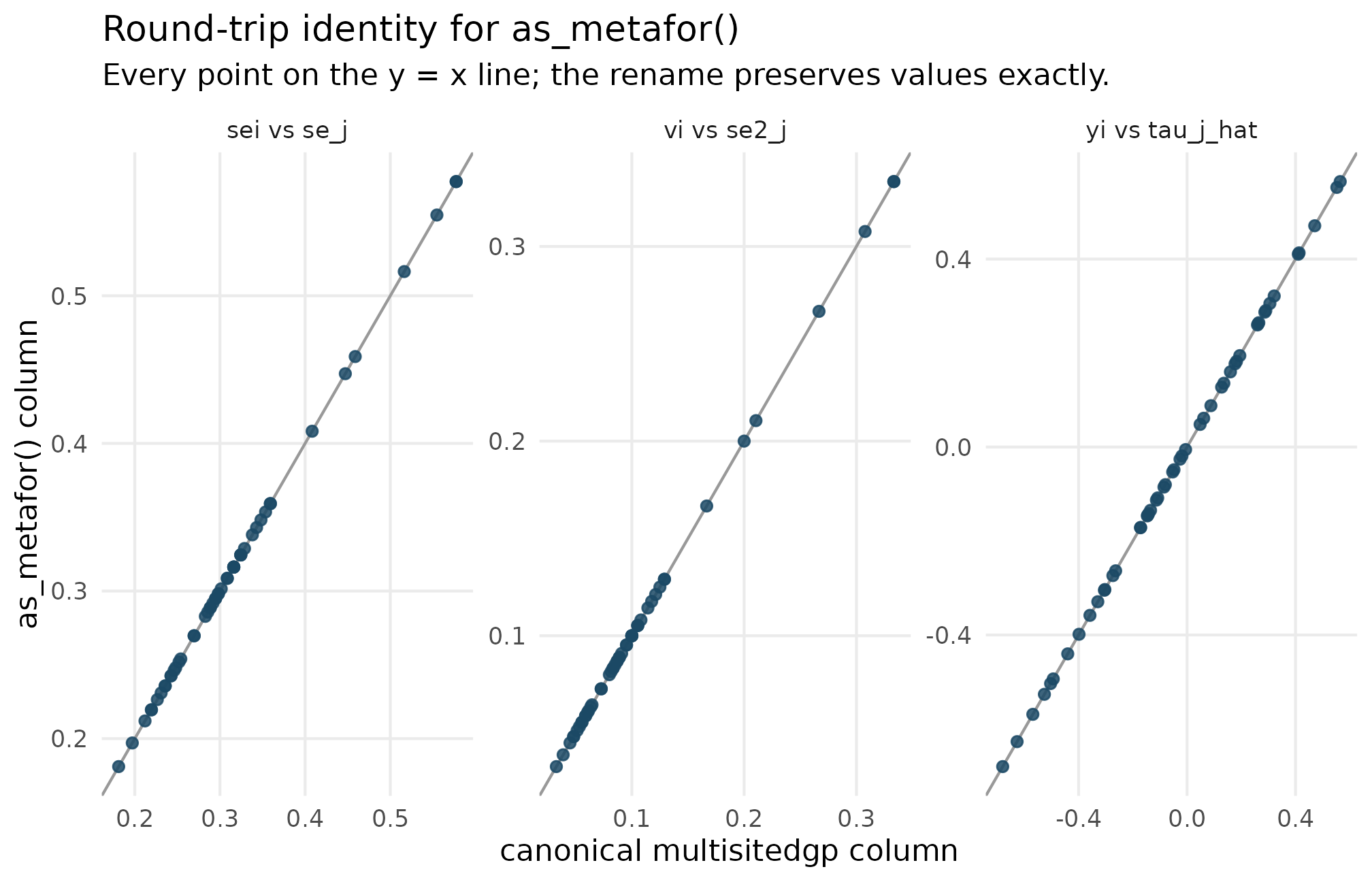
Round-trip identity for as_metafor on a 50-site simulation. Each panel plots a metafor column against its canonical multisitedgp source; all 50 points lie exactly on the unit line, confirming the adapter is a relabeling. Key read: read off any horizontal deviation from the diagonal as a contract violation — there should be none.
The same picture holds for as_baggr() and
as_multisitepower() — the rename map differs, but the
invariant does not.
4. Reserved-name protection
Each adapter reserves the column names it produces. If a user-supplied design carries a covariate whose name collides with a reserved name, the adapter aborts before the rename — silently overwriting the covariate would corrupt the analysis. The reserved sets are small enough to fit in a table:
| adapter | reserved input names |
|---|---|
as_metafor() |
yi, vi, sei
|
as_baggr() |
tau, se (plus tau_true if
include_truth) |
as_multisitepower() |
site, estimate, se,
n
|
The check fires only on user-supplied covariate columns, not on the
seven canonical columns the adapter is renaming from. The check
constants live as .RESERVED_METAFOR,
.RESERVED_BAGGR, and .RESERVED_MULTISITEPOWER
at the top of R/adapters.R.
A demonstration: build a 20-site design that carries a covariate
named yi, the metafor effect column. The adapter aborts
with a three-line message — the violation, the offending reserved set,
and the fix.
covariates <- data.frame(yi = as.numeric(scale(seq_len(20L))))
collision <- sim_multisite(
  multisitedgp_design(
    J        = 20L,
    formula  = ~ yi,
    beta     = 0.10,
    data     = covariates
  ),
  seed = 1L
)
err_mf <- tryCatch(as_metafor(collision), error = conditionMessage)
cat(err_mf, sep = "\n")
#> ✖ Covariate column "yi" collides with metafor reserved name.
#> ℹ metafor uses reserved adapter column name(s): yi, vi, sei.
#> → Use a renamed covariate column or `tibble::as_tibble()` for a plain tibble.
The same machinery fires for as_baggr() on a covariate
named tau:
covariates2 <- data.frame(tau = stats::rnorm(20L))
collision2 <- sim_multisite(
  multisitedgp_design(
    J        = 20L,
    formula  = ~ tau,
    beta     = 0.10,
    data     = covariates2
  ),
  seed = 1L
)
err_bg <- tryCatch(as_baggr(collision2), error = conditionMessage)
cat(err_bg, sep = "\n")
#> ✖ Covariate column "tau" collides with baggr reserved name.
#> ℹ baggr uses reserved adapter column name(s): tau, se.
#> → Use a renamed covariate column or `tibble::as_tibble()` for a plain tibble.
The fix the message points to: rename the covariate before adapting,
or use tibble::as_tibble() for a plain tibble without
renames.
A non-colliding covariate threads through cleanly. Below we add two —
school_type (factor) and urbanicity (numeric)
— and confirm both land in the adapted tibble alongside the renamed
canonical columns.
cv <- data.frame(
  school_type = factor(rep(c("A", "B"), 25L)),
  urbanicity  = stats::rnorm(50L)
)
dat_cv <- sim_multisite(
  multisitedgp_design(
    J        = 50L,
    formula  = ~ school_type + urbanicity,
    beta     = c(0.05, 0.02),
    data     = cv
  ),
  seed = 1L
)
mf_cv <- as_metafor(dat_cv)
print(mf_cv, n = 4)
#> # A tibble: 50 × 5
#>       yi     vi   sei school_type urbanicity
#>    <dbl>  <dbl> <dbl> <fct>            <dbl>
#> 1 -0.311 0.108  0.329 A               0.919
#> 2  0.114 0.0727 0.270 B               0.782
#> 3 -0.397 0.0645 0.254 A               0.0746
#> 4  0.429 0.4    0.632 B              -1.99
#> # ℹ 46 more rows
The output has five columns: the three-column metafor rename, then
the two pass-through covariates in original order. Internally,
setdiff(names(x), .canonical_data_columns()) selects the
carry-through set (R/adapters.R line 167) — any
non-canonical column qualifies.
5. Soft-dependency guard
metafor, baggr, and
multisitepower are listed in Suggests, not
Imports — none is required to use multisiteDGP
itself, only to use the matching adapter. Each adapter calls
requireNamespace("target", quietly = TRUE) through the
internal .require_soft_dependency() helper and aborts with
a three-line error when the target package is missing:
| line | content |
|---|---|
| 1 | Package "<pkg>" is required for "<adapter>()". |
| 2 | <pkg> is a multisiteDGP Suggests dependency … |
| 3 | Use install.packages("<pkg>") and try again. |
The exact message body for multisitepower (commonly
absent on a fresh CRAN check environment) is the chunk output of Section
2.3. The guard fires before the reserved-name check.
The .default method of each adapter handles the
wrong-class case — calling as_metafor() on a list, a data
frame, or any object that is not a multisitedgp_data aborts
with a parallel three-line message.
err_default <- tryCatch(
  as_metafor(list(yi = 1, vi = 1)),
  error = conditionMessage
)
cat(err_default, sep = "\n")
#> ✖ `x` must be a multisitedgp_data object for `as_metafor()`.
#> ℹ Got object with class: list.
#> → Use `sim_multisite()` or `sim_meta()` before calling the adapter.
The first line names the adapter and the violated input class, the
second prints the actual class of the offending object, and the third
gives the canonical fix — call sim_multisite() or
sim_meta() first.
6. Acceptance criteria for a new adapter
The package ships three adapters because three downstream ecosystems
are the common applied case. A fourth adapter — say
as_metaSEM() or as_robumeta() — is
straightforward to add, but only if it satisfies the six checks below.
The list is the maintainer’s checklist; it doubles as the test fixture
the new adapter’s PR should ship with.
(C1) Input contract. The adapter is an S3 generic
with a .multisitedgp_data method and a
.default method. The .multisitedgp_data method
takes a multisitedgp_data object; the .default
method errors with the offending object’s class. No adapter consumes a
raw data.frame or a list — the input is always the
simulator’s output.
(C2) Output rename map. The adapter’s docstring
includes the canonical-to-target rename map as a three-column or
four-column table, and the same map appears as a unit-test fixture
asserting
identical(out$<target_col>, x$<canonical_col>)
for each row of the map. Conditional columns (e.g., n only
when n_j non-NA) are documented as such; the
unit test exercises both the present and absent branches. The output is
a plain tbl_df — no multisitedgp_data class
survives.
(C3) Soft-dependency guard. The target package is
added to DESCRIPTION Suggests, never
Imports. The adapter’s first substantive line is a
.require_soft_dependency("<pkg>", "<adapter>")
call. The guard’s error path is exercised in the test suite by a
mockery::stub() that returns FALSE from
requireNamespace(), or by skipping the adapter test when
the package is unavailable
(testthat::skip_if_not_installed()).
(C4) Reserved-name protection. Every column the
adapter’s rename map produces appears in a top-level
.RESERVED_<adapter> constant. The
.multisitedgp_data method calls
.check_adapter_reserved_names(x, reserved = .RESERVED_<adapter>, adapter = "<name>")
after the soft-dep guard and before the rename. The
unit test confirms the abort fires with the reserved-set listed in the
message.
(C5) Round-trip invariant. A unit test confirms
identical() between every renamed column and its canonical
source on a fixture simulation. Floating-point tolerance
(all.equal()) is not adequate — the contract is bit-for-bit
identity, so the test must be the strict identical() form.
A testthat::expect_identical() call per column is the
conventional shape.
(C6) Covariate pass-through. A unit test threads a
covariate through sim_multisite() (or
sim_meta()) and confirms it appears in the adapted tibble
after the renamed canonical columns, in original order. The pass-through
is automatic via .bind_adapter_covariates() if (C1)-(C5)
are satisfied; the test just confirms the helper still binds them.
A fourth adapter shipping all six fixtures is what makes the addition
non-disruptive. The internal helper machinery
(.require_soft_dependency(),
.check_adapter_reserved_names(),
.bind_adapter_covariates()) is generic; the rename body is
rarely longer than the 7-line .as_metafor_rename()
function.
7. Where to next
Adapters are the boundary between simulation design and downstream
analysis — a contract that lets the analysis script read like an
analysis script (metafor::rma(yi = yi, vi = vi)) instead of
like a data-rewiring script. The contract is small enough to memorize:
strip the class, rename to the target convention, do not touch the
values. The round trip is bit-for-bit; the reserved-name check is the
cost of the no-overwrite guarantee; the soft-dep guard is the cost of
keeping metafor / baggr /
multisitepower out of Imports.
-
A1 · Getting started — first
encounter with the
as_metafor()adapter end-to-end. - A6 · Case study — multisite trial and A7 · Case study — meta-analysis — full analyses that consume the adapters.
- M1 · The two-stage DGP — the canonical-column factorization the rename relabels.
- M3 · Margin and SE models — paradigm context for the front doors that adapters consume.
- M7 · Reproducibility and provenance — hash invariance under adapter calls.
- Reference pages:
as_metafor(),as_baggr(),as_multisitepower().
References
The factorization
with
that the canonical columns encode is from Lee et
al. (2025). The empirical-Bayes shrinkage target that
metafor::rma() produces under the adapted
(yi, vi) inputs is the analysis goal in Walters (2024).
Acknowledgments
This research was supported by the Institute of Education Sciences, U.S. Department of Education, through Grant R305D240078 to the University of Alabama. The opinions expressed are those of the authors and do not represent views of the Institute or the U.S. Department of Education.
Session info
#> R version 4.6.0 (2026-04-24)
#> Platform: x86_64-pc-linux-gnu
#> Running under: Ubuntu 24.04.4 LTS
#>
#> Matrix products: default
#> BLAS:   /usr/lib/x86_64-linux-gnu/openblas-pthread/libblas.so.3
#> LAPACK: /usr/lib/x86_64-linux-gnu/openblas-pthread/libopenblasp-r0.3.26.so;  LAPACK version 3.12.0
#>
#> locale:
#>  [1] LC_CTYPE=C.UTF-8       LC_NUMERIC=C           LC_TIME=C.UTF-8
#>  [4] LC_COLLATE=C.UTF-8     LC_MONETARY=C.UTF-8    LC_MESSAGES=C.UTF-8
#>  [7] LC_PAPER=C.UTF-8       LC_NAME=C              LC_ADDRESS=C
#> [10] LC_TELEPHONE=C         LC_MEASUREMENT=C.UTF-8 LC_IDENTIFICATION=C
#>
#> time zone: UTC
#> tzcode source: system (glibc)
#>
#> attached base packages:
#> [1] stats     graphics  grDevices utils     datasets  methods   base
#>
#> other attached packages:
#> [1] ggplot2_4.0.3      multisiteDGP_0.1.1
#>
#> loaded via a namespace (and not attached):
#>  [1] gtable_0.3.6          xfun_0.57             bslib_0.10.0
#>  [4] QuickJSR_1.9.2        ggrepel_0.9.8         inline_0.3.21
#>  [7] lattice_0.22-9        mathjaxr_2.0-0        numDeriv_2016.8-1.1
#> [10] vctrs_0.7.3           tools_4.6.0           generics_0.1.4
#> [13] yulab.utils_0.2.4     parallel_4.6.0        stats4_4.6.0
#> [16] tibble_3.3.1          pkgconfig_2.0.3       Matrix_1.7-5
#> [19] checkmate_2.3.4       ggplotify_0.1.3       RColorBrewer_1.1-3
#> [22] S7_0.2.2              desc_1.4.3            RcppParallel_5.1.11-2
#> [25] lifecycle_1.0.5       compiler_4.6.0        farver_2.1.2
#> [28] textshaping_1.0.5     codetools_0.2-20      forestplot_3.2.0
#> [31] htmltools_0.5.9       sass_0.4.10           bayesplot_1.15.0
#> [34] yaml_2.3.12           pillar_1.11.1         pkgdown_2.2.0
#> [37] crayon_1.5.3          jquerylib_0.1.4       cachem_1.1.0
#> [40] StanHeaders_2.32.10   metadat_1.6-0         abind_1.4-8
#> [43] nlme_3.1-169          rstan_2.32.7          tidyselect_1.2.1
#> [46] digest_0.6.39         dplyr_1.2.1           labeling_0.4.3
#> [49] fastmap_1.2.0         grid_4.6.0            cli_3.6.6
#> [52] metafor_5.0-1         magrittr_2.0.5        loo_2.9.0
#> [55] utf8_1.2.6            pkgbuild_1.4.8        withr_3.0.2
#> [58] scales_1.4.0          backports_1.5.1       rappdirs_0.3.4
#> [61] rmarkdown_2.31        matrixStats_1.5.0     gridExtra_2.3
#> [64] ragg_1.5.2            evaluate_1.0.5        knitr_1.51
#> [67] baggr_0.8             nleqslv_3.3.7         gridGraphics_0.5-1
#> [70] rstantools_2.6.0      rlang_1.2.0           Rcpp_1.1.1-1.1
#> [73] glue_1.8.1            jsonlite_2.0.0        R6_2.6.1
#> [76] systemfonts_1.3.2     fs_2.1.0