Appendix A — Case dossiers
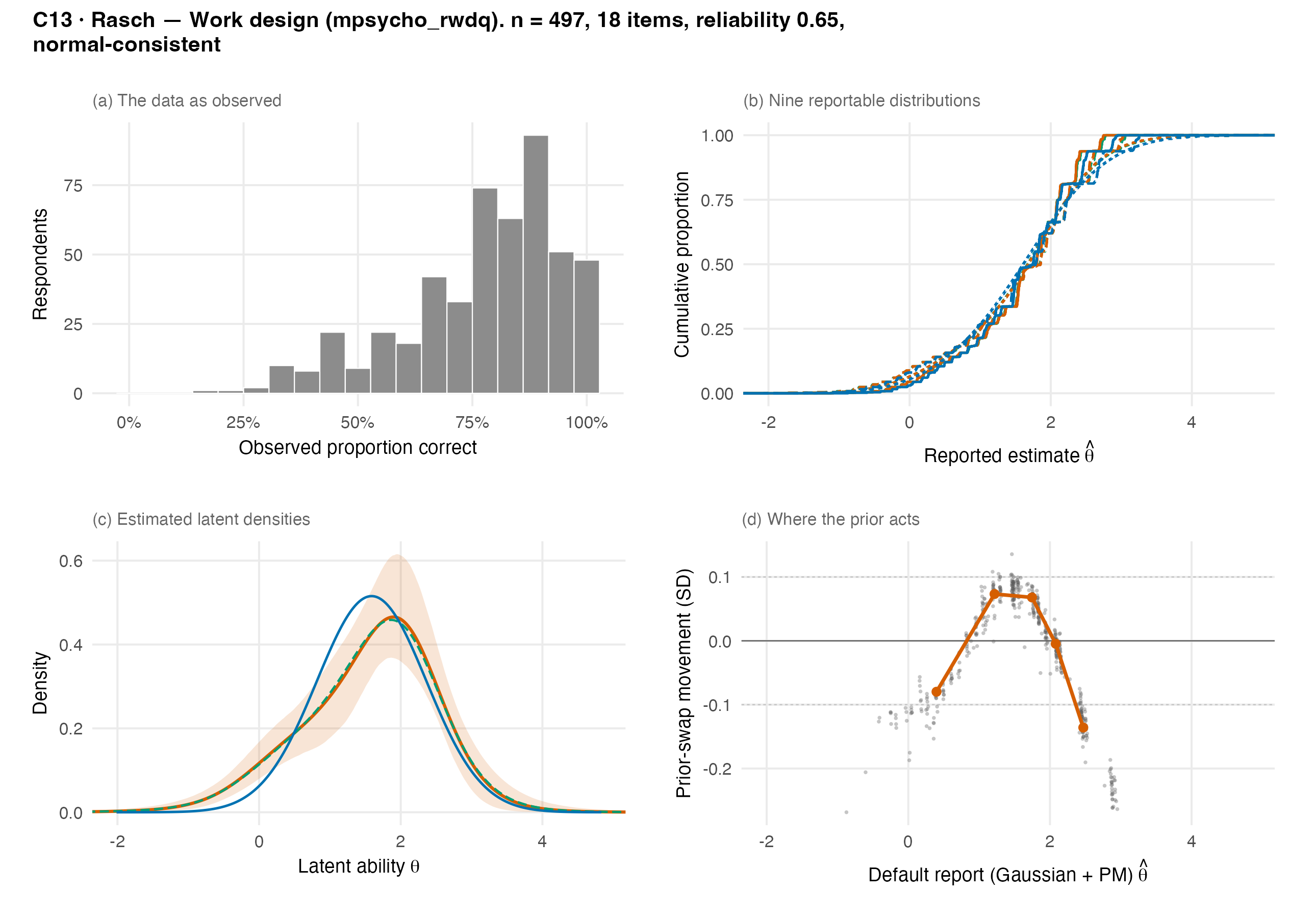
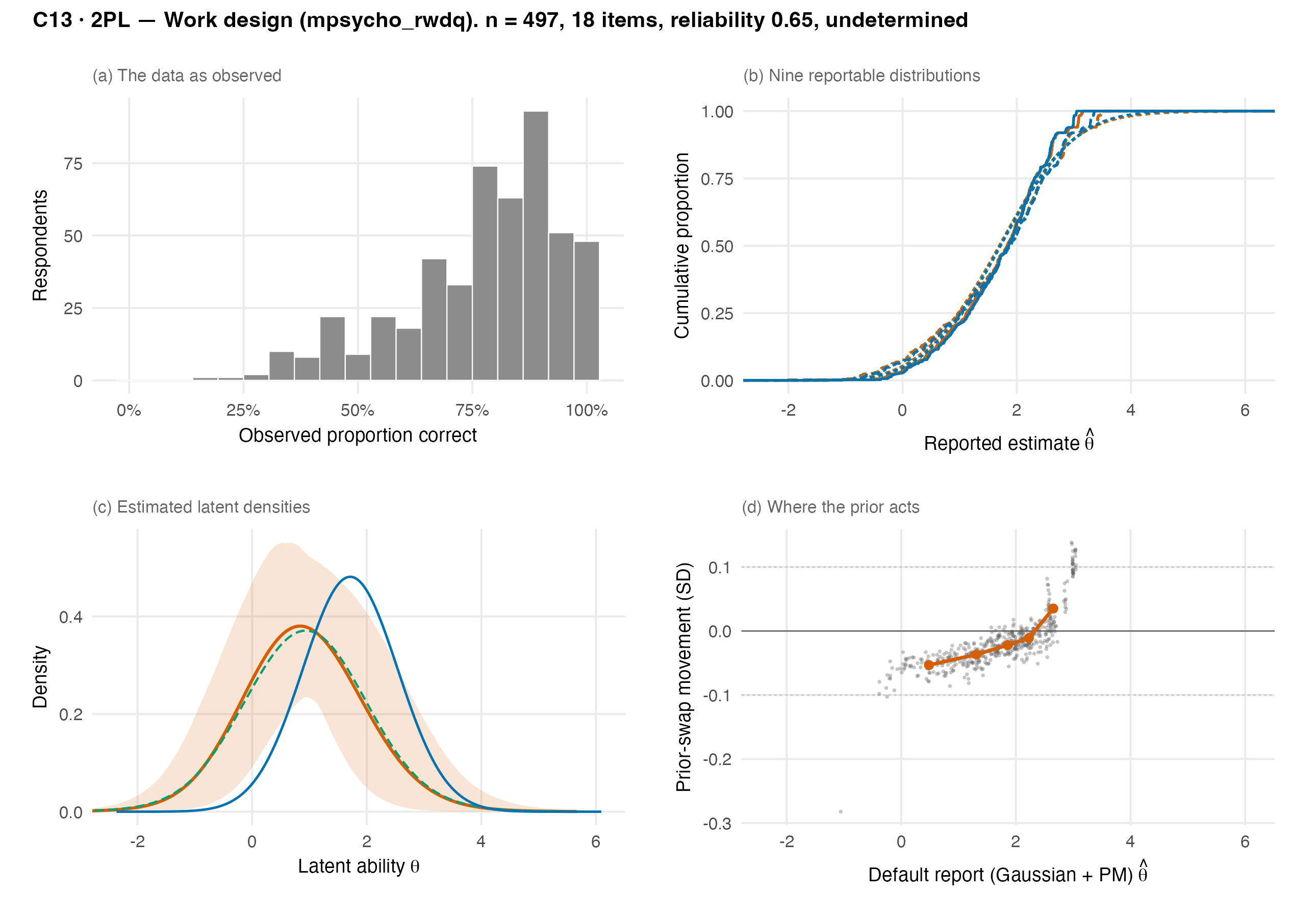
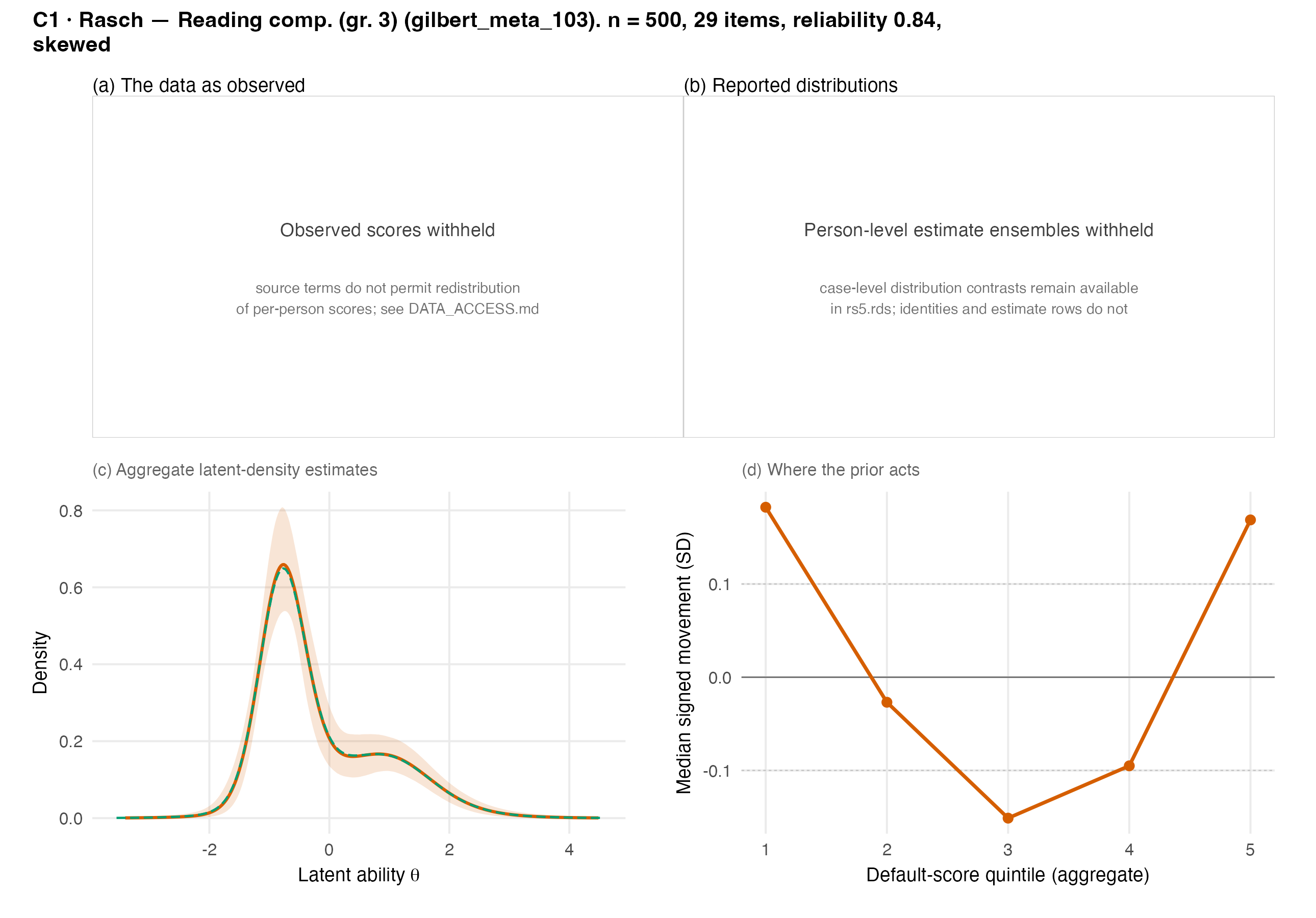
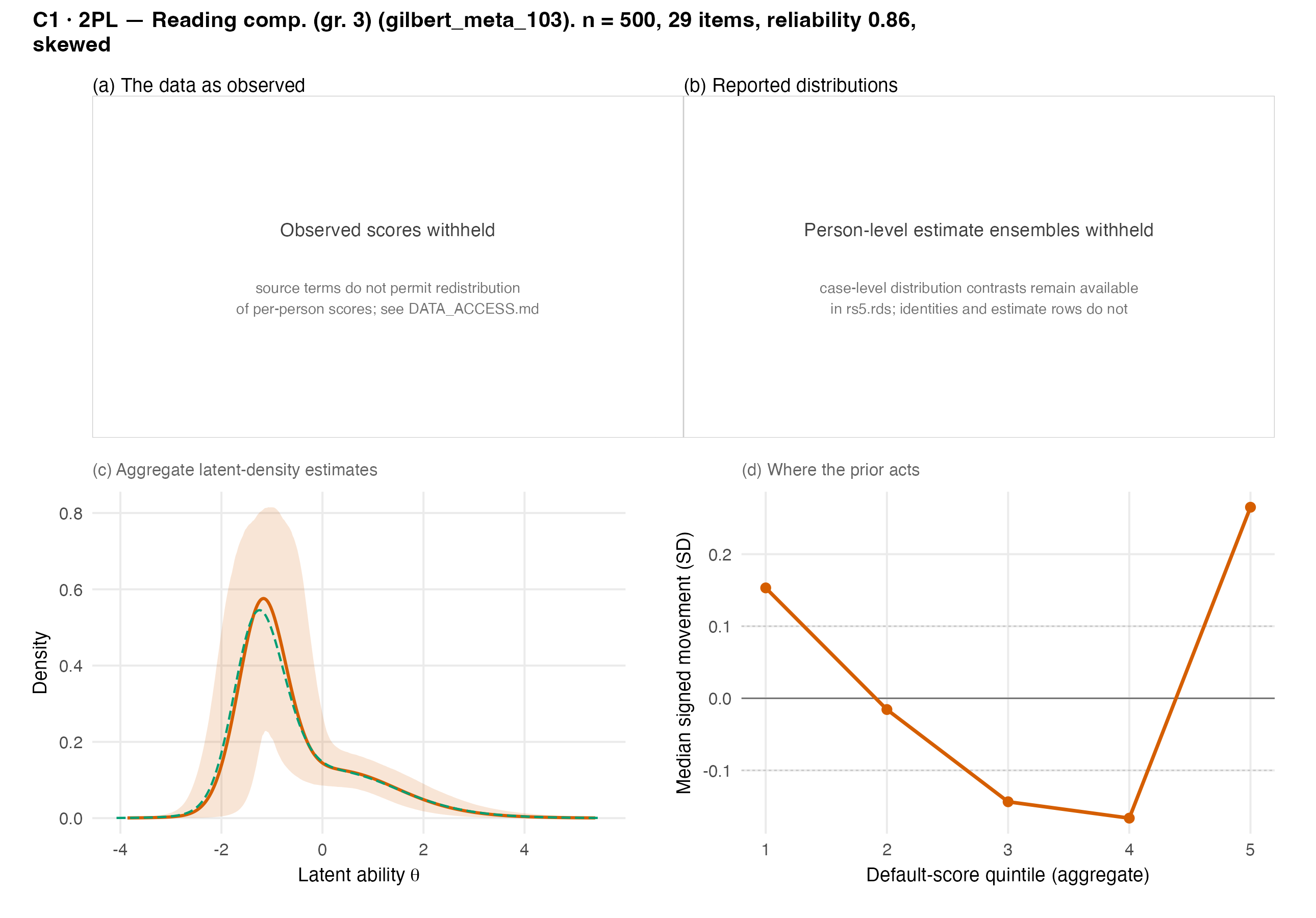
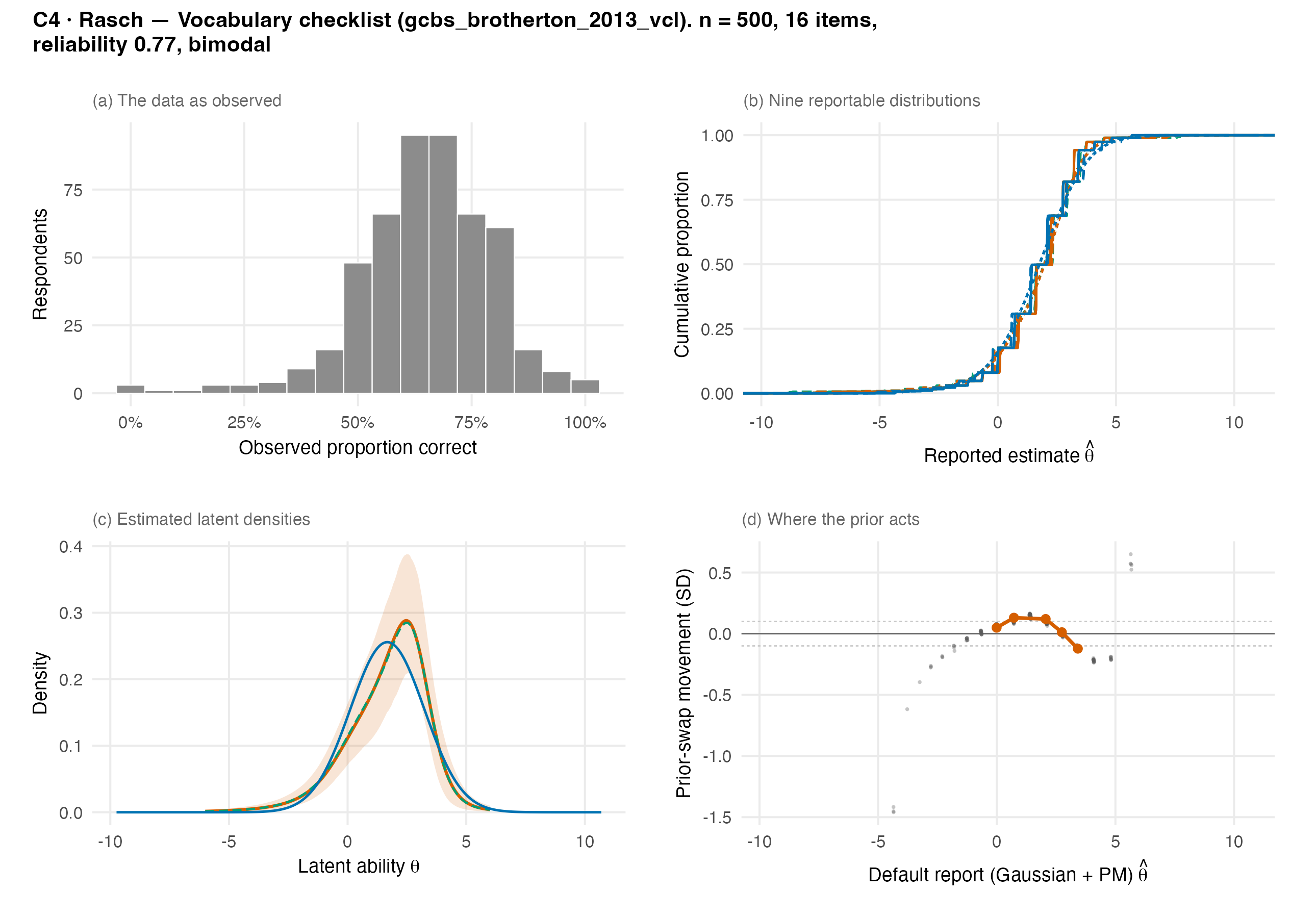
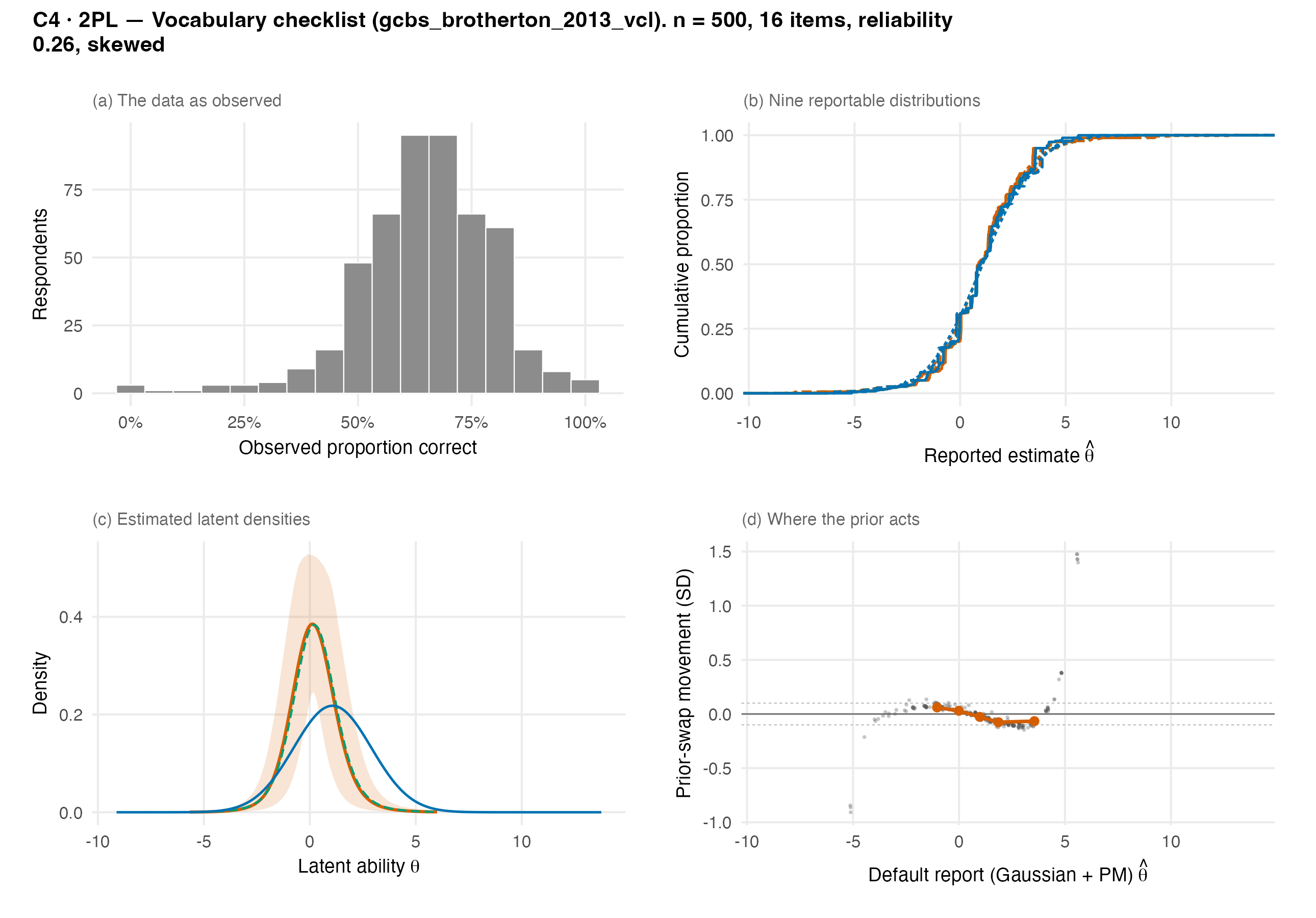
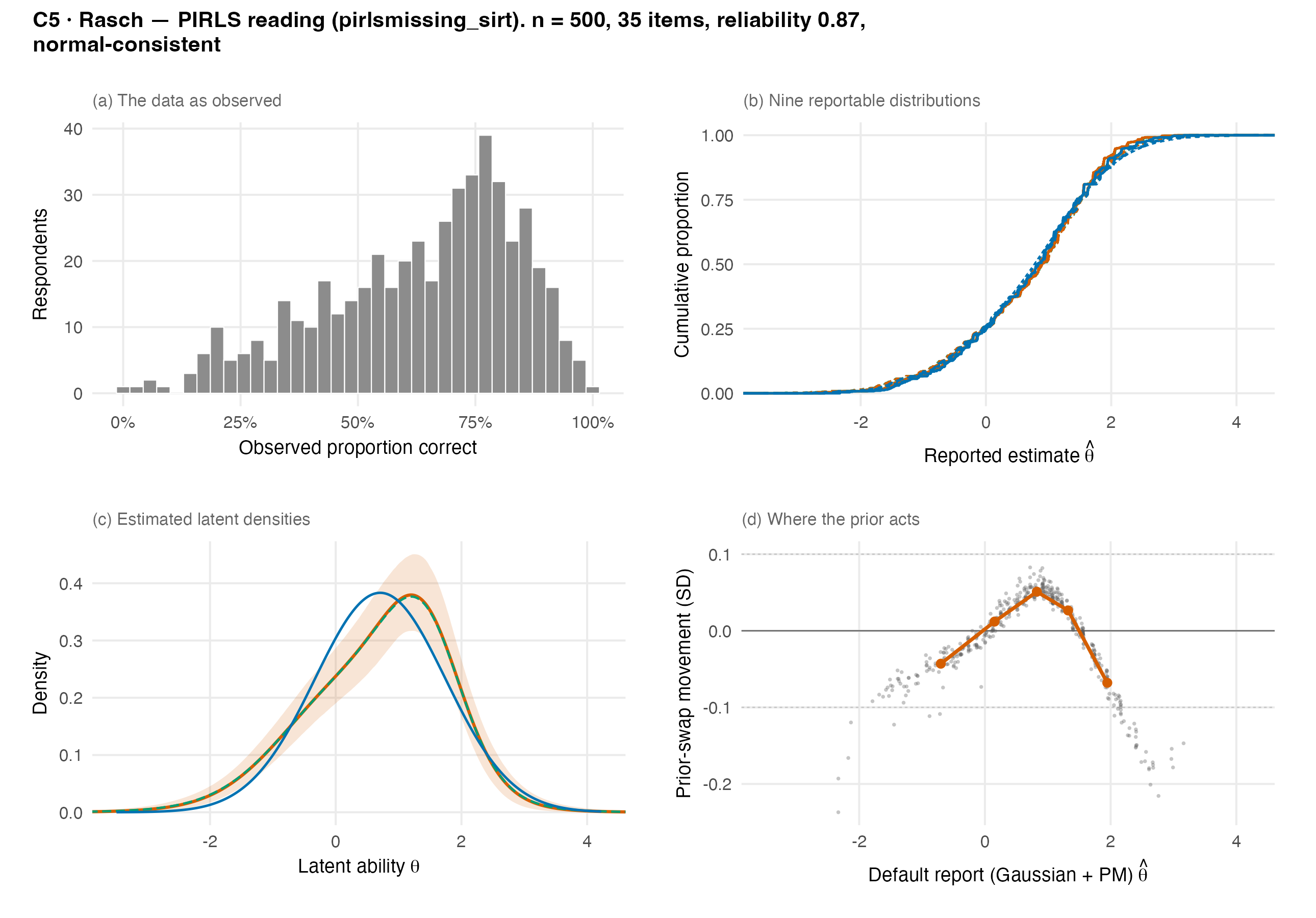
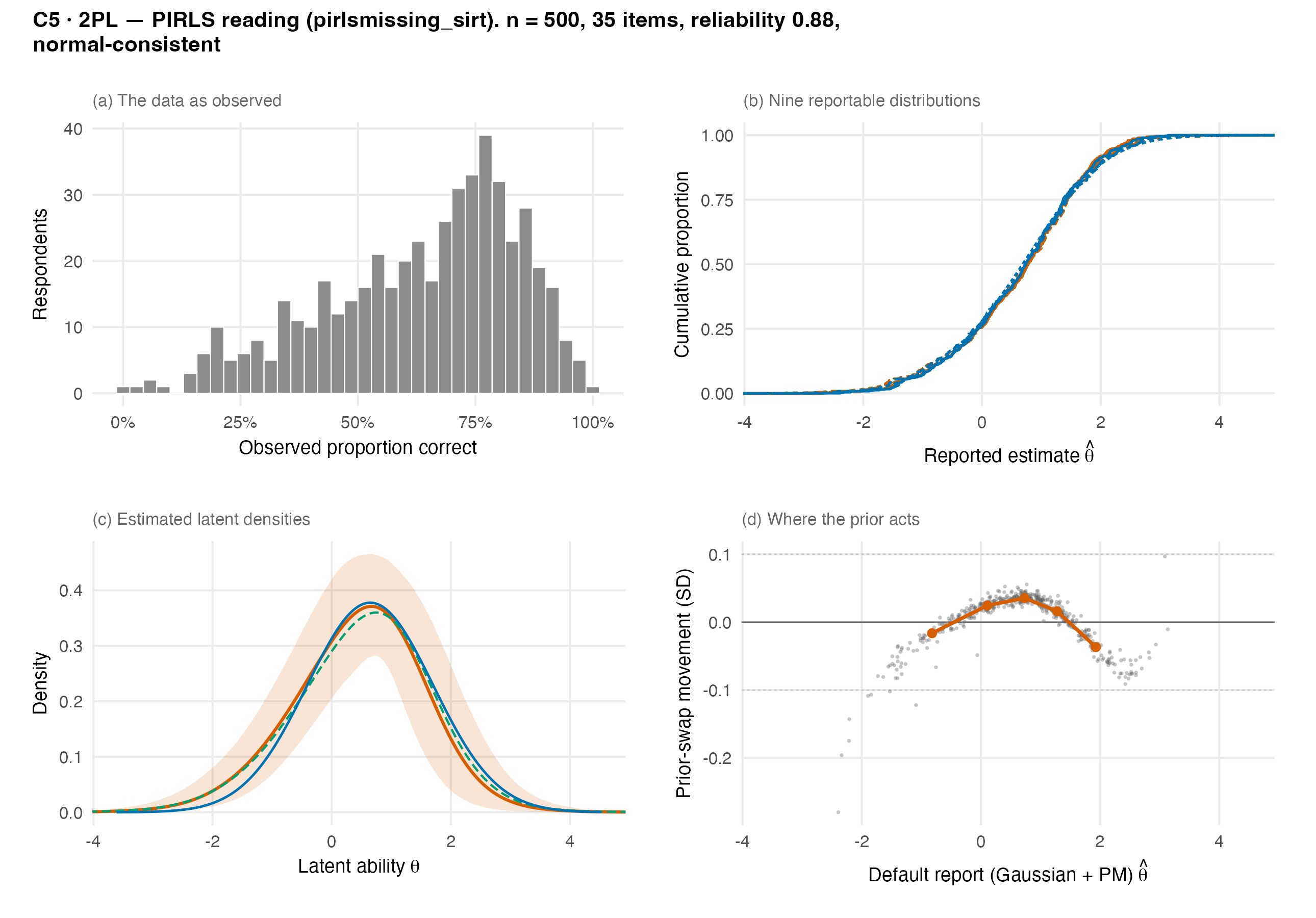
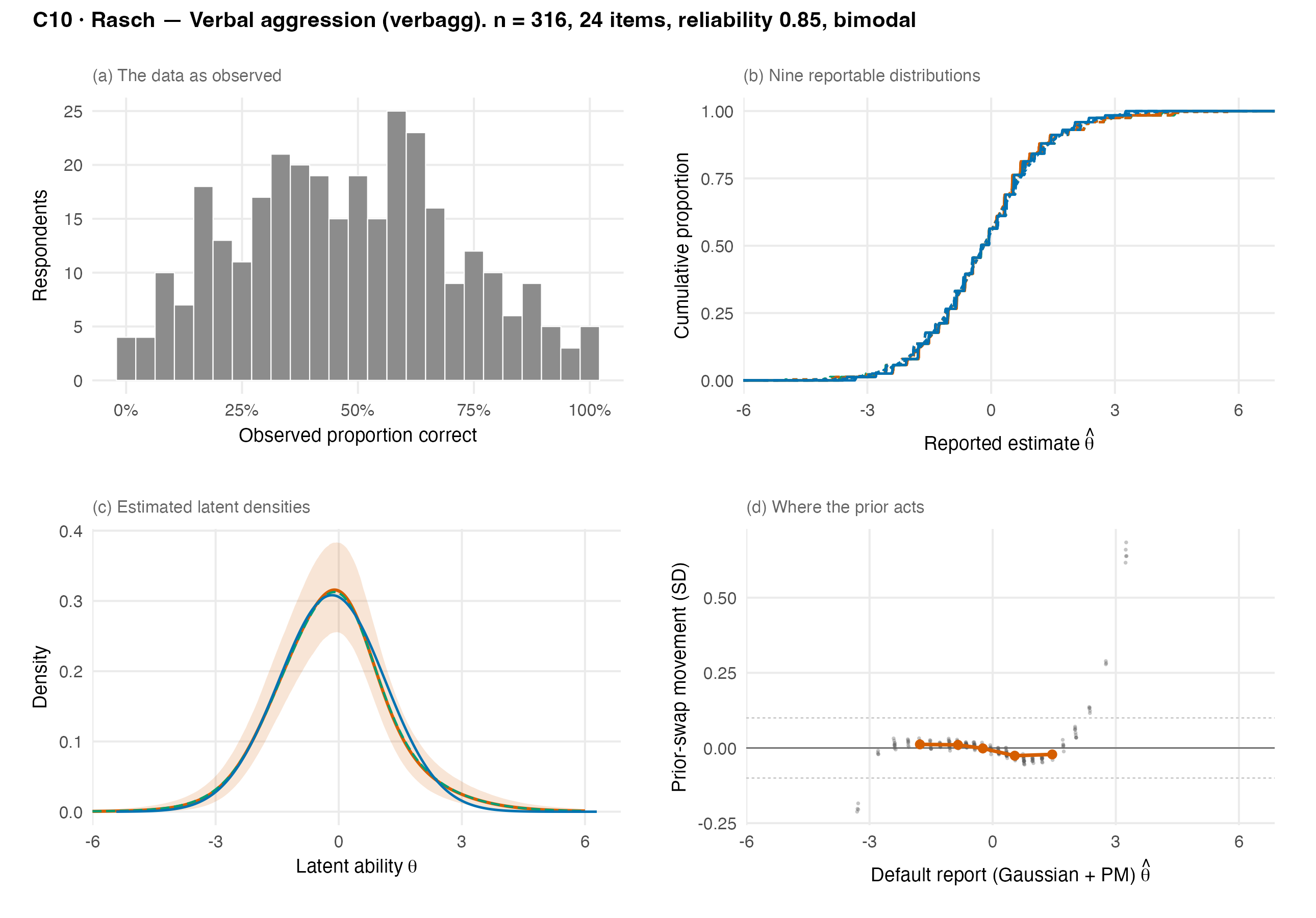
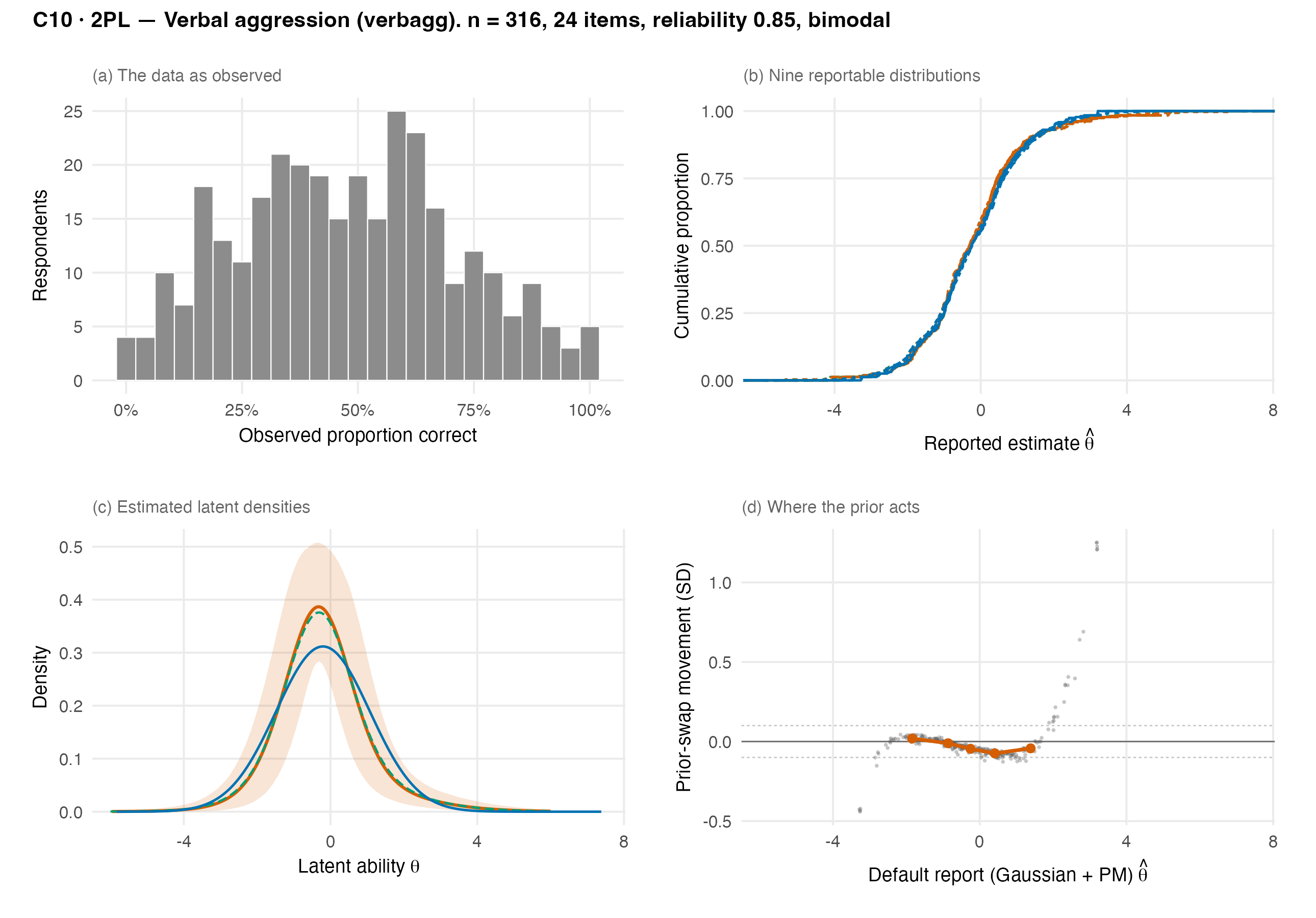
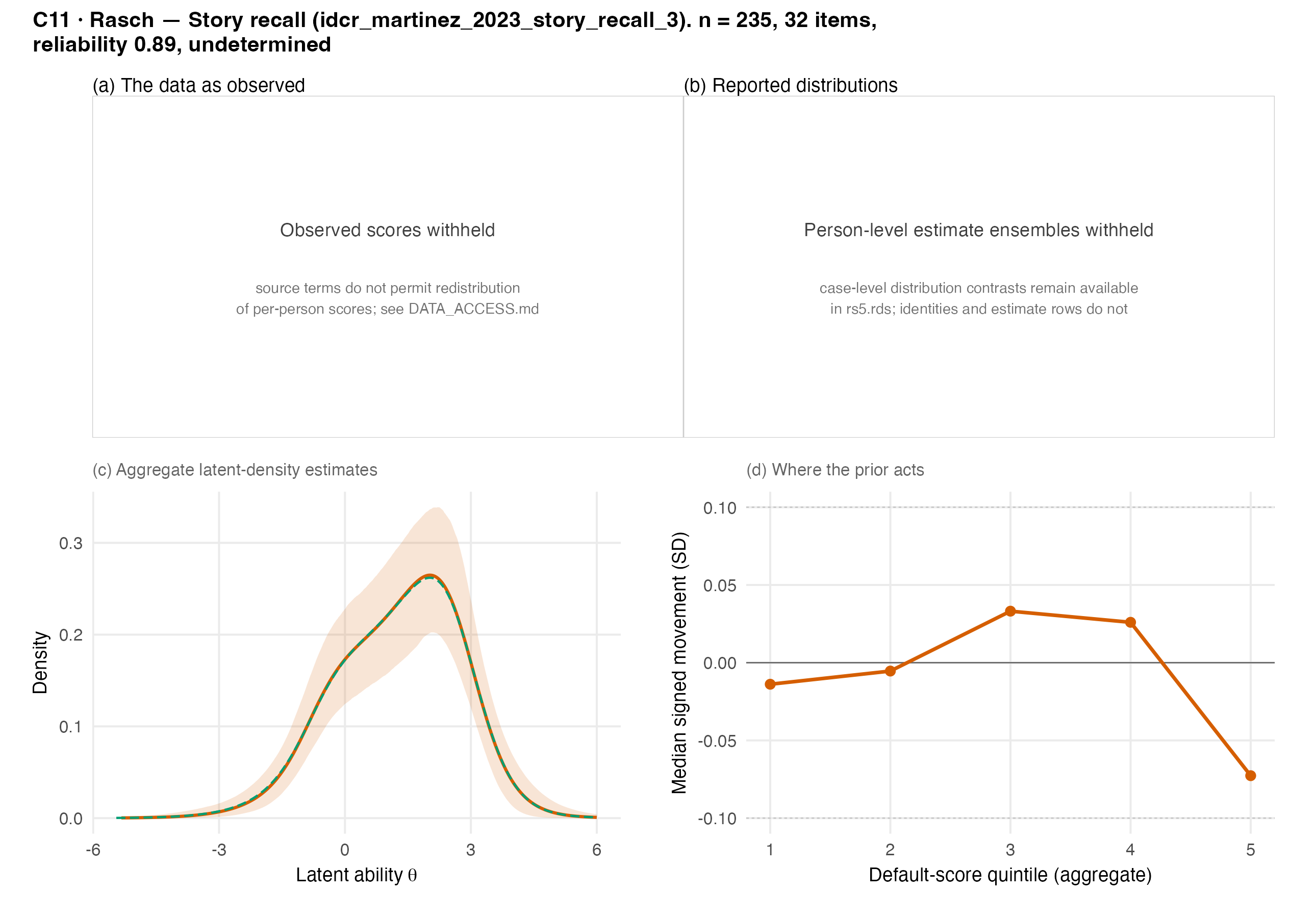
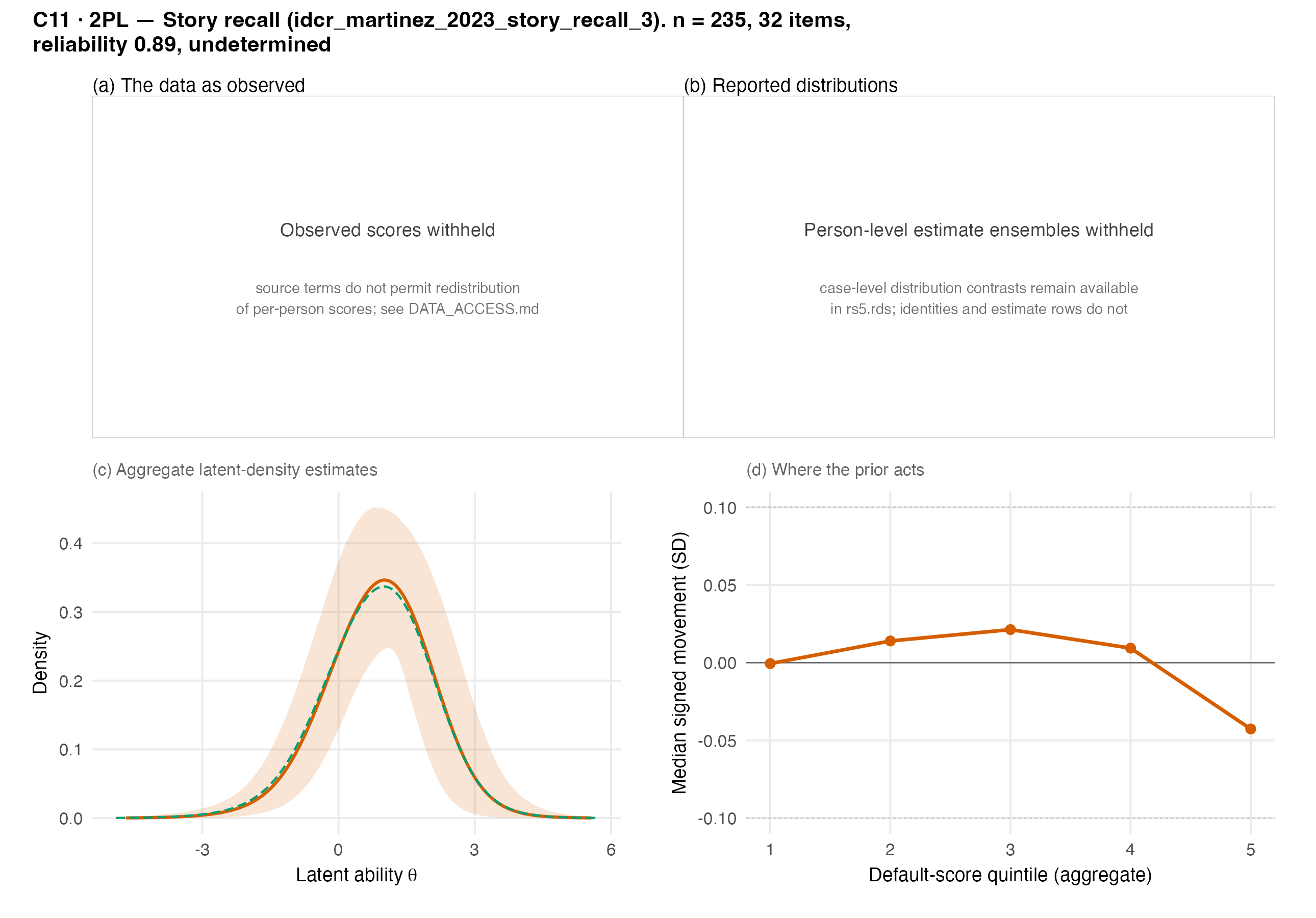
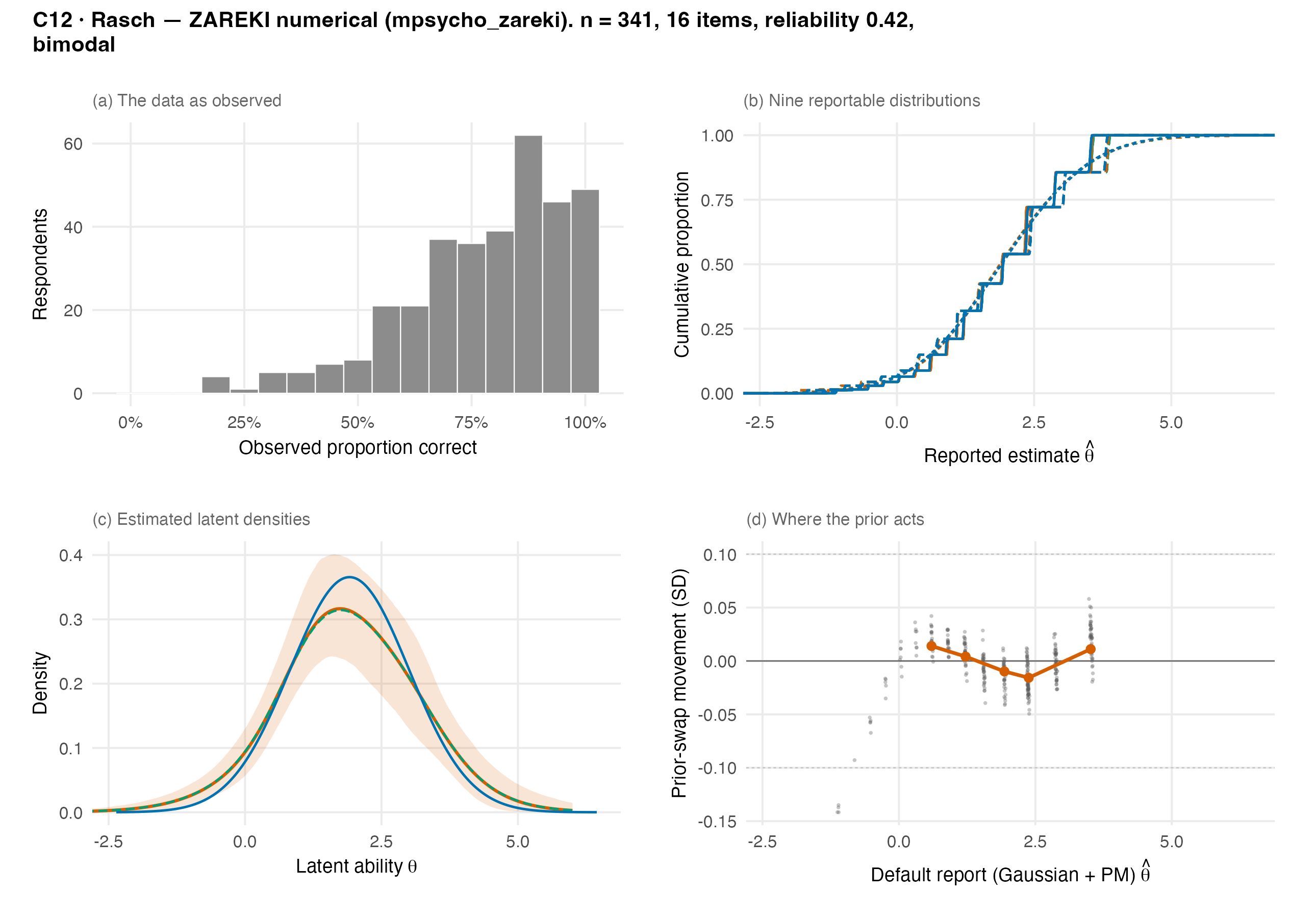
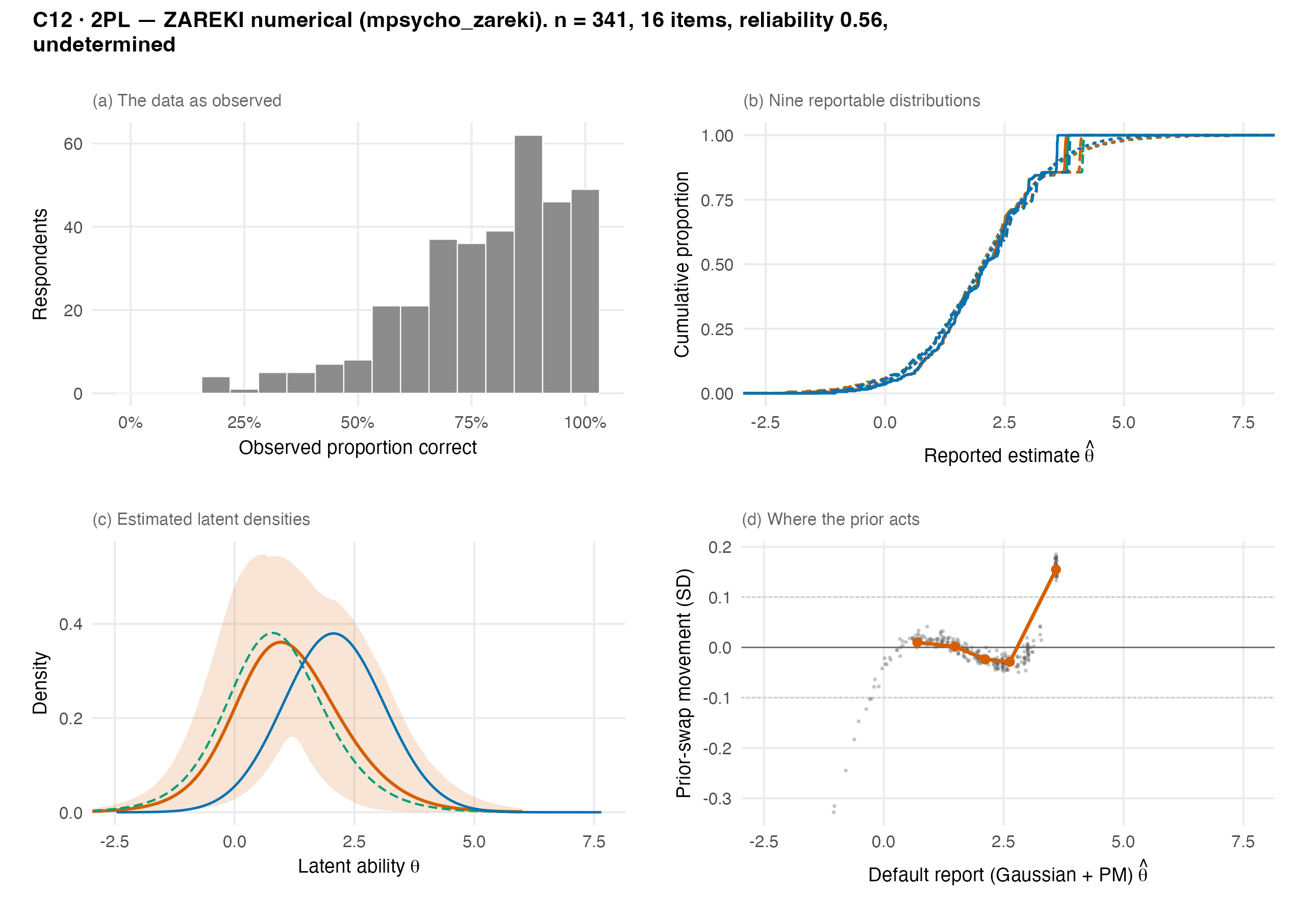
One dossier per case: identity and provenance, the frozen coordinates under both item models, the case’s gallery, and the matched simulation cell where the case has one. Every field is read from the derived layer at render time; the dataset citation is reproduced verbatim from the frozen citations table. The gallery’s four panels are described once in Chapter 11 and in each figure’s caption.
A.1 C1 — Content-literacy reading comprehension assessment
Warehouse unit gilbert_meta_103 (characterized tier; catalogue status accepted_ambiguous_v1_1). Population: US third-grade students, online content-literacy intervention. 1,914 respondents in total, of whom 500 entered the analysis sample; 29 items; analysis seed 40505369. Identified from: Warehouse catalogue and the primary reference (Relyea et al. 2025 Reading Research Quarterly).
Dataset citation (verbatim from the frozen citations table). Relyea, J. E., Gilbert, J. B., Burkhauser, M., Scherer, E., Mosher, D. M., Wei, Z., … & Kim, J. S. (2025). Asset‐Based Implementation of Structured Adaptations in an Online Third‐Grade Content Literacy Intervention. Reading Research Quarterly, 60(4), e70048.
| Model | rho-bar | marginal_rxx | Shape class | Matched simulation cell |
|---|---|---|---|---|
| 2PL | 0.860 | 0.861 | skewed | 2pl · 500 · 0.9 · skew_pos_strong |
| Rasch | 0.840 | 0.847 | skewed | rasch · 500 · 0.8 · skew_pos_strong |
Under 2PL this row matches a simulation cell whose primary KS loss ratio is 0.51 (strong win); in that cell the simulated distribution-goal winner is DP (focused) + GR and the individual-score winner DP (focused) + PM, and Gaussian + PM carries 2.08 times the selected winner’s distributional loss. The verdict is the simulation’s, read at this row’s coordinates.
Under Rasch this row matches a simulation cell whose primary KS loss ratio is 0.72 (strong win); in that cell the simulated distribution-goal winner is DP (focused) + GR and the individual-score winner DP (focused) + PM, and Gaussian + PM carries 1.92 times the selected winner’s distributional loss. The verdict is the simulation’s, read at this row’s coordinates.
A.2 C2 — Vocabulary assessment from a content-literacy intervention
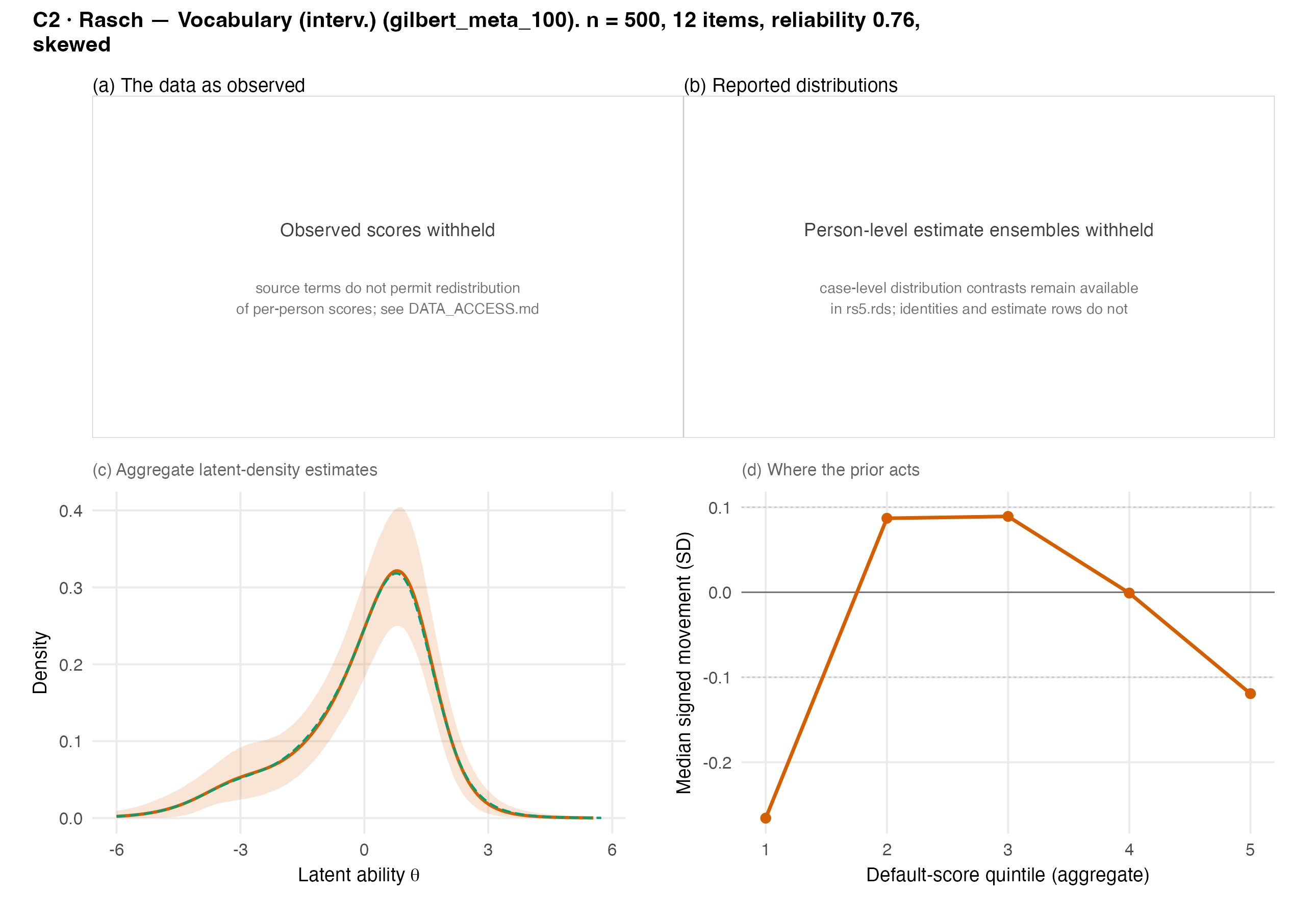
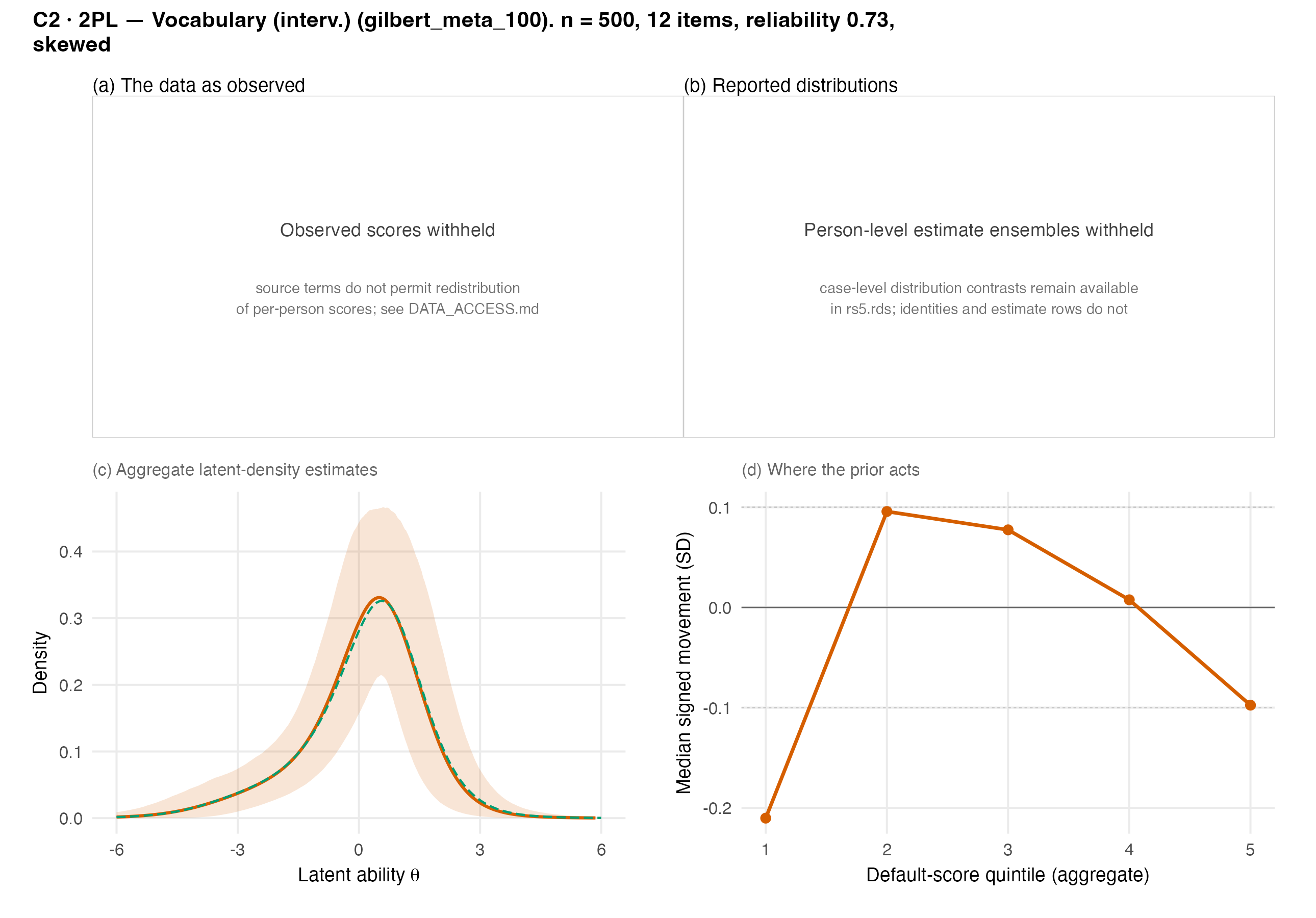
Warehouse unit gilbert_meta_100 (characterized tier; catalogue status accepted_core_v1). Population: School students in a cluster-randomized content-literacy intervention. 2,118 respondents in total, of whom 500 entered the analysis sample; 12 items; analysis seed 50516843. Identified from: Source publication: the single empirical example in Gilbert Domingue & Kim (2025) Psychological Methods.
Dataset citation (verbatim from the frozen citations table). Gilbert, J. B., Domingue, B. W., & Kim, J. S. (2025). Estimating causal effects on psychological networks using item response theory. Psychological Methods. Advance online publication. https://doi.org/10.1037/met0000764
| Model | rho-bar | marginal_rxx | Shape class | Matched simulation cell |
|---|---|---|---|---|
| 2PL | 0.730 | 0.792 | skewed | 2pl · 500 · 0.7 · skew_pos_strong |
| Rasch | 0.764 | 0.493 | skewed | rasch · 500 · 0.8 · skew_pos_strong |
Under 2PL this row matches a simulation cell whose primary KS loss ratio is 0.53 (strong win); in that cell the simulated distribution-goal winner is DP (focused) + GR and the individual-score winner DP (focused) + PM, and Gaussian + PM carries 2.24 times the selected winner’s distributional loss. The verdict is the simulation’s, read at this row’s coordinates.
Under Rasch this row matches a simulation cell whose primary KS loss ratio is 0.72 (strong win); in that cell the simulated distribution-goal winner is DP (focused) + GR and the individual-score winner DP (focused) + PM, and Gaussian + PM carries 1.92 times the selected winner’s distributional loss. The verdict is the simulation’s, read at this row’s coordinates.
A.3 C3 — Inductive Reasoning Developmental Test (IRDT/TDRI) 3rd version
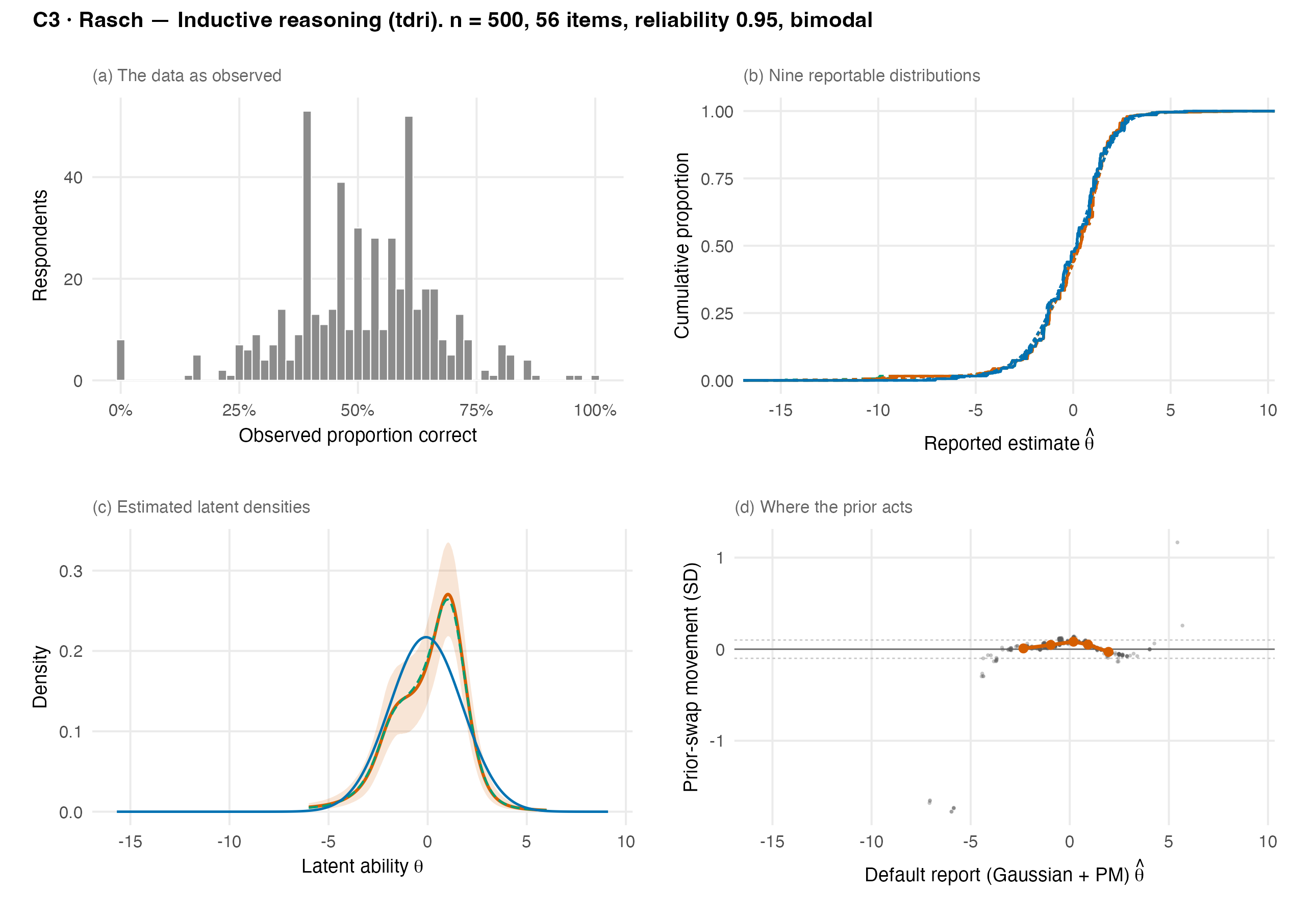
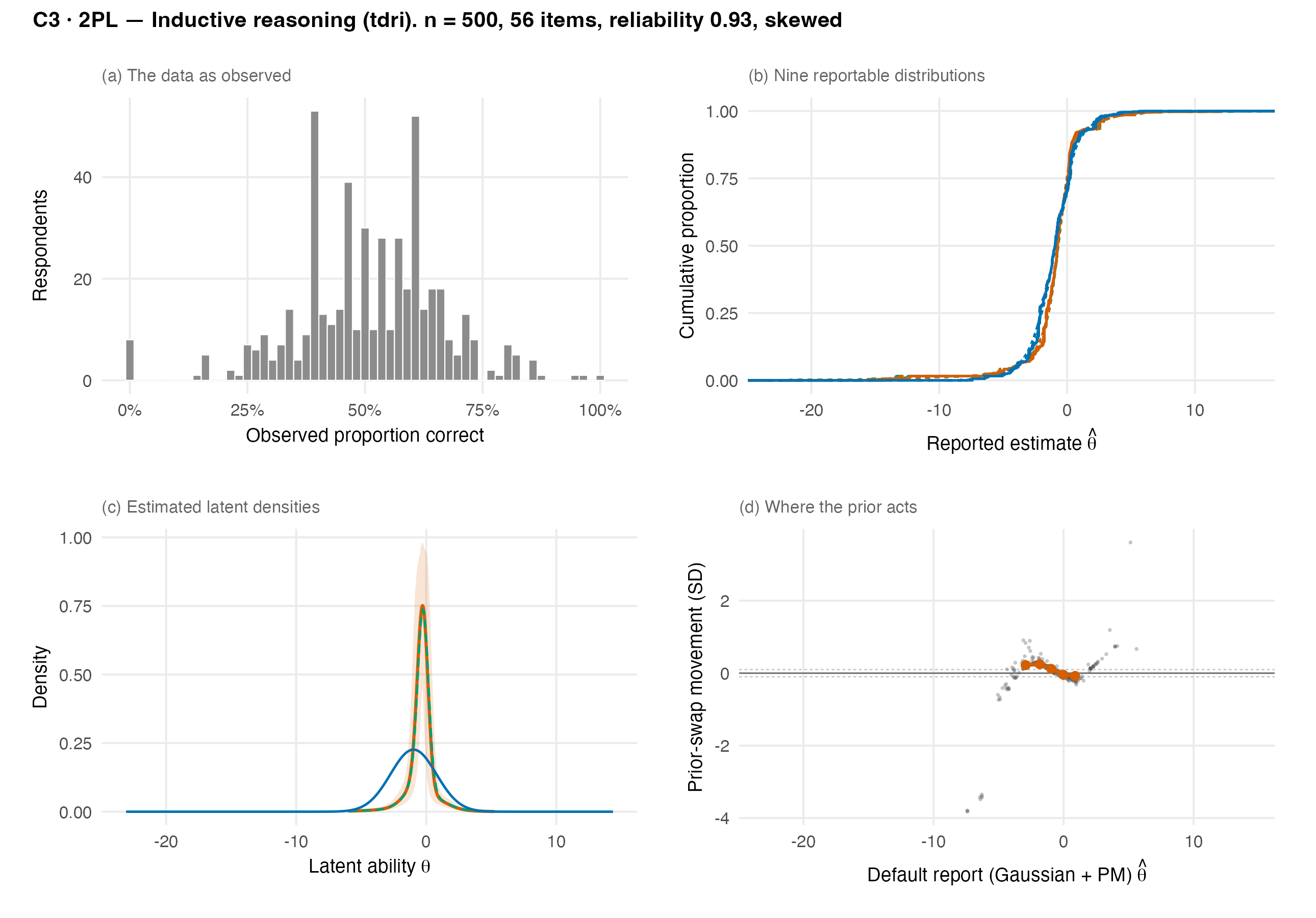
Warehouse unit tdri (characterized tier; catalogue status accepted_core_v1). Population: Brazilian respondents, mixed ages. 1,803 respondents in total, of whom 500 entered the analysis sample; 56 items; analysis seed 248186030. Identified from: Warehouse catalogue and the primary reference (Golino & Gomes 2015).
Dataset citation (verbatim from the frozen citations table). Golino, H. F., & Gomes, C. M. (2015). Investigando estágios de desenvolvimento do raciocínio indutivo usando a análise fatorial confimatória, o Modelo Logístico Simples de Rasch e o modelo de teste logístico linear (Rasch Estendido). In H. F. Golino, C. M. Gomes, A. Amantes, & G. Coelho, Psicometria Contemporânea: Compreendendo os Modelos Rasch (pp. 283-331). São Paulo: Casa do Psicólogo/Pearson.
| Model | rho-bar | marginal_rxx | Shape class | Matched simulation cell |
|---|---|---|---|---|
| 2PL | 0.933 | 0.949 | skewed | 2pl · 500 · 0.9 · skew_pos_strong |
| Rasch | 0.946 | 0.535 | bimodal | rasch · 500 · 0.9 · bimodal_strong |
Under 2PL this row matches a simulation cell whose primary KS loss ratio is 0.51 (strong win); in that cell the simulated distribution-goal winner is DP (focused) + GR and the individual-score winner DP (focused) + PM, and Gaussian + PM carries 2.08 times the selected winner’s distributional loss. The verdict is the simulation’s, read at this row’s coordinates.
Under Rasch this row matches a simulation cell whose primary KS loss ratio is 0.48 (strong win); in that cell the simulated distribution-goal winner is DP (focused) + GR and the individual-score winner DP (focused) + PM, and Gaussian + PM carries 2.27 times the selected winner’s distributional loss. The verdict is the simulation’s, read at this row’s coordinates.
A.4 C4 — Vocabulary check-list
Warehouse unit gcbs_brotherton_2013_vcl (characterized tier; catalogue status accepted_ambiguous_v1_1). Population: Adults, internet sample administered alongside the Generic Conspiracist Beliefs Scale study. 2,495 respondents in total, of whom 500 entered the analysis sample; 16 items; analysis seed 81770971. Identified from: Warehouse catalogue; slug suffix vcl denotes the vocabulary check-list rather than the conspiracist-beliefs scale.
Dataset citation (verbatim from the frozen citations table). Brotherton, R., French, C. C., & Pickering, A. D. (2013). Measuring belief in conspiracy theories: The generic conspiracist beliefs scale. Frontiers in psychology, 4, 279.
| Model | rho-bar | marginal_rxx | Shape class | Matched simulation cell |
|---|---|---|---|---|
| 2PL | 0.261 | 0.778 | skewed | no match |
| Rasch | 0.772 | 0.296 | bimodal | rasch · 500 · 0.8 · bimodal_strong |
Under Rasch this row matches a simulation cell whose primary KS loss ratio is 0.48 (strong win); in that cell the simulated distribution-goal winner is DP (focused) + GR and the individual-score winner DP (focused) + PM, and Gaussian + PM carries 2.54 times the selected winner’s distributional loss. The verdict is the simulation’s, read at this row’s coordinates.
A.5 C5 — PIRLS reading extract
Warehouse unit pirlsmissing_sirt (characterized tier; catalogue status accepted_no_primary_v1_1). Population: Fourth-grade students, international assessment. 3,480 respondents in total, of whom 500 entered the analysis sample; 35 items; analysis seed 255968925. Identified from: Warehouse catalogue.
Dataset citation (verbatim from the frozen citations table). Robitzsch A (2022). sirt: Supplementary Item Response Theory Models. R package version 3.12-66, https://CRAN.R-project.org/package=sirt.
| Model | rho-bar | marginal_rxx | Shape class | Matched simulation cell |
|---|---|---|---|---|
| 2PL | 0.878 | 0.884 | normal | 2pl · 500 · 0.9 · normal |
| Rasch | 0.868 | 0.814 | normal | rasch · 500 · 0.9 · normal |
Under 2PL this row matches a simulation cell whose primary KS loss ratio is 1.01 (harm flag); in that cell the simulated distribution-goal winner is Gaussian + GR and the individual-score winner Gaussian + PM, and Gaussian + PM carries 1.36 times the selected winner’s distributional loss. The verdict is the simulation’s, read at this row’s coordinates.
Under Rasch this row matches a simulation cell whose primary KS loss ratio is 1.03 (harm flag); in that cell the simulated distribution-goal winner is Gaussian + GR and the individual-score winner Gaussian + PM, and Gaussian + PM carries 1.54 times the selected winner’s distributional loss. The verdict is the simulation’s, read at this row’s coordinates.
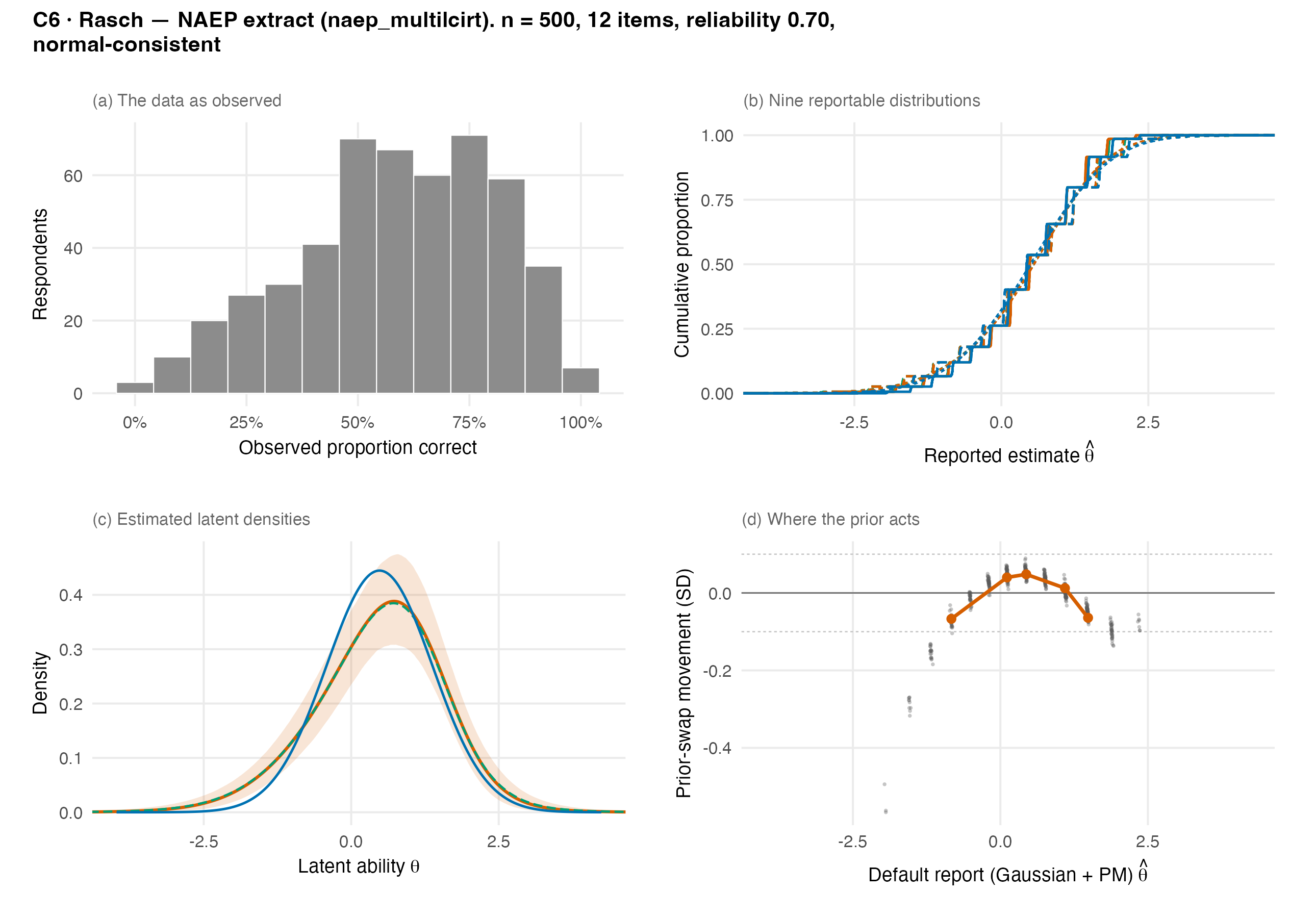
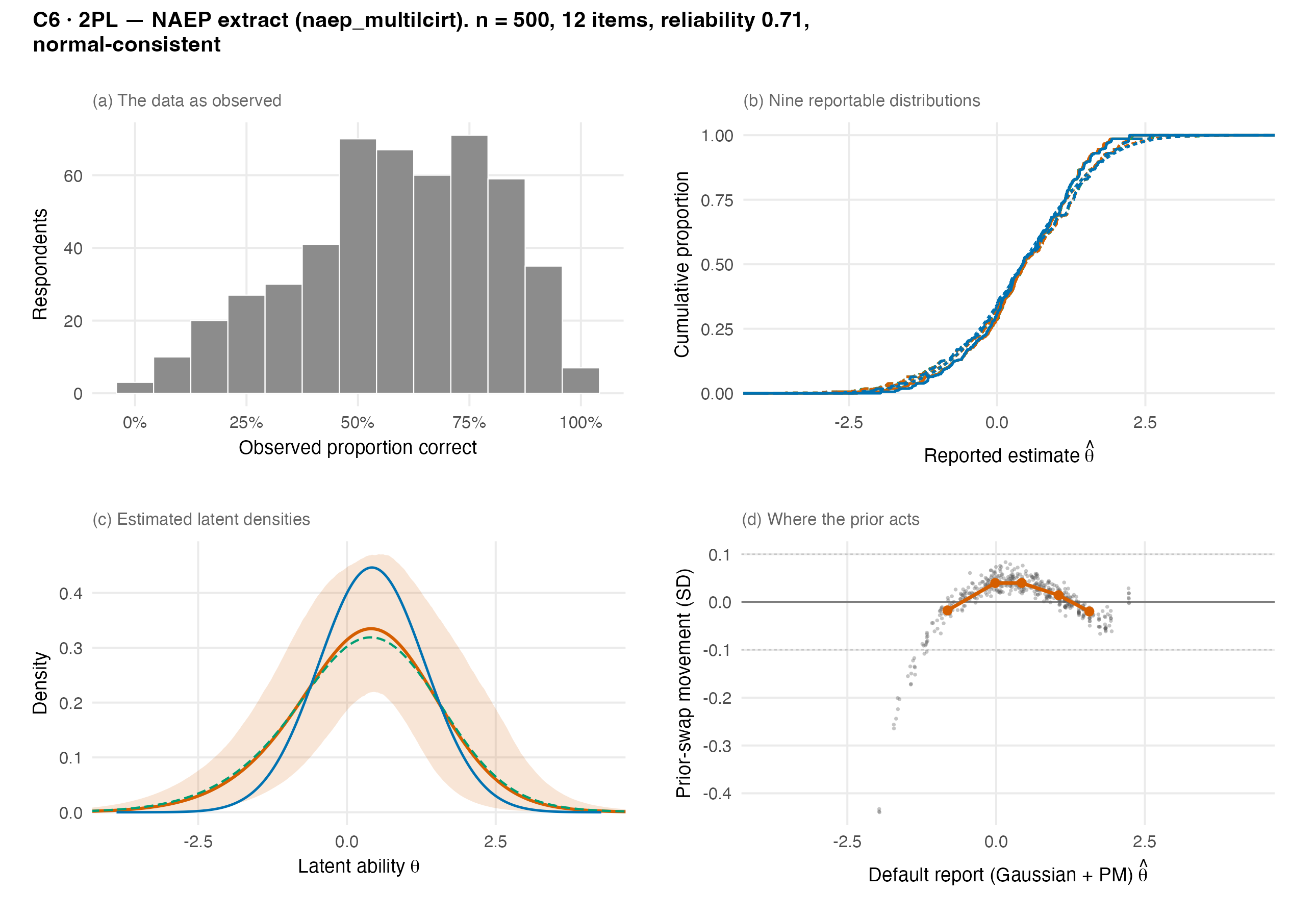
A.6 C6 — NAEP extract
Warehouse unit naep_multilcirt (characterized tier; catalogue status accepted_no_primary_v1_1). Population: US students, national assessment. 1,510 respondents in total, of whom 500 entered the analysis sample; 12 items; analysis seed 46209811. Identified from: Warehouse catalogue.
Dataset citation (verbatim from the frozen citations table). Bartolucci, F., Bacci, S. and Gnaldi, M. (2014), MultiLCIRT: An R package for multidimensional latent class item response models, Computational Statistics and Data Analysis, 71, 971-985.
| Model | rho-bar | marginal_rxx | Shape class | Matched simulation cell |
|---|---|---|---|---|
| 2PL | 0.709 | 0.724 | normal | 2pl · 500 · 0.7 · normal |
| Rasch | 0.703 | 0.607 | normal | rasch · 500 · 0.7 · normal |
Under 2PL this row matches a simulation cell whose primary KS loss ratio is 0.99 (harm flag); in that cell the simulated distribution-goal winner is DP (focused) + GR and the individual-score winner Gaussian + PM, and Gaussian + PM carries 1.59 times the selected winner’s distributional loss. The verdict is the simulation’s, read at this row’s coordinates.
Under Rasch this row matches a simulation cell whose primary KS loss ratio is 1.04 (harm flag); in that cell the simulated distribution-goal winner is Gaussian + GR and the individual-score winner Gaussian + PM, and Gaussian + PM carries 2.36 times the selected winner’s distributional loss. The verdict is the simulation’s, read at this row’s coordinates.
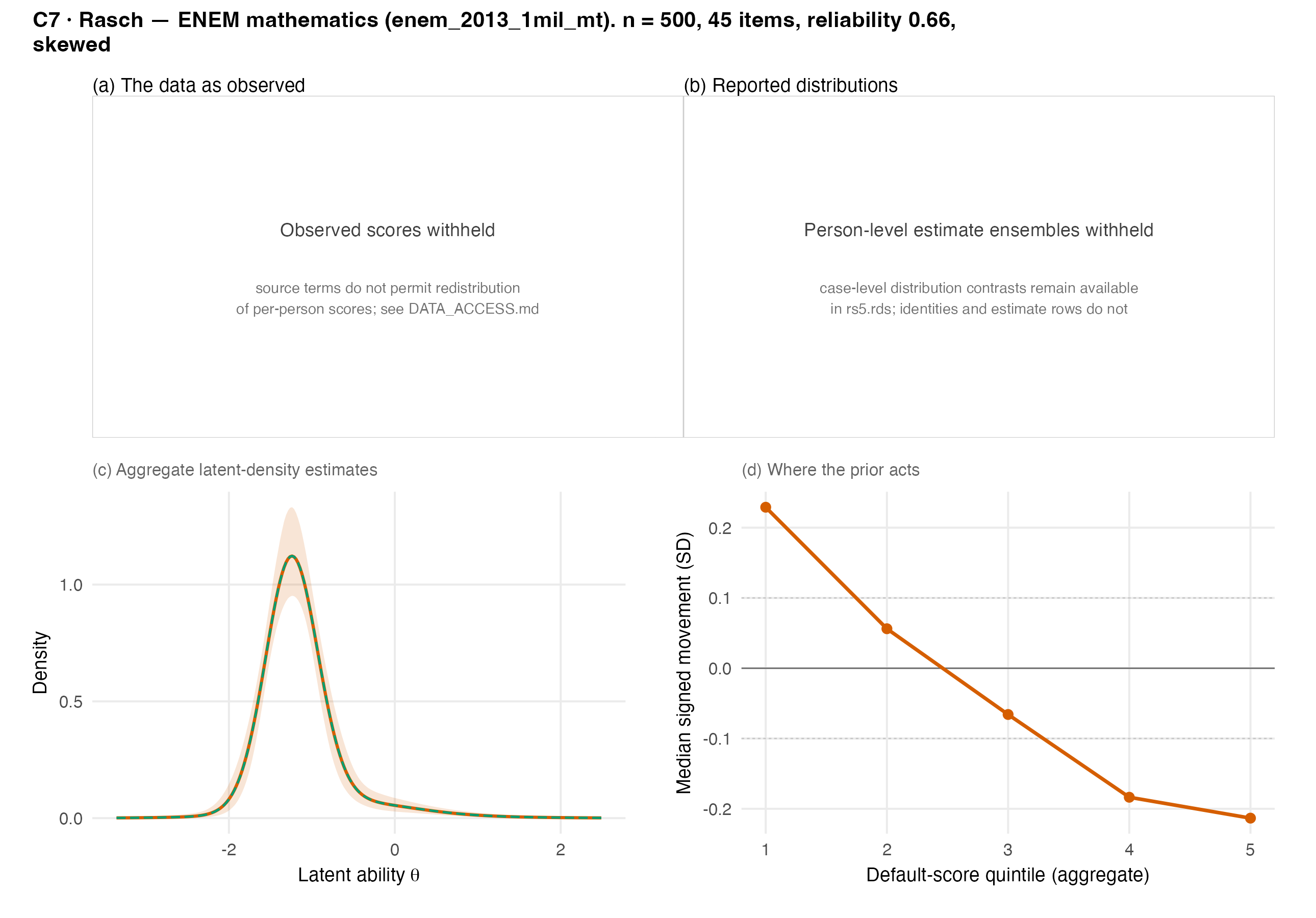
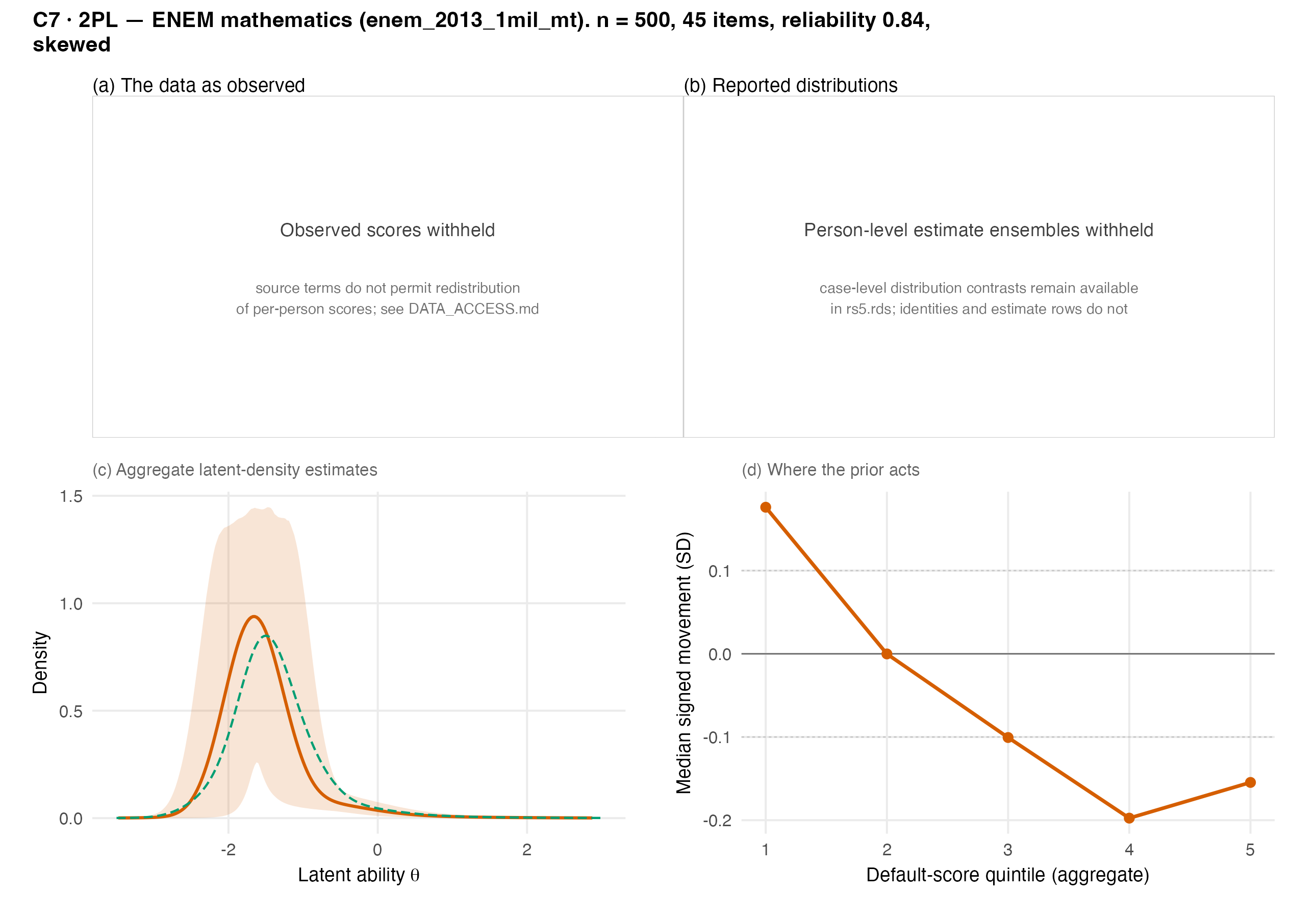
A.7 C7 — ENEM 2013 mathematics section
Warehouse unit enem_2013_1mil_mt (characterized tier; catalogue status provisional_grade_b). Population: Brazilian secondary-school leavers, national examination. 999,822 respondents in total, of whom 500 entered the analysis sample; 45 items; analysis seed 219125270. Identified from: Warehouse build record: official INEP ENEM 2013 archive; slug suffix mt denotes matematica; 45 items.
Dataset citation (verbatim from the frozen citations table). Derived RDS built from the official ENEM 2013 INEP zip via enem_2013.R; rows=44991990, unique_ids=999822, unique_items=45, sample_rule=1e6_fixed_seed.
| Model | rho-bar | marginal_rxx | Shape class | Matched simulation cell |
|---|---|---|---|---|
| 2PL | 0.844 | 0.785 | skewed | 2pl · 500 · 0.8 · skew_pos_strong |
| Rasch | 0.657 | 0.957 | skewed | rasch · 500 · 0.7 · skew_pos_strong |
Under 2PL this row matches a simulation cell whose primary KS loss ratio is 0.48 (strong win); in that cell the simulated distribution-goal winner is DP (focused) + GR and the individual-score winner DP (focused) + PM, and Gaussian + PM carries 2.40 times the selected winner’s distributional loss. The verdict is the simulation’s, read at this row’s coordinates.
Under Rasch this row matches a simulation cell whose primary KS loss ratio is 0.70 (strong win); in that cell the simulated distribution-goal winner is DP (focused) + GR and the individual-score winner DP (focused) + PM, and Gaussian + PM carries 2.41 times the selected winner’s distributional loss. The verdict is the simulation’s, read at this row’s coordinates.
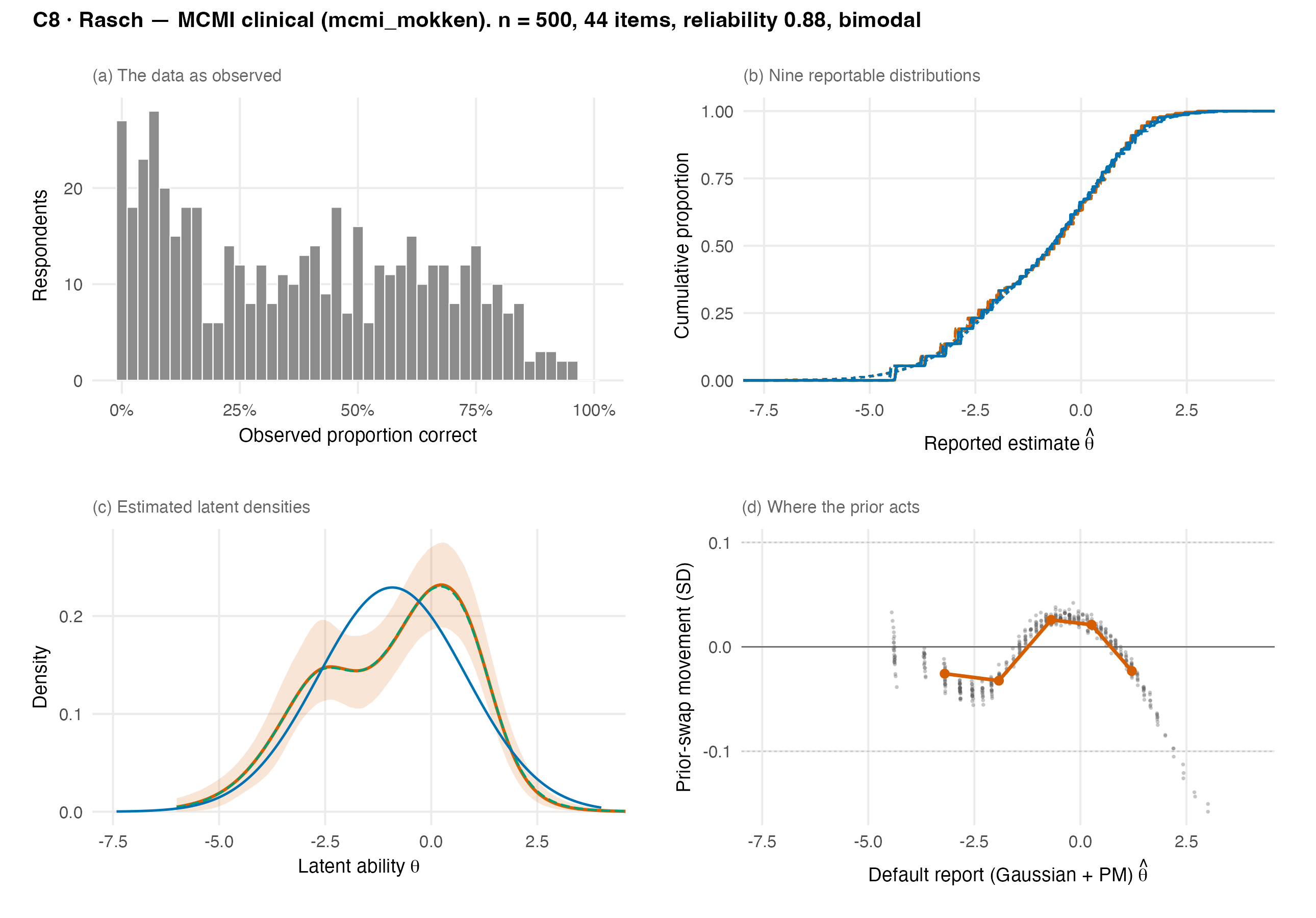
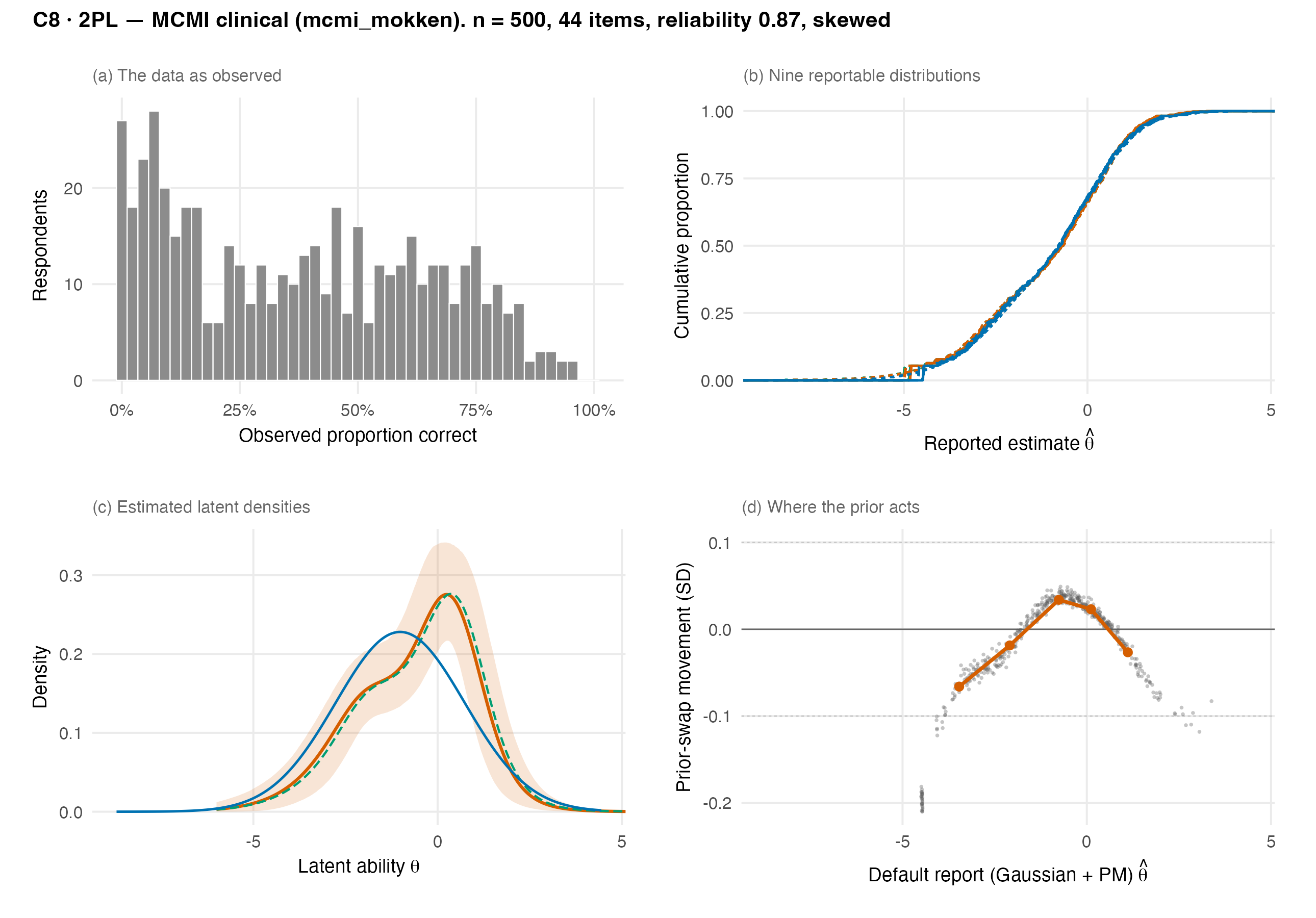
A.8 C8 — Millon Clinical Multiaxial Inventory extract
Warehouse unit mcmi_mokken (transitional tier; catalogue status accepted_no_primary_v1_1). Population: Dutch clinical sample, adults. 1,208 respondents in total, of whom 500 entered the analysis sample; 44 items; analysis seed 11872871. Identified from: Warehouse catalogue.
Dataset citation (verbatim from the frozen citations table). Rossi, G., Elklit, A., & Simonsen, E. (2010). Empirical evidence for a four factor framework of personality disorder organization: multigroup confirmatory factor analysis of the millon clinical multiaxial inventory—III personality disorder scales across belgian and danish data samples. Journal of Personality Disorders, 24(1), 128-150.
| Model | rho-bar | marginal_rxx | Shape class | Matched simulation cell |
|---|---|---|---|---|
| 2PL | 0.868 | 0.929 | skewed | 2pl · 500 · 0.9 · skew_pos_strong |
| Rasch | 0.876 | 0.701 | bimodal | rasch · 500 · 0.9 · bimodal_strong |
Under 2PL this row matches a simulation cell whose primary KS loss ratio is 0.51 (strong win); in that cell the simulated distribution-goal winner is DP (focused) + GR and the individual-score winner DP (focused) + PM, and Gaussian + PM carries 2.08 times the selected winner’s distributional loss. The verdict is the simulation’s, read at this row’s coordinates.
Under Rasch this row matches a simulation cell whose primary KS loss ratio is 0.48 (strong win); in that cell the simulated distribution-goal winner is DP (focused) + GR and the individual-score winner DP (focused) + PM, and Gaussian + PM carries 2.27 times the selected winner’s distributional loss. The verdict is the simulation’s, read at this row’s coordinates.
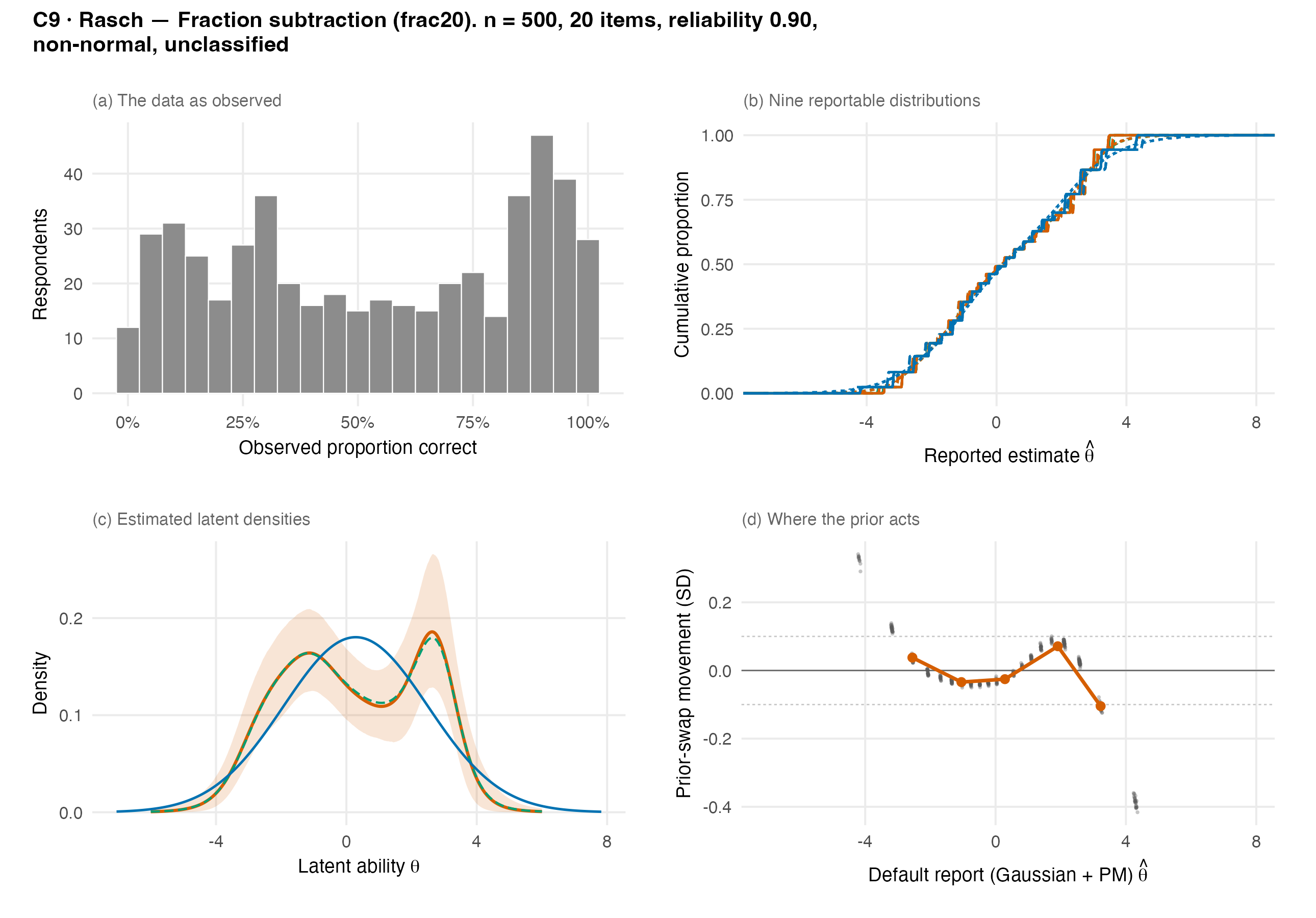
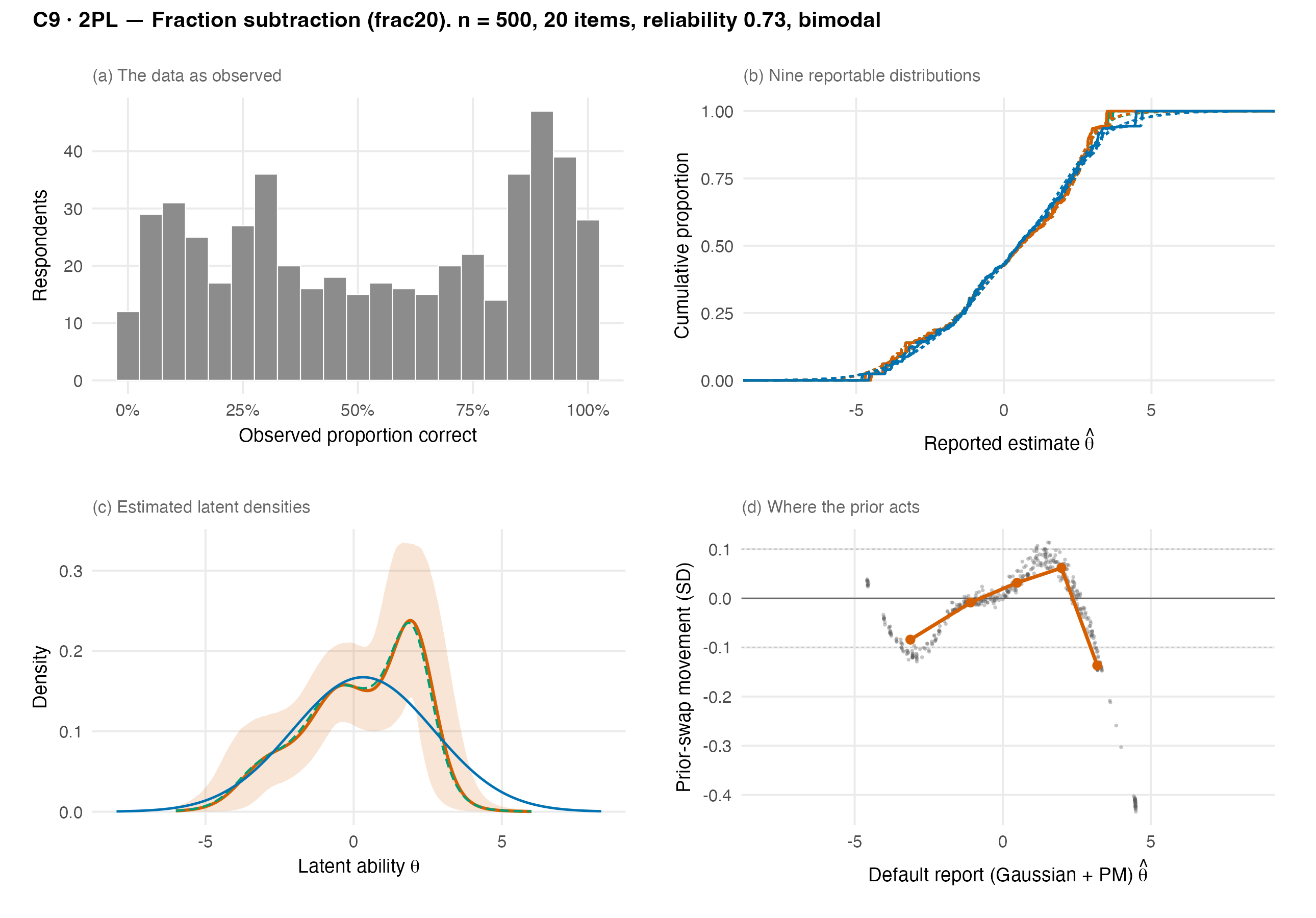
A.9 C9 — Fraction subtraction test
Warehouse unit frac20 (transitional tier; catalogue status accepted_legacy_v1_1). Population: Students, cognitive-diagnosis benchmark dataset. 536 respondents in total, of whom 500 entered the analysis sample; 20 items; analysis seed 119838441. Identified from: Warehouse catalogue.
Dataset citation (verbatim from the frozen citations table). Tatsuoka, C. (2002). Data analytic methods for latent partially ordered classification models. Journal of the Royal Statistical Society: Series C (Applied Statistics), 51(3), 337-350.
| Model | rho-bar | marginal_rxx | Shape class | Matched simulation cell |
|---|---|---|---|---|
| 2PL | 0.731 | 0.890 | bimodal | 2pl · 500 · 0.7 · bimodal_strong |
| Rasch | 0.899 | 0.396 | non-normal (unclassified) | no match |
Under 2PL this row matches a simulation cell whose primary KS loss ratio is 0.71 (strong win); in that cell the simulated distribution-goal winner is DP (focused) + GR and the individual-score winner DP (focused) + PM, and Gaussian + PM carries 1.62 times the selected winner’s distributional loss. The verdict is the simulation’s, read at this row’s coordinates.
A.10 C10 — Verbal aggression questionnaire
Warehouse unit verbagg (as-found tier; catalogue status accepted_core_v1). Population: Adults, questionnaire study. 316 respondents in total, of whom 316 entered the analysis sample; 24 items; analysis seed 253062181. Identified from: Warehouse catalogue.
Dataset citation (verbatim from the frozen citations table). De Boeck and Wilson (2004), Explanatory Item Response Models, Springer.
| Model | rho-bar | marginal_rxx | Shape class | Matched simulation cell |
|---|---|---|---|---|
| 2PL | 0.849 | 0.874 | bimodal | 2pl · 200 · 0.8 · bimodal_strong |
| Rasch | 0.847 | 0.683 | bimodal | rasch · 200 · 0.8 · bimodal_strong |
Under 2PL this row matches a simulation cell whose primary KS loss ratio is 0.73 (strong win); in that cell the simulated distribution-goal winner is DP (focused) + CB and the individual-score winner DP (focused) + PM, and Gaussian + PM carries 1.47 times the selected winner’s distributional loss. The verdict is the simulation’s, read at this row’s coordinates.
Under Rasch this row matches a simulation cell whose primary KS loss ratio is 0.76 (strong win); in that cell the simulated distribution-goal winner is DP (focused) + GR and the individual-score winner DP (focused) + PM, and Gaussian + PM carries 1.57 times the selected winner’s distributional loss. The verdict is the simulation’s, read at this row’s coordinates.
A.11 C11 — Story recall task 3 (prose recall scored by detail)
Warehouse unit idcr_martinez_2023_story_recall_3 (as-found tier; catalogue status provisional_grade_b). Population: Adults, Automating and Improving Memory Measurement (AIMM) project at UMD. 235 respondents in total, of whom 235 entered the analysis sample; 32 items; analysis seed 204253420. Identified from: Dataset documentation shipped with the unit: project Read Me and Story Rubric.
Dataset citation (verbatim from the frozen citations table). Derived RDS built from Story Recall 3_itemLevel.csv via idcr_martinez_2023.r; rows=7150, unique_items=32, shared_support_docs=3.
| Model | rho-bar | marginal_rxx | Shape class | Matched simulation cell |
|---|---|---|---|---|
| 2PL | 0.893 | 0.893 | undetermined | no match |
| Rasch | 0.889 | 0.653 | undetermined | no match |
No matched simulation cell is available for this case, so no simulation verdict is transferred to it.
A.12 C12 — ZAREKI neuropsychological battery for number processing
Warehouse unit mpsycho_zareki (as-found tier; catalogue status accepted_no_primary_v1_1). Population: Children, clinical neuropsychological assessment. 341 respondents in total, of whom 341 entered the analysis sample; 16 items; analysis seed 153125947. Identified from: Warehouse catalogue.
Dataset citation (verbatim from the frozen citations table). Koller, I., & Alexandrowicz, R. W. (2010) Eine psychometrische Analyse der ZAREKI-R mittels Rasch-Modellen [A psychometric analysis of the ZAREKI-R using Rasch-models]. Diagnostica 56, 57-67.
| Model | rho-bar | marginal_rxx | Shape class | Matched simulation cell |
|---|---|---|---|---|
| 2PL | 0.561 | 0.730 | undetermined | no match |
| Rasch | 0.425 | 0.516 | bimodal | no match |
No matched simulation cell is available for this case, so no simulation verdict is transferred to it.
A.13 C13 — Work Design Questionnaire (R package authors survey)
Warehouse unit mpsycho_rwdq (transitional tier; catalogue status accepted_no_primary_v1_1). Population: Adults, R package authors. 1,055 respondents in total, of whom 497 entered the analysis sample; 18 items; analysis seed 261421130. Identified from: Warehouse catalogue.
Dataset citation (verbatim from the frozen citations table). Mair, P., Hofmann, E., Gruber, K., Zeileis, A., & Hornik, K. (2015) Motivation, values, and work design as drivers of participation in the R open source Project for Statistical Computing. Proceedings of the National Academy of Sciences of the United States of America, 112(48), 14788-14792.
| Model | rho-bar | marginal_rxx | Shape class | Matched simulation cell |
|---|---|---|---|---|
| 2PL | 0.654 | 0.706 | undetermined | no match |
| Rasch | 0.651 | 0.706 | normal | rasch · 500 · 0.7 · normal |
Under Rasch this row matches a simulation cell whose primary KS loss ratio is 1.04 (harm flag); in that cell the simulated distribution-goal winner is Gaussian + GR and the individual-score winner Gaussian + PM, and Gaussian + PM carries 2.36 times the selected winner’s distributional loss. The verdict is the simulation’s, read at this row’s coordinates.