17 Safety evidence, scope, and unmatched cases
This chapter corrects two different problems that v2 collapsed into one. Some case-cells cannot be matched because a coordinate is unavailable or outside support. Separately, sim-v3 contains seven MSEL safety flags whose post-outcome interpretation constrains the scope and wording of H4. Neither fact creates a preregistered blanket “withhold every recommendation” rule.
17.1 The case-cells that carry no match
Of the 26 case-cells, four return undetermined and one, C9–Rasch, returns non-normal without a class, so the standardized screen identifies no simulation cell for them. Two more carry a class but a reliability below nearest-tier support. That leaves 19 rows to be matched in Chapter 15, and the seven above receive no cell verdict at all.
C12–Rasch is a particularly important correction. Its continuous \bar\rho=.425 is 0.075 below the .5 tier and below the .45 nearest-cell support boundary. V1 forced it into the .5 bimodal cell and then described that cell as occupied. V3 removed the match, and this edition keeps it removed. C4–2PL, at \bar\rho=.261, is farther outside for the same reason.
17.2 What the safety labels do say
Sim-v3’s opportunity-region screen has 7 flagged cells (2 block and 5 caution), all bimodal at reliability .5 or .6 and N=200 or 500. Their individual squared-error ratios range from 1.052 to 1.138. These are real simulation results and remain important whenever individual accuracy is part of the target.
The interpretation, however, was formalized after outcomes in Addendum 006. The addendum constrains H4’s scope and wording and explicitly does not block distribution-recovery claims. Current sim-v3 guidance is goal-dependent. This edition therefore reports the safety labels, their timing, and their inferential target; it does not invent a universal stop rule.
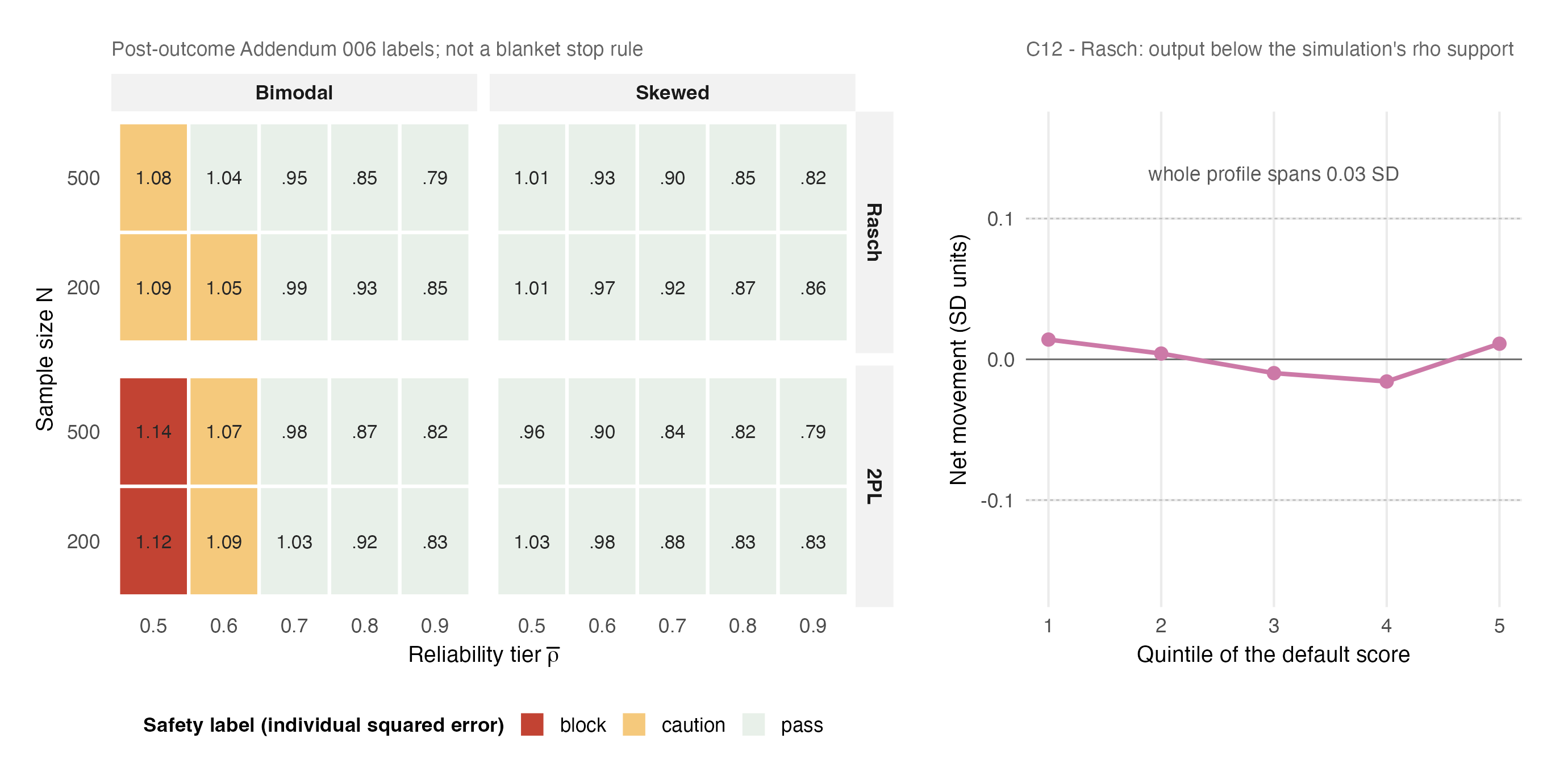
Figure 17.1 deliberately places two unjoined facts side by side. The left panel is truth-based MSEL evidence from the simulation. The right is visible movement on C12. Real case data cannot observe distance from truth, so a quiet case profile neither discharges nor lowers the stakes of the simulation warning. Conversely, because C12–Rasch lies below the simulated reliability support, the warning cannot be assigned to it as a matched-cell verdict, even though the bimodal class it carries is the class the flagged cells share.
17.3 What is still missing
Case-specific guidance had two prerequisites. The first, a complete standardized shape-screen refit with a newly frozen manifest, was run for this edition (Section 5.4) and is what reopened Chapter 15. The second is a placement policy for reliabilities below .45, and this edition takes the declining branch: it does not extrapolate below the grid, so C12–Rasch and C4–2PL receive no verdict rather than a clamped one. Studying that region would take a simulation designed for it. A decision rule that weights individual and distributional loss would be an additional, goal-specific analysis; it would not retroactively make the post-outcome safety interpretation preregistered.