
Diagnosing Your Prior: Avoiding Unintended Consequences
JoonHo Lee (jlee296@ua.edu)
2026-08-22
Source:vignettes/diagnostics.Rmd
diagnostics.RmdOverview
When you elicit a Gamma hyperprior for based on your expectations about the number of clusters , you are implicitly specifying priors on many other quantities that you may not have consciously considered. These “unintended priors” can lead your posterior inference in unexpected directions, particularly in low-information settings where the data cannot overwhelm an inadvertently strong prior.
This vignette introduces the diagnostic tools in the DPprior package that help you verify your prior behaves as intended across all relevant dimensions. By the end, you will understand:
- Why diagnostics matter: the “unintended prior” problem
- The complete diagnostic suite available in DPprior
- How to interpret and weight distribution diagnostics
- Explicit estimand-specific warning policies and how to respond to them
- How to use diagnostics to iteratively refine your prior
1. Why Diagnostics Matter
1.1 The Blind Spot in Prior Elicitation
The standard workflow for eliciting a DP prior focuses on cluster counts:
- You think about : “How many groups do I expect?”
- You think about : “How uncertain am I about that?”
- You build
DPprior_target_K(), pass it toDPprior_fit(), and obtain
This is intuitive and principled. However, your elicited prior on determines not just , but also:
- The distribution of itself: mean, variance, and shape
- The cluster weight distribution: how mass is allocated across clusters
- The co-clustering probability: how likely two random observations share a cluster
- A named weight-tail probability, such as , kept distinct from largest-weight evidence for
These characteristics are implicit consequences of your choice. You may not have intended any particular behavior for these quantities, yet your prior assigns specific probabilities to them.
1.2 The Unintended Prior Problem
Vicentini & Jermyn (2025) demonstrated that matching a target distribution does not guarantee intuitive weight behavior. Consider a concrete example:
J <- 50
mu_K <- 5

# Canonical K-only calibration
target_K <- DPprior_target_K(J = J, mu_K = mu_K, var_K = 8)
fit_K <- DPprior_fit(J = J, target_K = target_K, method = "A2-MN")

cat("K-only prior: Gamma(", round(fit_K$parameters$a, 3), ", ",
    round(fit_K$parameters$b, 3), ")\n", sep = "")
#> K-only prior: Gamma(2.036, 1.605)
cat("\nCluster count behavior:\n")
#>
#> Cluster count behavior:
cat("  E[K] =", round(fit_K$achieved$K$mean, 2), "\n")
#>   E[K] = 5
cat("  This matches our target of", mu_K, "clusters.\n")
#>   This matches our target of 5 clusters.

cat("\nBut what about weight behavior?\n")
#>
#> But what about weight behavior?
cat("  E[w₁] =",
    round(mean_w1(fit_K$parameters$a, fit_K$parameters$b), 3), "\n")
#>   E[w₁] = 0.501
cat("  P(W_SB > 0.3) =",
    round(prob_wsb_exceeds(0.3, fit_K$parameters$a, fit_K$parameters$b), 3), "\n")
#>   P(W_SB > 0.3) = 0.665
cat("  P(W_SB > 0.5) =",
    round(prob_wsb_exceeds(0.5, fit_K$parameters$a, fit_K$parameters$b), 3), "\n")
#>   P(W_SB > 0.5) = 0.481
cat("  P(W_SB > 0.9) =",
    round(prob_wsb_exceeds(0.9, fit_K$parameters$a, fit_K$parameters$b), 3), "\n")
#>   P(W_SB > 0.9) = 0.163
fit_K[c("status", "usable", "verified", "message")]
#> $status
#> [1] "converged"
#>
#> $usable
#> [1] TRUE
#>
#> $verified
#> [1] TRUE
#>
#> $message
#> [1] "scaled component residuals and independent higher-order verification passed"
The prior expects 5 clusters, but there is a substantial probability (nearly 50%) that a randomly selected observation belongs to a cluster containing more than half of all observations. Is this what you intended when you said “I expect 5 clusters”?
Most researchers, when they think “5 clusters,” imagine something like five roughly comparable groups—not a situation where one cluster might dominate the entire mixture.
1.3 Why This Matters in Practice
The unintended prior problem is especially consequential in low-information settings (Lee et al., 2025):
- Multisite trials with few sites: When is moderate (20–100), each site provides limited data
- Sparse clustering applications: When observations per cluster are small
- Exploratory analyses: When you don’t have strong prior data to inform expectations
In these settings, the posterior can remain close to the prior. If your prior places more mass than intended on large size-biased clusters, your posterior may inherit this behavior even when the data suggest otherwise.
2. The Complete Diagnostic Suite
The DPprior package provides a comprehensive set of diagnostics that you can access in several ways.
2.1 Automatic Diagnostics During Fitting
The simplest approach is to enable diagnostics during the fitting process:
target_K <- DPprior_target_K(J = 50, mu_K = 5, var_K = 8)
fit <- DPprior_fit(
  J = 50, target_K = target_K, check_diagnostics = TRUE
)
When check_diagnostics = TRUE, the function computes all
diagnostic quantities and stores them in the returned object.
2.2 Post-Hoc Diagnostic Computation
You can also compute diagnostics after fitting:
# Fit without diagnostics first
target_K <- DPprior_target_K(J = 50, mu_K = 5, var_K = 8)
fit <- DPprior_fit(
  J = 50, target_K = target_K, check_diagnostics = FALSE
)

# Then compute and verify diagnostics. W_SB evidence is named explicitly;
# a W_max policy remains explicitly indeterminate when its backend is unavailable.
diag <- DPprior_diagnostics(fit)
print(diag)
#> DPprior Prior Diagnostics
#> ============================================================
#> Schema: dpprior.result/1
#> Status: CONVERGED
#> Usable: yes; verified: yes
#> Method used: canonical_prior_diagnostics
#> Message: All canonical diagnostic components passed independent selected-versus-verifier checks.
#>
#> Prior: alpha ~ Gamma(shape=2.03609, rate=1.60505); J=50
#>
#> alpha (DP concentration parameter)
#>   Status converged; mean 1.269; SD 0.889; CV 0.7008; median 1.068
#>
#> K_J (occupied clusters among J=50 units)
#>   Status converged; E[K_J] 5; SD 2.828; median 5; mode 3; M=80
#>
#> W_SB (first size-biased DP weight)
#>   Status converged; mean 0.5014; median 0.4784
#>   P(W_SB > 0.5) = 0.481478
#>   P(W_SB > 0.9) = 0.163382
#>   W_SB is not W_max.
#>
#> W_max: unavailable (this canonical diagnostics bundle contains no W_max estimate; no W_SB value was substituted).
#>
#> rho (conditional pairwise co-clustering probability)
#>   Status converged; mean 0.5014; SD 0.2549
#>
#> No warning policy requested; no categorical warning was computed.
diag[c("status", "usable", "verified", "message")]
#> $status
#> [1] "converged"
#>
#> $usable
#> [1] TRUE
#>
#> $verified
#> [1] TRUE
#>
#> $message
#> [1] "All canonical diagnostic components passed independent selected-versus-verifier checks."
2.3 Overview of Diagnostic Components
The diagnostic object contains several components:
| Component | Description |
|---|---|
diagnostics$alpha |
Verified mean and CV |
diagnostics$K |
Verified mean, variance, PMF, and quadrature order |
diagnostics$weights |
Verified first-size-biased-weight mean |
diagnostics$coclustering |
Verified co-clustering mean and variance |
diagnostics$policy_results |
Exact policy evidence, or an explicit indeterminate record when its backend is unavailable |
diagnostics$warnings |
One warning for each triggered named policy |
Let us examine each component in detail.
3. Alpha Distribution Diagnostics
The first set of diagnostics concerns the concentration parameter itself. Since , we can compute all moments analytically.
3.1 Accessing Alpha Diagnostics
target_K <- DPprior_target_K(J = 50, mu_K = 5, var_K = 8)
fit <- DPprior_fit(
  J = 50, target_K = target_K, check_diagnostics = FALSE
)
diag <- DPprior_diagnostics(fit)
alpha_diag <- diag$diagnostics$alpha
alpha_sd <- sqrt(fit$parameters$a) / fit$parameters$b
alpha_quantiles <- qgamma(
  c(q5 = 0.05, q25 = 0.25, q50 = 0.50, q75 = 0.75, q95 = 0.95),
  shape = fit$parameters$a, rate = fit$parameters$b
)

cat("Alpha distribution summary:\n")
#> Alpha distribution summary:
cat("  Mean:     E[α] =", round(alpha_diag$mean, 4), "\n")
#>   Mean:     E[α] = 1.2686
cat("  SD:       SD(α) =", round(alpha_sd, 4), "\n")
#>   SD:       SD(α) = 0.889
cat("  CV:       CV(α) =", round(alpha_diag$CV, 4), "\n")
#>   CV:       CV(α) = 0.7008
cat("\nQuantiles:\n")
#>
#> Quantiles:
cat("   5th percentile:",
    round(alpha_quantiles["q5"], 4), "\n")
#>    5th percentile: 0.2305
cat("  25th percentile:",
    round(alpha_quantiles["q25"], 4), "\n")
#>   25th percentile: 0.6155
cat("  50th percentile:",
    round(alpha_quantiles["q50"], 4), "\n")
#>   50th percentile: 1.068
cat("  75th percentile:",
    round(alpha_quantiles["q75"], 4), "\n")
#>   75th percentile: 1.7058
cat("  95th percentile:",
    round(alpha_quantiles["q95"], 4), "\n")
#>   95th percentile: 2.992
3.2 Interpreting the Coefficient of Variation
The coefficient of variation (CV) of is particularly informative:
| CV Range | Interpretation |
|---|---|
| CV < 0.3 | Highly informative: You are quite certain about |
| 0.3 ≤ CV < 0.5 | Moderately informative: Reasonable uncertainty |
| 0.5 ≤ CV < 1.0 | Weakly informative: Substantial uncertainty about |
| CV ≥ 1.0 | Highly diffuse: Very uncertain about |
For a Gamma distribution, , so the CV depends only on the shape parameter .
# Compare different CV levels
a_values <- c(0.5, 1, 2, 4, 10)
cv_values <- 1 / sqrt(a_values)

alpha_grid <- seq(0.01, 8, length.out = 300)
cv_df <- do.call(rbind, lapply(seq_along(a_values), function(i) {
  a <- a_values[i]
  # Use b = a so E[alpha] = 1 for all
  b <- a
  data.frame(
    alpha = alpha_grid,
    density = dgamma(alpha_grid, shape = a, rate = b),
    CV = sprintf("CV = %.2f (a = %.1f)", cv_values[i], a)
  )
}))
cv_df$CV <- factor(cv_df$CV, levels = unique(cv_df$CV))

ggplot(cv_df, aes(x = alpha, y = density, color = CV)) +
  geom_line(linewidth = 1) +
  scale_color_viridis_d(option = "plasma", end = 0.85) +
  labs(
    x = expression(alpha),
    y = "Density",
    title = "Prior Informativeness Controlled by Shape Parameter",
    subtitle = "All priors have E[α] = 1; higher a means lower CV (more informative)"
  ) +
  theme_minimal() +
  theme(legend.position = "right")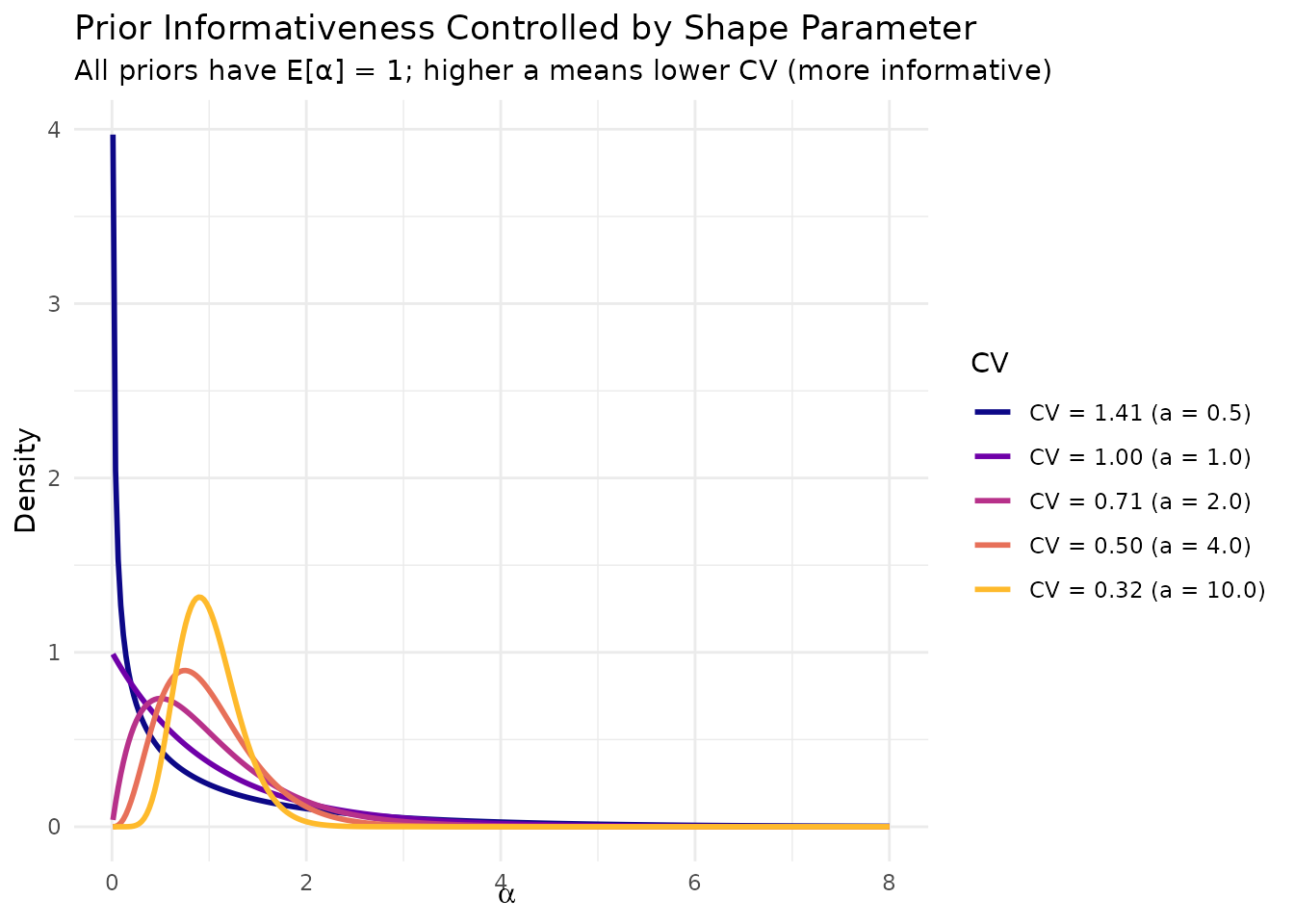
Different levels of informativeness in the α prior, controlled by the shape parameter a.
4. Weight Distribution Diagnostics
The weight diagnostics are crucial for detecting unintended prior
behavior. The DPprior package provides comprehensive diagnostics for the
first size-biased stick
(historically named w1 in helper functions).
4.1 Understanding
Recall from the Dual-Anchor vignette that under Sethuraman’s stick-breaking representation:
The quantity has a natural interpretation: it is the proportion of the cluster containing a randomly selected observation. If is high, a random observation is likely to belong to a cluster containing more than half of all observations.
4.2 Accessing Weight Diagnostics
wsb <- diag$diagnostics$weights
wsb_median <- quantile_w1(
  0.5, fit$parameters$a, fit$parameters$b
)
wsb_tail <- vapply(
  c(0.5, 0.9), prob_wsb_exceeds, numeric(1),
  a = fit$parameters$a, b = fit$parameters$b
)
names(wsb_tail) <- c("threshold_0.5", "threshold_0.9")
cat("Weight distribution summary:\n")
#> Weight distribution summary:
cat("  E[W_SB] =", round(wsb$mean, 4), "\n")
#>   E[W_SB] = 0.5014
cat("  Median(W_SB) =", round(wsb_median, 4), "\n")
#>   Median(W_SB) = 0.4784

cat("\nNamed W_SB tail probabilities from the closed-form helper:\n")
#>
#> Named W_SB tail probabilities from the closed-form helper:
print(wsb_tail)
#> threshold_0.5 threshold_0.9
#>     0.4814780     0.1633817
cat("\nW_SB diagnostic status fields:\n")
#>
#> W_SB diagnostic status fields:
print(wsb[c("status", "usable", "verified", "message")])
#> $status
#> [1] "converged"
#>
#> $usable
#> [1] TRUE
#>
#> $verified
#> [1] TRUE
#>
#> $<NA>
#> NULL
Canonical diagnostics do not substitute a
value for
.
A
warning policy is retained as outcome = "indeterminate"
with basis = "backend_unavailable" unless an independently
authorized backend is available. Certified upper-bound constraints
belong to the separate wmax_tail_upper hard-dual route.
4.3 Closed-Form Calculations
All diagnostics are computed using closed-form expressions (derived in Lee, 2026, following Vicentini & Jermyn, 2025):
CDF:
Quantile function:
First-size-biased-weight tail probability:
You can access these functions directly:
a <- fit$parameters$a
b <- fit$parameters$b

# Direct computation of tail probabilities
cat("Direct computation of P(W_SB > t):\n")
#> Direct computation of P(W_SB > t):
for (t in c(0.3, 0.5, 0.7, 0.9)) {
  p <- prob_wsb_exceeds(t, a, b)
  cat(sprintf("  P(W_SB > %.1f) = %.4f\n", t, p))
}
#>   P(W_SB > 0.3) = 0.6646
#>   P(W_SB > 0.5) = 0.4815
#>   P(W_SB > 0.7) = 0.3200
#>   P(W_SB > 0.9) = 0.1634

# Quantiles
cat("\nQuantiles of W_SB distribution:\n")
#>
#> Quantiles of W_SB distribution:
for (q in c(0.25, 0.5, 0.75, 0.95)) {
  x <- quantile_w1(q, a, b)
  cat(sprintf("  %d%% quantile: %.4f\n", round(100*q), x))
}
#>   25% quantile: 0.2162
#>   50% quantile: 0.4784
#>   75% quantile: 0.7911
#>   95% quantile: 0.9954
5. Explicit Estimand-Specific Warning Policies
DPprior does not assign an ambiguous LOW/MODERATE/HIGH category. A
warning policy must name the estimand ("W_SB" or
"W_max"), mass threshold, comparison direction, and action
threshold.
5.1 Separate the Mass Threshold from the Action Threshold
For example, the policy below asks whether exceeds 0.40. The two 0.5 and 0.40 values answer different questions and are recorded separately.
warning_policy <- list(
  estimand = "W_SB",
  direction = "above",
  weight_threshold = 0.5,
  action_threshold = 0.40
)
5.2 Enabling an Explicit Warning Policy
You can enable automatic warnings during fitting:
# A prior with a predeclared W_SB policy
target_risky <- DPprior_target_K(J = 50, mu_K = 2, var_K = 2)
fit_risky <- DPprior_fit(
  J = 50, target_K = target_risky,
  warning_policy = list(
    estimand = "W_SB", direction = "above",
    weight_threshold = 0.5, action_threshold = 0.40
  )
)
#> Warning: Explicit W_SB policy triggered: P(W_SB > 0.5) is 0.851149 against
#> action threshold 0.4.
The warning reports the named estimand and exact policy comparison. It does not claim that is the largest weight.
5.3 Reviewing the Policy Record
You can also review the named policy record in the diagnostic object:
diag_risky <- DPprior_diagnostics(
  fit_risky,
  warning_policy = list(
    estimand = "W_SB", direction = "above",
    weight_threshold = 0.5, action_threshold = 0.40
  )
)
#> Warning: Explicit W_SB policy triggered: P(W_SB > 0.5) is 0.851149 and the
#> requested comparison is 'above' action threshold 0.4.

cat("Named policy record:\n")
#> Named policy record:
policy_record <- diag_risky$diagnostics$policy_results[[1]]
print(policy_record)
#> $estimand
#> [1] "W_SB"
#>
#> $direction
#> [1] "above"
#>
#> $threshold
#> [1] 0.4
#>
#> $value
#> [1] 0.8511488
#>
#> $lower
#> NULL
#>
#> $upper
#> NULL
#>
#> $outcome
#> [1] "triggered"
#>
#> $basis
#> [1] "exact_tail_probability"
cat("  P(W_SB > 0.5) =",
    round(policy_record$value, 4), "\n")
#>   P(W_SB > 0.5) = 0.8511
5.4 Interpreting a Triggered Policy
A triggered policy means the named comparison was met. For the example above, the exact tail probability exceeded the predeclared 0.40 action threshold. This may or may not be appropriate depending on your application:
When a large tail probability might be appropriate:
- You genuinely expect most data to fall into one dominant group
- You are modeling rare events where most observations are “baseline”
- You have strong prior evidence of an unbalanced partition
When a large tail probability is likely unintended:
- You expect roughly equal-sized clusters
- You think “ clusters” should mean roughly balanced groups
- You are doing exploratory clustering without strong prior expectations
5.5 Responding to a Triggered Policy
If a predeclared weight policy triggers and that behavior is unintended, you have several options:
- Increase : Expecting more clusters typically reduces the tail probability
- Decrease : More certainty about cluster count can help
- Use dual-anchor elicitation: Directly constrain weight behavior
We will demonstrate option 3 in Section 7.
6. Visualizing Diagnostics
The DPprior package provides several visualization functions for understanding your prior.
6.1 The Complete Dashboard
The plot() method for a DPprior_fit object
creates a comprehensive four-panel dashboard:
target_K <- DPprior_target_K(J = 50, mu_K = 5, var_K = 8)
fit <- DPprior_fit(
  J = 50, target_K = target_K, check_diagnostics = FALSE
)
plot(fit)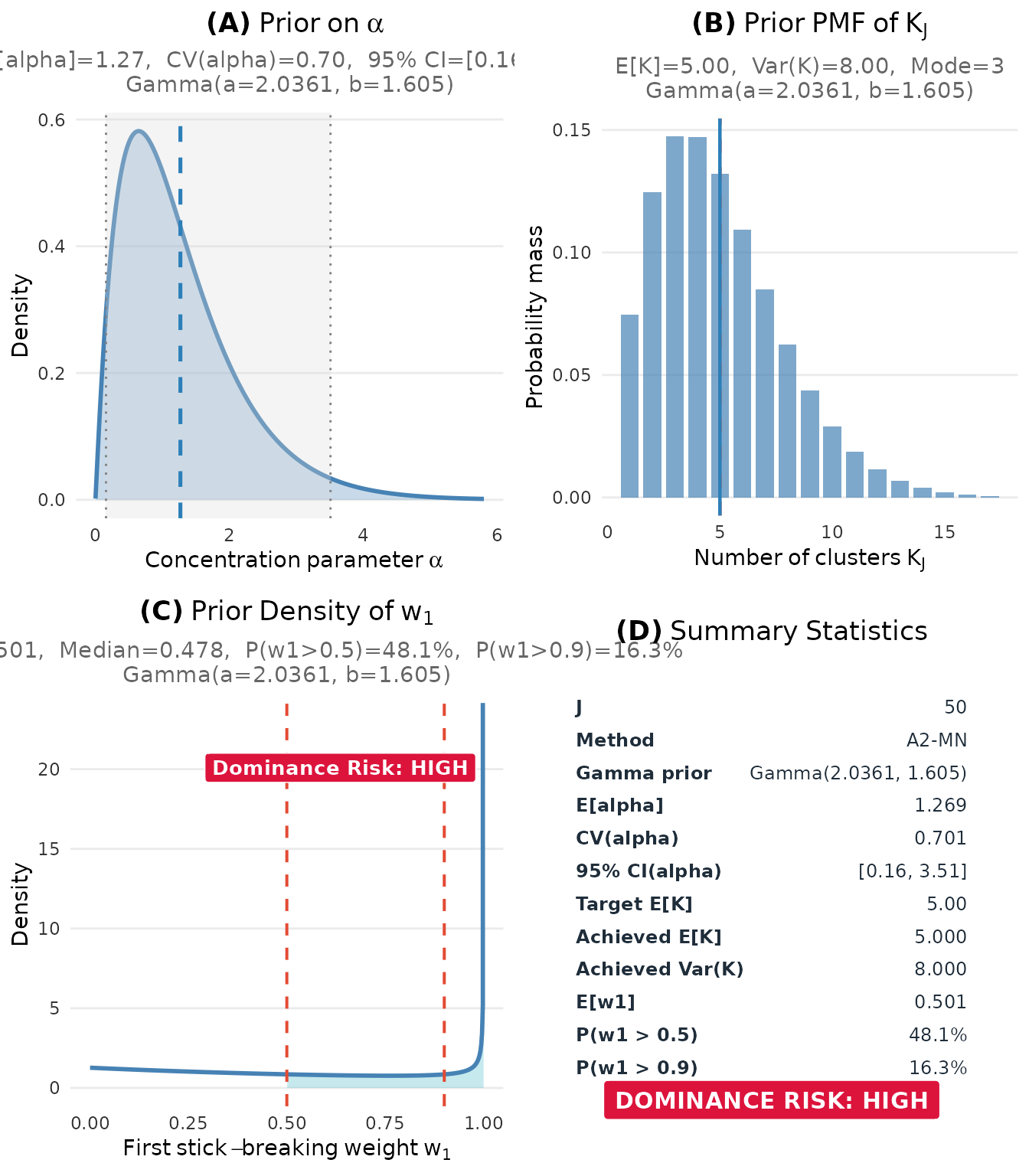
Complete diagnostic dashboard showing all key prior characteristics.
#> TableGrob (2 x 2) "dpprior_dashboard": 4 grobs
#>   z     cells              name           grob
#> 1 1 (1-1,1-1) dpprior_dashboard gtable[layout]
#> 2 2 (2-2,1-1) dpprior_dashboard gtable[layout]
#> 3 3 (1-1,2-2) dpprior_dashboard gtable[layout]
#> 4 4 (2-2,2-2) dpprior_dashboard gtable[layout]
6.2 Individual Diagnostic Plots
For more focused analysis, you can create individual plots:
# Alpha prior density
plot_alpha_prior(fit)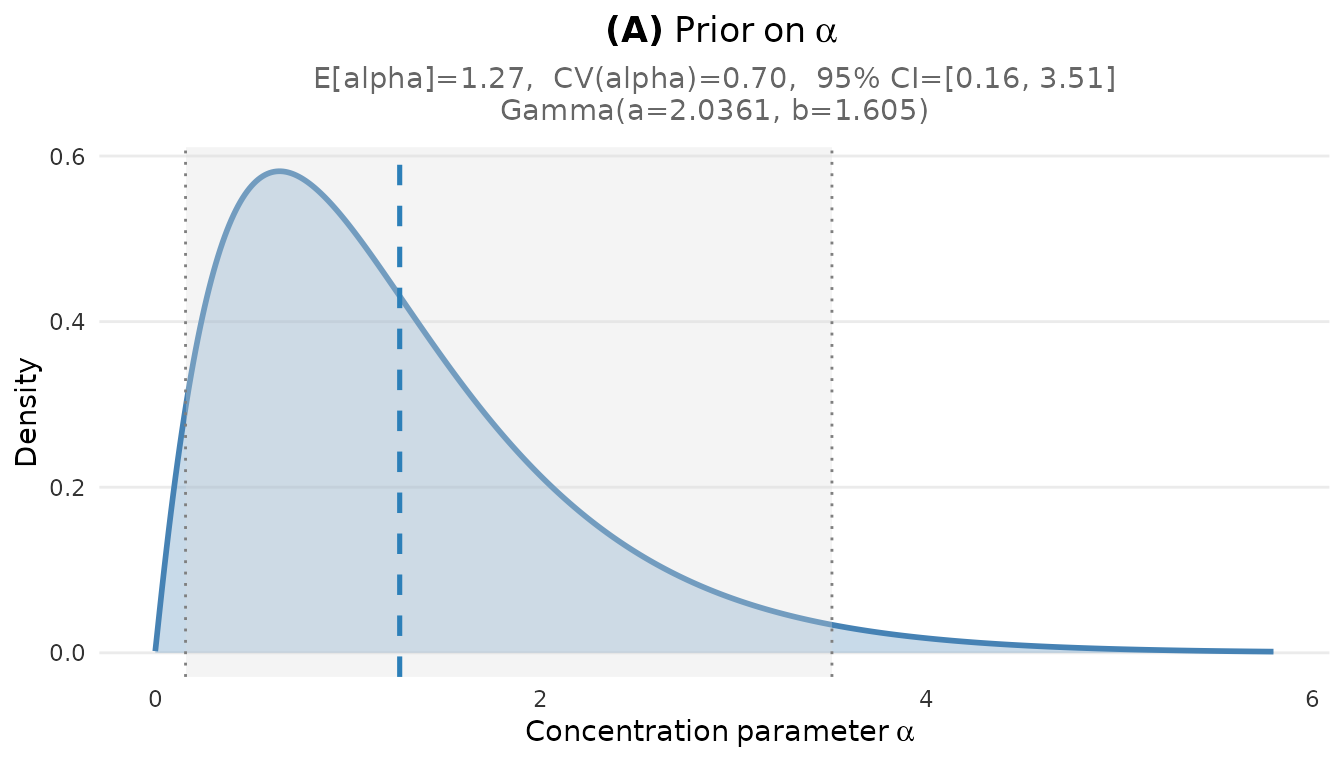
Prior density for the concentration parameter alpha.
# K marginal PMF
plot_K_prior(fit)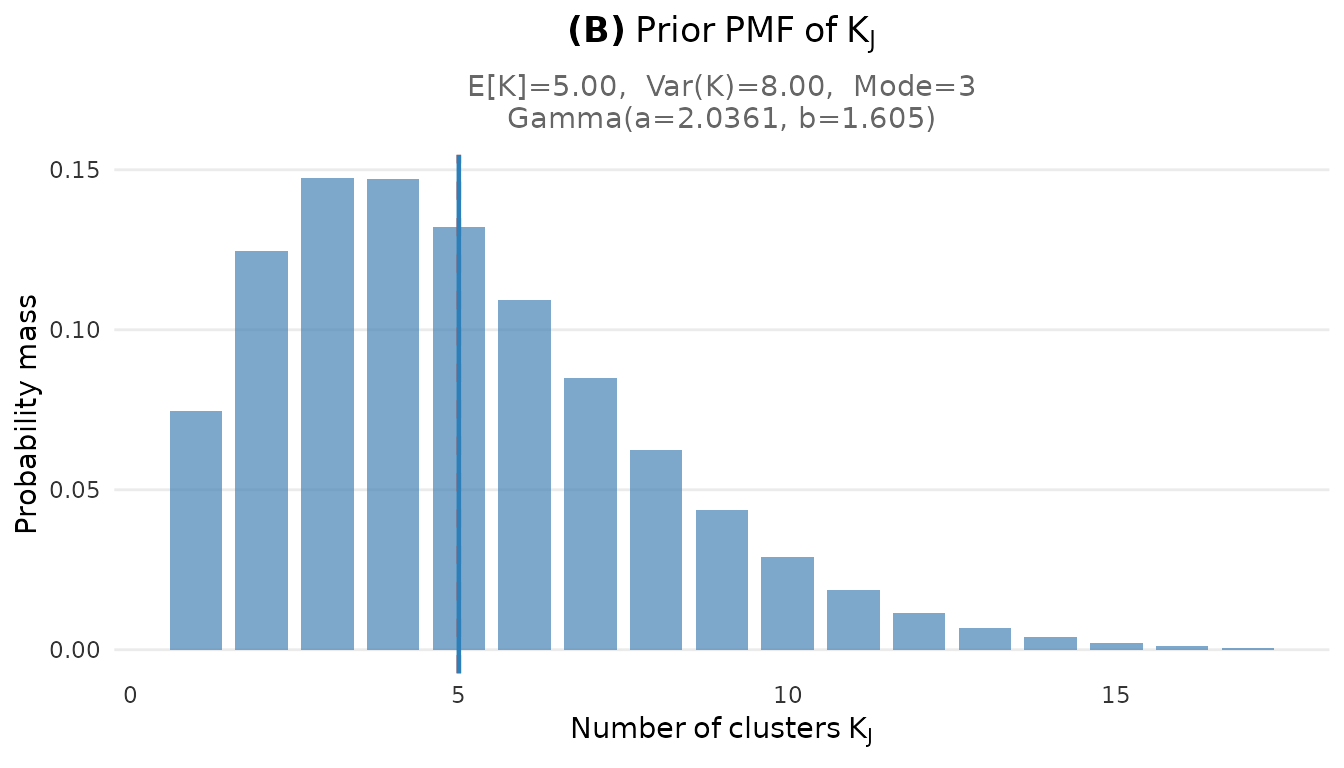
Marginal PMF of the number of clusters K.
# First-size-biased-weight distribution with reviewed mass thresholds
plot_w1_prior(fit)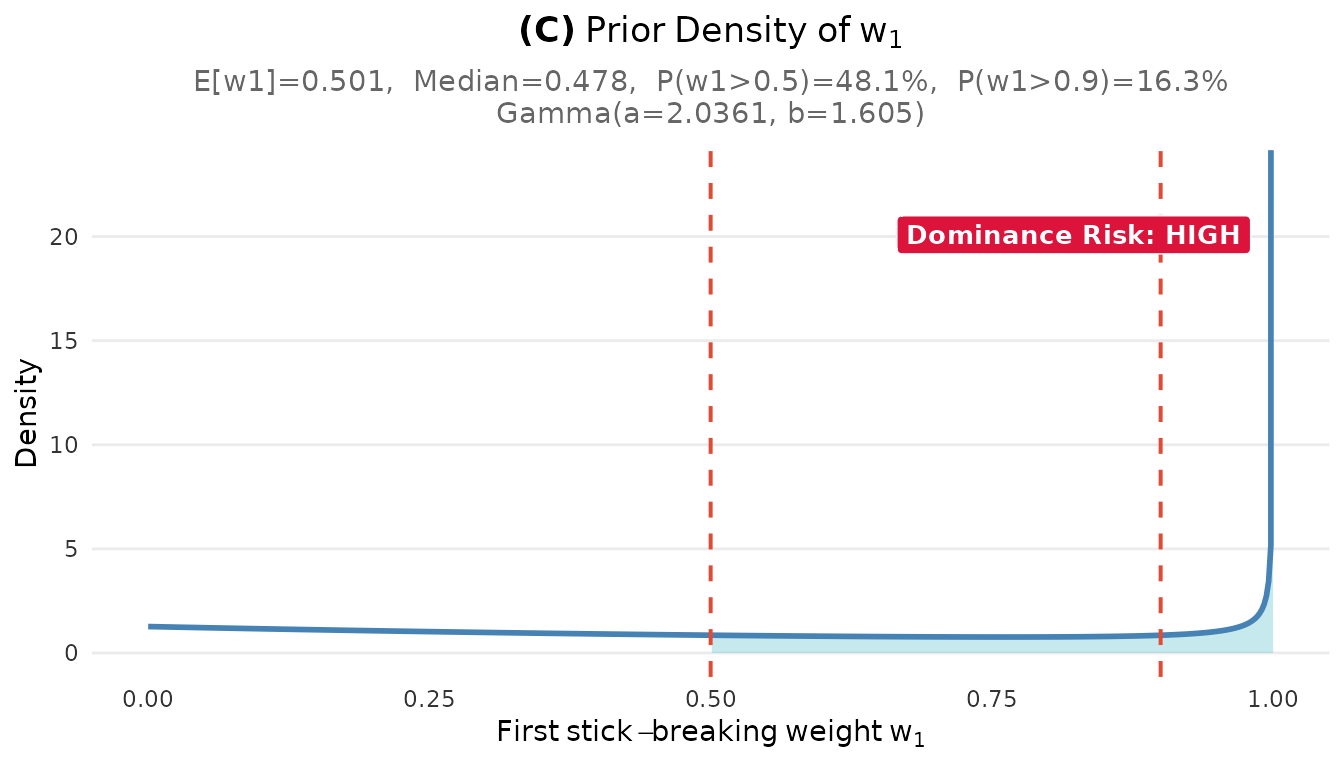
Distribution of the first size-biased weight W_SB.
6.3 Comparing Multiple Priors
When considering different prior specifications, you can visualize them side by side:
comparison_targets <- list(
  "Low uncertainty (var_K = 6)" =
    DPprior_target_K(J = 50, mu_K = 5, var_K = 6),
  "Medium uncertainty (var_K = 10)" =
    DPprior_target_K(J = 50, mu_K = 5, var_K = 10),
  "High uncertainty (var_K = 20)" =
    DPprior_target_K(J = 50, mu_K = 5, var_K = 20)
)
fits <- lapply(comparison_targets, function(target_K) {
  DPprior_fit(J = 50, target_K = target_K, check_diagnostics = FALSE)
})

# Compute log Stirling numbers for efficiency
logS <- compute_log_stirling(50)

# Build comparison data
k_df <- do.call(rbind, lapply(names(fits), function(nm) {
  fit <- fits[[nm]]
  pmf <- pmf_K_marginal(
    50, fit$parameters$a, fit$parameters$b, logS = logS
  )
  data.frame(
    K = seq_along(pmf) - 1,  # pmf_K_marginal returns k=0,...,J
    probability = pmf,
    Prior = nm
  )
}))
k_df <- k_df[k_df$K >= 1, ]  # Remove k=0
k_df$Prior <- factor(k_df$Prior, levels = names(fits))

# Plot
ggplot(k_df[k_df$K <= 20, ], aes(x = K, y = probability, color = Prior)) +
  geom_point(size = 2) +
  geom_line(linewidth = 0.8) +
  scale_color_manual(values = palette_3) +
  labs(
    x = expression(Number~of~clusters~K[J]),
    y = "Probability",
    title = "Prior PMF of K Under Different Variance Assumptions",
    subtitle = "All priors have μ_K = 5; higher variance spreads the distribution"
  ) +
  theme_minimal() +
  theme(legend.position = "bottom", legend.title = element_blank())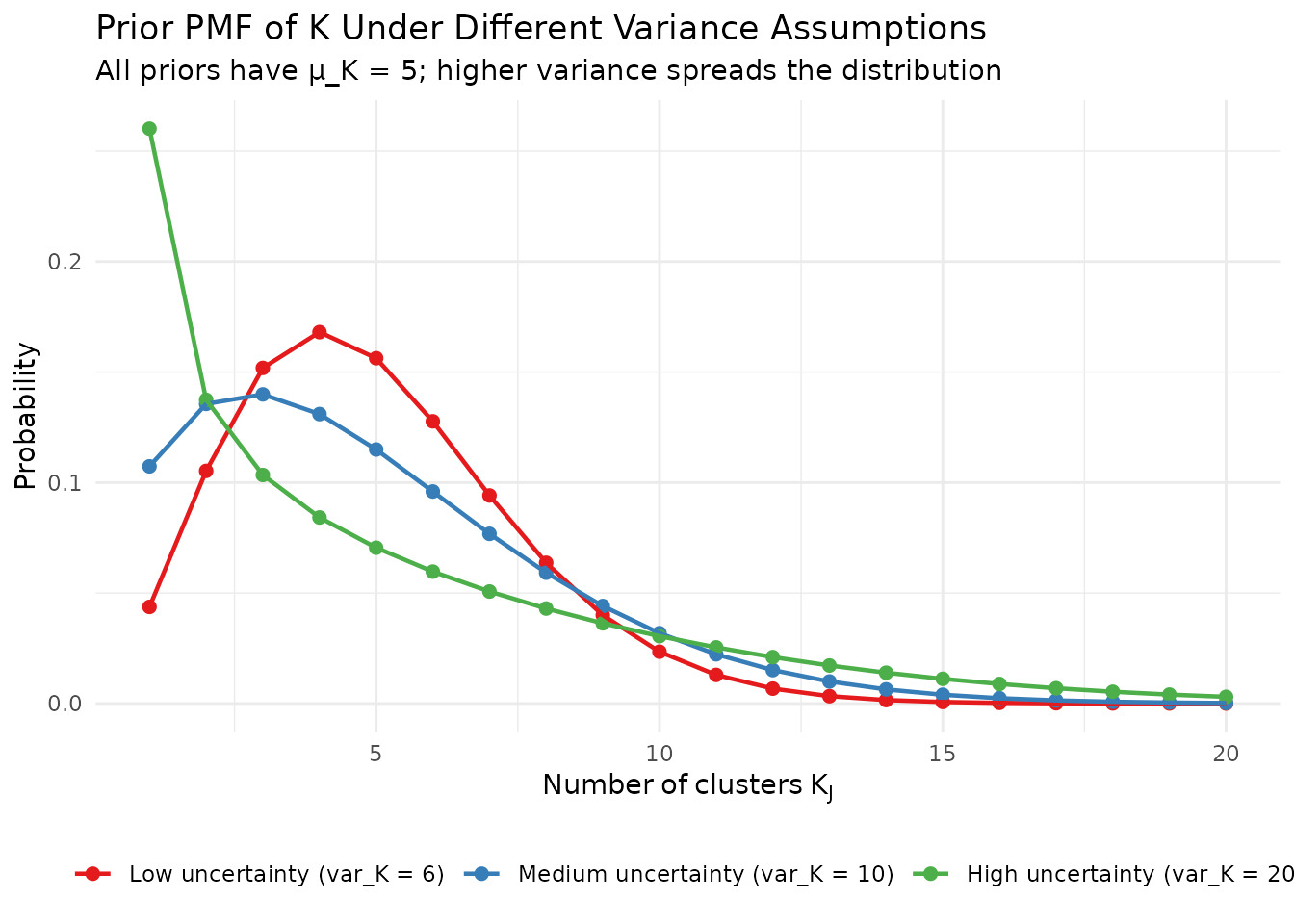
Comparison of K distributions under different variance assumptions.
7. Diagnostic-Driven Refinement
The diagnostic tools enable an iterative workflow for refining your prior until it matches your intentions across all dimensions.
7.1 The Refinement Workflow
The recommended workflow is:
-
Start with K-only calibration: Build
DPprior_target_K()and pass it unchanged toDPprior_fit() - Run diagnostics: Check , , and explicitly named weight estimands
- Identify mismatches: Does any aspect of the prior surprise you?
- Refine: Adjust parameters or use dual-anchor if needed
- Repeat: Until all aspects of the prior match your intentions
7.2 Complete Example: From Problem to Solution
Let us walk through a complete example of diagnostic-driven refinement.
Step 1: Initial K-only prior
# Researcher expects ~5 clusters with moderate uncertainty
target_K <- DPprior_target_K(J = 50, mu_K = 5, var_K = 8)
fit1 <- DPprior_fit(
  J = 50, target_K = target_K, method = "A2-MN",
  check_diagnostics = FALSE
)

cat("Step 1: Initial K-only prior\n")
#> Step 1: Initial K-only prior
cat("Gamma(a =", round(fit1$parameters$a, 4), ", b =",
    round(fit1$parameters$b, 4), ")\n\n")
#> Gamma(a = 2.0361 , b = 1.6051 )
Step 2: Run diagnostics
diag1 <- DPprior_diagnostics(fit1)
K1 <- diag1$diagnostics$K
wsb1 <- diag1$diagnostics$weights
wsb1_tail <- prob_wsb_exceeds(
  0.5, fit1$parameters$a, fit1$parameters$b
)

cat("Step 2: Diagnostics reveal...\n")
#> Step 2: Diagnostics reveal...
cat("  K behavior: E[K] =", round(K1$mean, 2),
    ", Var(K) =", round(K1$variance, 2), "✓\n")
#>   K behavior: E[K] = 5 , Var(K) = 8 ✓
cat("  Weight behavior: P(W_SB > 0.5) =",
    round(wsb1_tail, 3), "\n")
#>   Weight behavior: P(W_SB > 0.5) = 0.481
print(diag1[c("status", "usable", "verified", "message")])
#> $status
#> [1] "converged"
#>
#> $usable
#> [1] TRUE
#>
#> $verified
#> [1] TRUE
#>
#> $message
#> [1] "All canonical diagnostic components passed independent selected-versus-verifier checks."
Step 3: Identify the problem
plot_w1_prior(fit1)#> Step 3: Problem identification
#> The researcher wanted: ~5 clusters with balanced weights
#> The prior implies: ~5 clusters but a large W_SB tail probability
#> P(W_SB > 0.5) = 48 % is higher than expected for 'balanced' clusters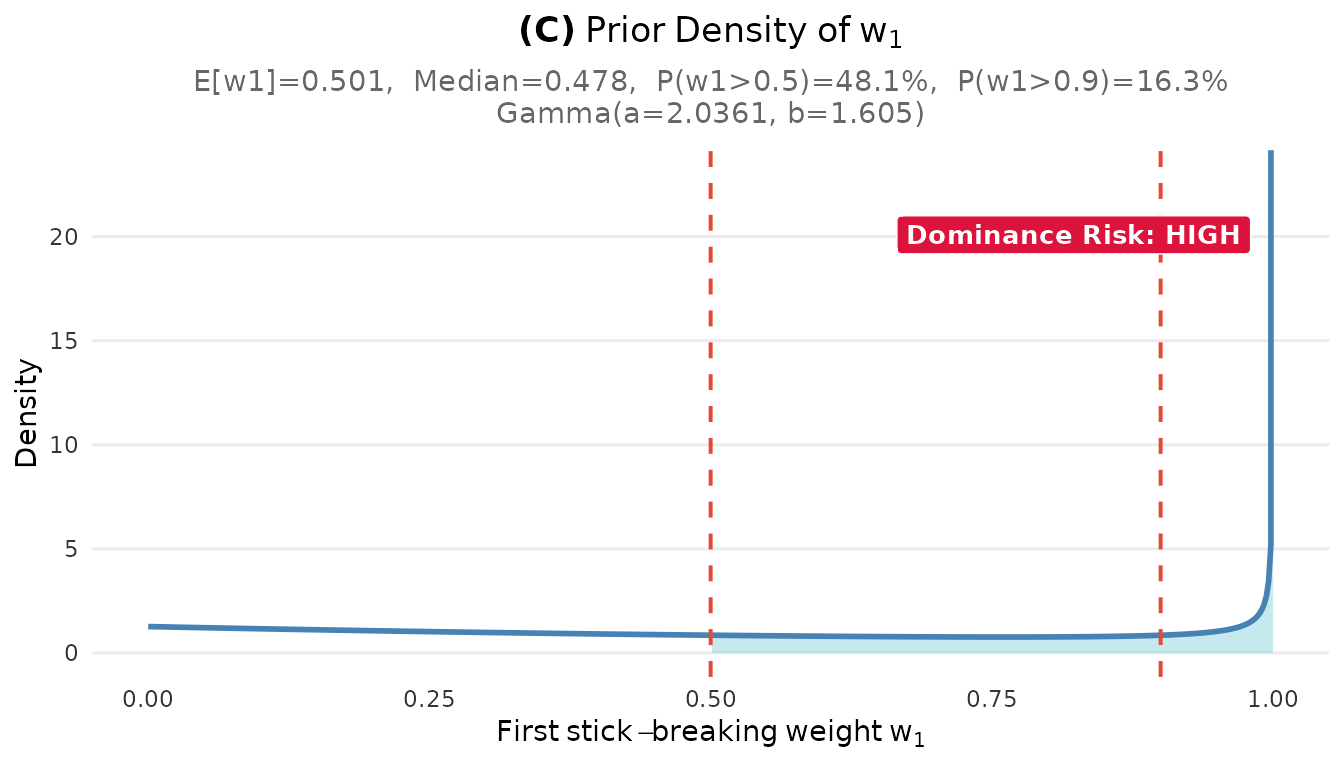
The K-only prior has a larger-than-intended W_SB tail probability.
Step 4: Apply dual-anchor refinement
cat("Step 4: Dual-anchor refinement\n")
#> Step 4: Dual-anchor refinement
cat("  Adding constraint: P(W_SB > 0.5) ≤ 0.25\n\n")
#>   Adding constraint: P(W_SB > 0.5) ≤ 0.25

fit2 <- DPprior_dual_hard(
  fit = fit1,
  constraint = list(
    metric = "wsb_tail", threshold = 0.5,
    relation = "<=", bound = 0.25
  )
)

cat("Refined prior: Gamma(a =", round(fit2$parameters$a, 4), ", b =",
    round(fit2$parameters$b, 4), ")\n")
#> Refined prior: Gamma(a = 8.0042 , b = 3.6655 )
cat("Constraint verified:", fit2$constraint$satisfied, "\n")
#> Constraint verified: TRUE
fit2[c("status", "usable", "verified", "message")]
#> $status
#> [1] "boundary"
#>
#> $usable
#> [1] TRUE
#>
#> $verified
#> [1] TRUE
#>
#> $message
#> [1] "Hard inequality solution passed verification with the constraint active."
Step 5: Read the verified hard-fit evidence
K2 <- fit2$achieved$K
wsb2_mean <- mean_w1(fit2$parameters$a, fit2$parameters$b)
wsb2_tail <- fit2$achieved$weight$value

cat("Step 5: Post-refinement evidence\n")
#> Step 5: Post-refinement evidence
cat("  K behavior: E[K] =", round(K2$mean, 2),
    " (shifted from target of 5)\n")
#>   K behavior: E[K] = 7.33  (shifted from target of 5)
cat("  Weight behavior: P(W_SB > 0.5) =",
    round(wsb2_tail, 3), "✓\n")
#>   Weight behavior: P(W_SB > 0.5) = 0.25 ✓
print(fit2[c("status", "usable", "verified", "message")])
#> $status
#> [1] "boundary"
#>
#> $usable
#> [1] TRUE
#>
#> $verified
#> [1] TRUE
#>
#> $message
#> [1] "Hard inequality solution passed verification with the constraint active."
Step 6: Visualize the improvement
# Compare w1 distributions
x_grid <- seq(0.001, 0.999, length.out = 500)
w1_df <- data.frame(
  x = rep(x_grid, 2),
  density = c(
    density_w1(x_grid, fit1$parameters$a, fit1$parameters$b),
    density_w1(x_grid, fit2$parameters$a, fit2$parameters$b)
  ),
  Prior = rep(c("K-only (before)", "Dual-anchor (after)"), each = length(x_grid))
)
w1_df$Prior <- factor(w1_df$Prior, levels = c("K-only (before)", "Dual-anchor (after)"))

# Cap extreme densities for visualization
w1_df$density[w1_df$density > 10] <- NA

ggplot(w1_df, aes(x = x, y = density, color = Prior)) +
  geom_line(linewidth = 1, na.rm = TRUE) +
  geom_vline(xintercept = 0.5, linetype = "dashed", color = "gray50") +
  scale_color_manual(values = c("#E41A1C", "#377EB8")) +
  annotate("text", x = 0.52, y = 5, label = "P(W_SB > 0.5)", hjust = 0, color = "gray40") +
  labs(
    x = expression(w[1]),
    y = "Density",
    title = "Weight Distribution: Before and After Dual-Anchor Refinement",
    subtitle = sprintf("P(W_SB > 0.5): Before = %.0f%%, After = %.0f%%",
                       100 * wsb1_tail,
                       100 * wsb2_tail)
  ) +
  coord_cartesian(xlim = c(0, 1), ylim = c(0, 6)) +
  theme_minimal() +
  theme(legend.position = "bottom", legend.title = element_blank())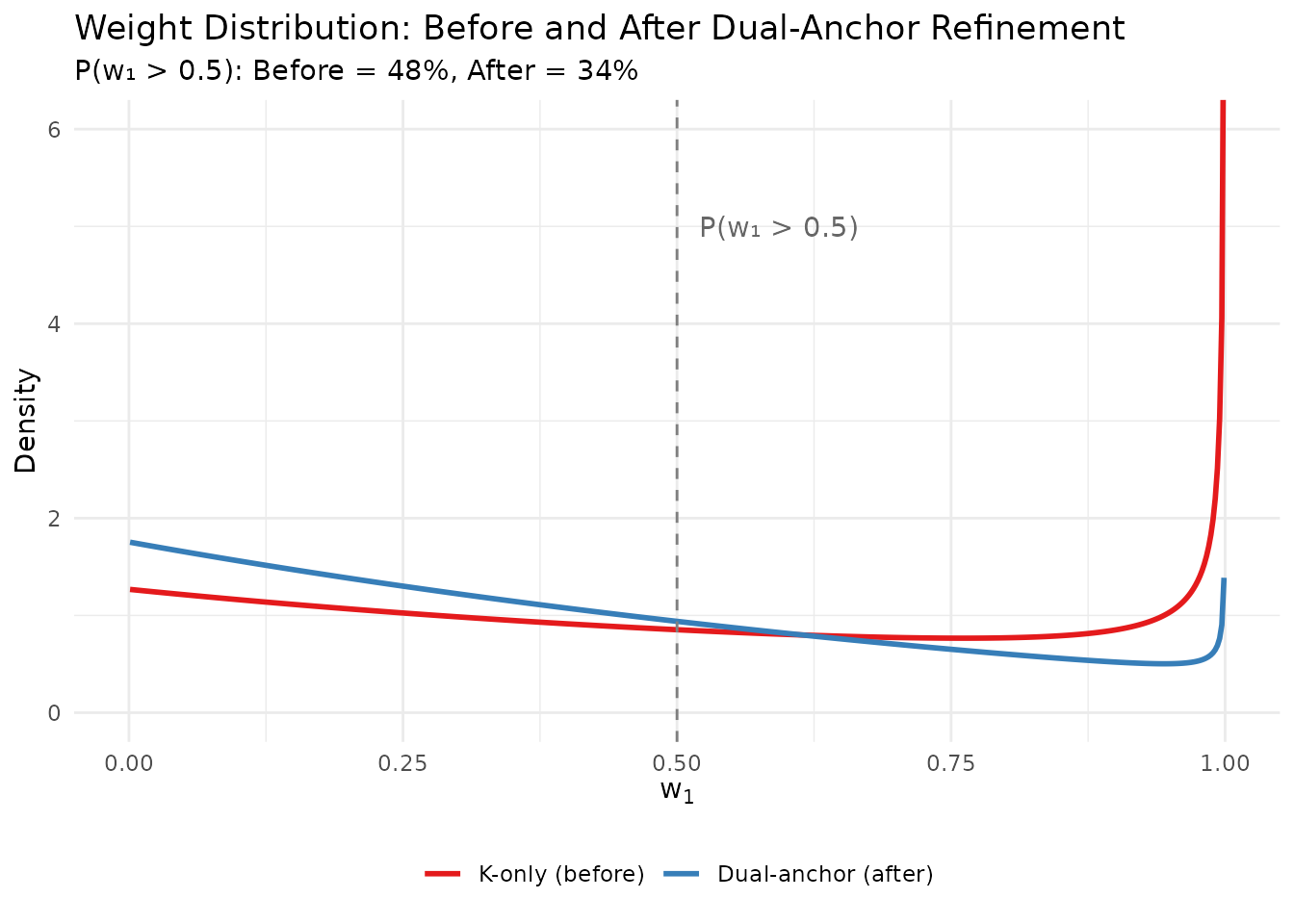
Comparison of weight distributions before and after dual-anchor refinement.
7.3 Summary of the Refinement
comparison_df <- data.frame(
  Metric = c(
    "Gamma(a, b)", "E[K]", "Var(K)", "E[W_SB]",
    "P(W_SB > 0.5)", "Diagnostic status"
  ),
  Before = c(
    sprintf("(%.3f, %.3f)", fit1$parameters$a, fit1$parameters$b),
    sprintf("%.2f", K1$mean),
    sprintf("%.2f", K1$variance),
    sprintf("%.3f", wsb1$mean),
    sprintf("%.1f%%", 100 * wsb1_tail),
    diag1$status
  ),
  After = c(
    sprintf("(%.3f, %.3f)", fit2$parameters$a, fit2$parameters$b),
    sprintf("%.2f", K2$mean),
    sprintf("%.2f", K2$variance),
    sprintf("%.3f", wsb2_mean),
    sprintf("%.1f%%", 100 * wsb2_tail),
    fit2$status
  )
)

knitr::kable(
  comparison_df,
  col.names = c("Metric", "K-only", "Dual-anchor"),
  caption = "Comparison of prior specifications before and after dual-anchor refinement"
)| Metric | K-only | Dual-anchor |
|---|---|---|
| Gamma(a, b) | (2.036, 1.605) | (8.004, 3.666) |
| E[K] | 5.00 | 7.33 |
| Var(K) | 8.00 | 7.41 |
| E[W_SB] | 0.501 | 0.333 |
| P(W_SB > 0.5) | 48.1% | 25.0% |
| Diagnostic status | converged | boundary |
The trade-off is clear: the refined prior has slightly higher E[K] than the original target of 5, but now has appropriately controlled weight behavior. This is the Pareto trade-off that the dual-anchor framework makes explicit.
8. Comparative Diagnostics
When evaluating multiple candidate priors, comparative diagnostics help you understand the trade-offs.
8.1 Comparing Multiple Priors
# Define three candidate priors
candidate_targets <- list(
  "Conservative" = DPprior_target_K(J = 50, mu_K = 5, var_K = 6),
  "Moderate" = DPprior_target_K(J = 50, mu_K = 5, var_K = 10),
  "Diffuse" = DPprior_target_K(J = 50, mu_K = 5, var_K = 20)
)
candidates <- lapply(candidate_targets, function(target_K) {
  DPprior_fit(J = 50, target_K = target_K, check_diagnostics = FALSE)
})

# Compute diagnostics for each
comp_results <- lapply(names(candidates), function(nm) {
  fit <- candidates[[nm]]
  # Retain a complete review object if fixed-order refinement does not verify.
  # Such a row remains unusable and must not be promoted to a scientific result.
  diag <- DPprior_diagnostics(fit, allow_approximate = TRUE)
  K_diag <- diag$diagnostics$K
  wsb_diag <- diag$diagnostics$weights
  data.frame(
    Prior = nm,
    a = round(fit$parameters$a, 3),
    b = round(fit$parameters$b, 3),
    E_K = round(K_diag$mean, 2),
    Var_K = round(K_diag$variance, 2),
    E_w1 = round(wsb_diag$mean, 3),
    P_WSB_gt_50 = sprintf(
      "%.1f%%", 100 * prob_wsb_exceeds(
        0.5, fit$parameters$a, fit$parameters$b
      )
    ),
    Status = diag$status,
    Usable = diag$usable,
    Verified = diag$verified,
    Message = diag$message
  )
})

comp_df <- do.call(rbind, comp_results)

knitr::kable(
  comp_df,
  col.names = c(
    "Prior", "a", "b", "E[K]", "Var(K)", "E[W_SB]",
    "P(W_SB>0.5)", "Status", "Usable", "Verified", "Message"
  ),
  caption = "Comparative diagnostics for three candidate priors"
)| Prior | a | b | E[K] | Var(K) | E[W_SB] | P(W_SB>0.5) | Status | Usable | Verified | Message |
|---|---|---|---|---|---|---|---|---|---|---|
| Conservative | 3.568 | 2.900 | 5 | 6 | 0.484 | 46.5% | converged | TRUE | TRUE | All canonical diagnostic components passed independent selected-versus-verifier checks. |
| Moderate | 1.408 | 1.077 | 5 | 10 | 0.518 | 49.7% | converged | TRUE | TRUE | All canonical diagnostic components passed independent selected-versus-verifier checks. |
| Diffuse | 0.518 | 0.341 | 5 | 20 | 0.585 | 56.3% | approximate | FALSE | FALSE | At least one canonical diagnostic component did not pass the fixed refinement contract. |
Any row with usable = FALSE is retained only for method
review; its numerical summaries are not an approved scientific
result.
8.2 Visualizing the Comparison
# Create comparison data for w1
w1_comp_df <- do.call(rbind, lapply(names(candidates), function(nm) {
  fit <- candidates[[nm]]
  x <- seq(0.001, 0.999, length.out = 300)
  d <- density_w1(x, fit$parameters$a, fit$parameters$b)
  d[d > 8] <- NA
  data.frame(x = x, density = d, Prior = nm)
}))
w1_comp_df$Prior <- factor(w1_comp_df$Prior, levels = names(candidates))

p1 <- ggplot(w1_comp_df, aes(x = x, y = density, color = Prior)) +
  geom_line(linewidth = 1, na.rm = TRUE) +
  geom_vline(xintercept = 0.5, linetype = "dashed", color = "gray60") +
  scale_color_manual(values = palette_3) +
  coord_cartesian(xlim = c(0, 1), ylim = c(0, 5)) +
  labs(x = expression(w[1]), y = "Density",
       title = expression("Prior on " * w[1])) +
  theme_minimal() +
  theme(legend.position = "bottom", legend.title = element_blank())

# Create comparison data for K
logS <- compute_log_stirling(50)
k_comp_df <- do.call(rbind, lapply(names(candidates), function(nm) {
  fit <- candidates[[nm]]
  pmf <- pmf_K_marginal(
    50, fit$parameters$a, fit$parameters$b, logS = logS
  )
  data.frame(k = seq_along(pmf) - 1, pmf = pmf, Prior = nm)
}))
k_comp_df <- k_comp_df[k_comp_df$k >= 1, ]
k_comp_df$Prior <- factor(k_comp_df$Prior, levels = names(candidates))

p2 <- ggplot(k_comp_df[k_comp_df$k <= 15, ],
             aes(x = k, y = pmf, color = Prior)) +
  geom_point(size = 2) +
  geom_line(linewidth = 0.8) +
  scale_color_manual(values = palette_3) +
  labs(x = expression(K[J]), y = "Probability",
       title = expression("Prior PMF of " * K[J])) +
  theme_minimal() +
  theme(legend.position = "bottom", legend.title = element_blank())

gridExtra::grid.arrange(p1, p2, ncol = 2)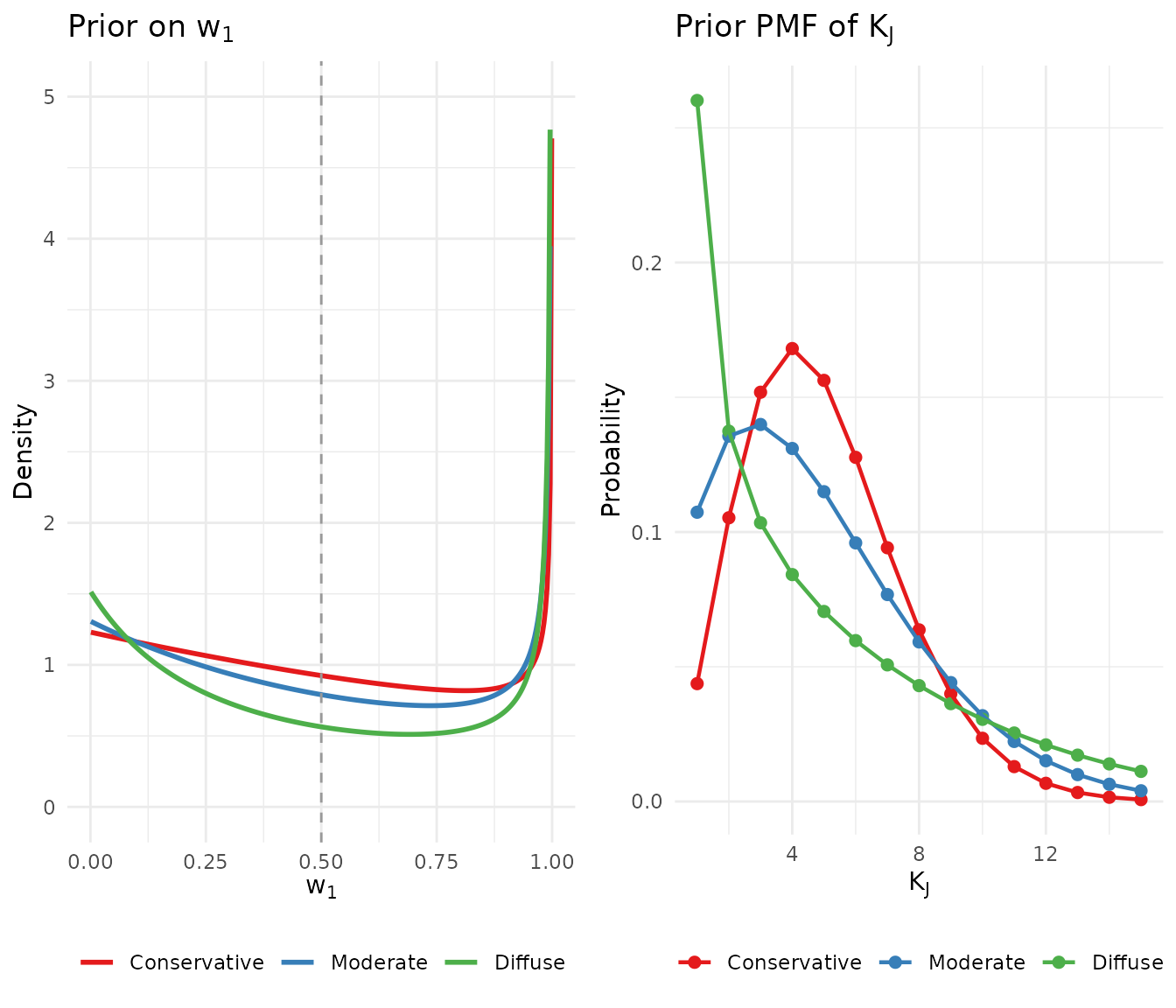
Comparison of three candidate priors across multiple dimensions.
Summary
| Diagnostic Aspect | What to Check | Concern If… |
|---|---|---|
| CV | diag$diagnostics$alpha$CV |
CV > 1 (very diffuse) or CV < 0.3 (very tight) without intention |
| E[K] | diag$diagnostics$K$mean |
Differs substantially from your target |
| Var(K) | diag$diagnostics$K$variance |
Differs substantially from your target or implied variance |
| P( > 0.5) | Explicit warning_policy record or
prob_wsb_exceeds()
|
Exceeds your predeclared action threshold |
| policy | diag$diagnostics$policy_results[[1]] |
An indeterminate/backend-unavailable result is reported as a point claim |
| Decision status | diag[c("status","usable","verified","message")] |
Approximation or failed verification is hidden |
Key Takeaways:
- Always run diagnostics after eliciting a prior, especially for weight-related quantities
- K-calibration is necessary but not sufficient: matching E[K] does not guarantee intuitive weight behavior
- Use an explicit estimand-specific warning policy to catch potential problems early
-
Apply
DPprior_dual_hard()when you need a verified inequality, orDPprior_dual_soft()when you intend a fixed-scale trade-off - Iterate until satisfied: prior elicitation is an iterative process
What’s Next?
Dual-Anchor Framework: Deep dive into controlling both cluster counts and weight behavior
Case Studies: Real-world examples of diagnostic-driven prior refinement
Theory Overview: Mathematical foundations of the diagnostic quantities
References
Lee, J., Che, J., Rabe-Hesketh, S., Feller, A., & Miratrix, L. (2025). Improving the estimation of site-specific effects and their distribution in multisite trials. Journal of Educational and Behavioral Statistics, 50(5), 731–764. https://doi.org/10.3102/10769986241254286
Vicentini, S., & Jermyn, I. H. (2025). Prior selection for the precision parameter of Dirichlet process mixture models. arXiv:2502.00864. https://doi.org/10.48550/arXiv.2502.00864
Sethuraman, J. (1994). A constructive definition of Dirichlet priors. Statistica Sinica, 4(2), 639–650.
For questions or feedback, please visit the GitHub repository.