Prior elicitation
We specify a Gamma hyperprior for the concentration parameter using shape \(a\) and rate \(b\), so that \(E(\alpha)=a/b\). The number \(J\) of exchangeable units is part of the specification. For example, a prior calibrated to give five clusters among 50 sites will generally imply a different count among 500 examinees.
Match the count judgment
The following commands fit a prior for \(J=50\), a target mean count of 5 and a target variance of 10:
Rscript 00_setup.R --profile calibration
Rscript calibration/01_count_calibration.R
At a fixed concentration parameter, the expected count is
\[E(K_J\mid\alpha)=\sum_{j=1}^{J}\frac{\alpha}{\alpha+j-1}.\]
We integrate the count moments over the Gamma hyperprior and choose \(a\) and \(b\) to match the two targets. Two-Stage Moment Matching (TSMM) uses an approximate solution as a starting value, then refines it using the exact finite-sample moments. In this example, the final values are approximately \((a,b)=(1.4082,1.0770)\).
The calibration script reports both stages and checks the final moments at a higher quadrature order. Numerical settings are collected in the policy file and applied by the calibration functions.
Examine the weights
Rscript calibration/02_weight_diagnostics.RThe size-biased weight is the population weight of the cluster containing a randomly selected unit. Under the Gamma hyperprior, its tail probability is
\[\Pr(W_{\mathrm{SB}}>t)=\left\{\frac{b}{b-\log(1-t)}\right\}^{a}.\]
This quantity describes a different selection of a cluster from choosing the largest population cluster. Both also differ from the largest observed allocation share, which depends on the finite sample. The weight script calculates these functionals and the bounds used to compare them.
Apply the Dual-Anchor procedure
Rscript calibration/03_dual_anchor.R
Rscript calibration/04_hard_and_failures.R
For the count-calibrated prior above, the probability that the size-biased weight exceeds one half is about .497. This exceeds the specified tolerance of .40. We therefore consider 29 values of the weight \(\lambda\) that controls the balance between count and weight losses. The loss scales are held fixed across these candidates.
We select the largest eligible \(\lambda\) for which the majority probability is at most .40. Eligibility requires an interior solution and successful numerical verification. The selected value is \(\lambda=.30\), with \((a,b)\approx(2.3158,1.4204)\) and a majority probability of about .398.
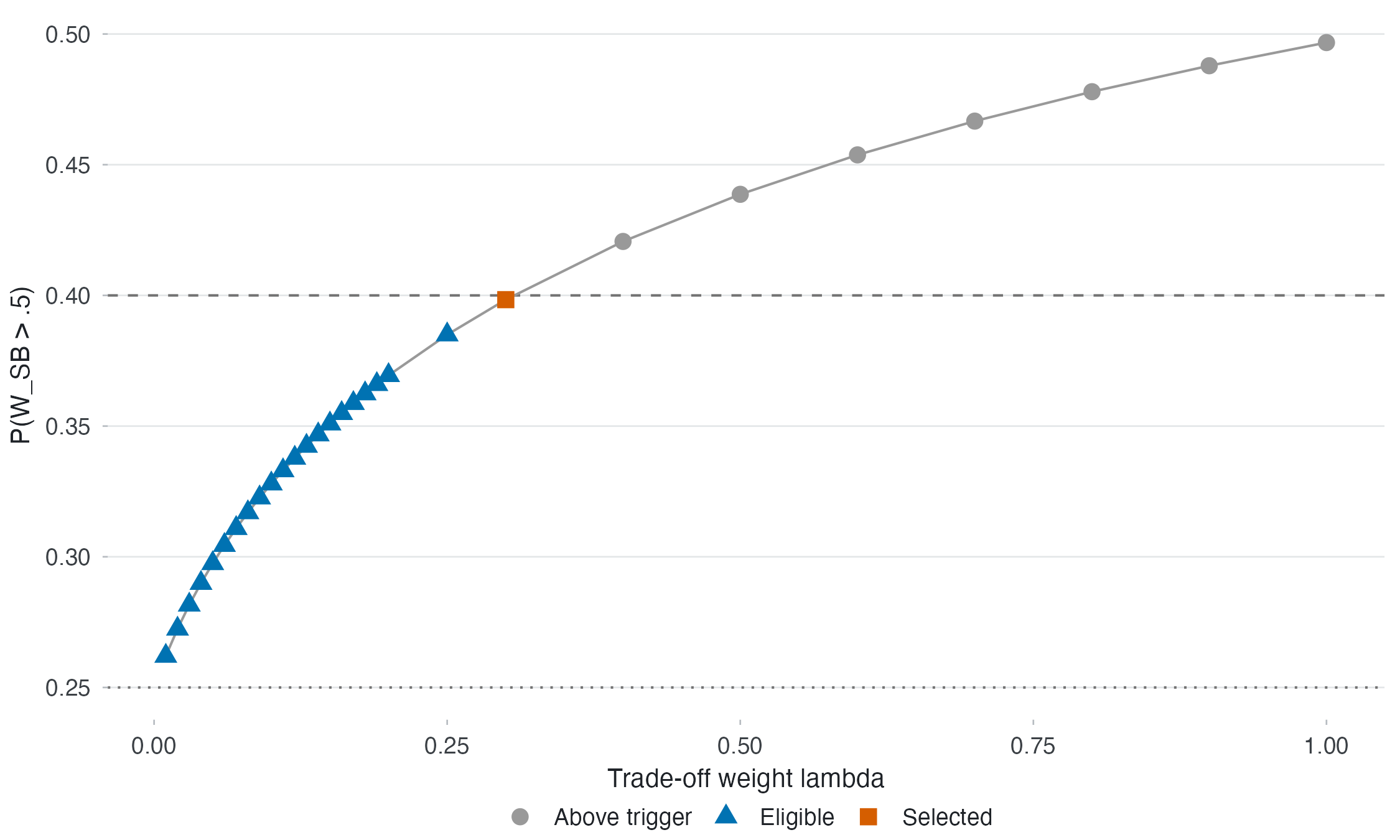
The weight loss uses .25 as a target, whereas .40 determines whether a candidate meets the stated tolerance. Requiring the probability to be at most .25 is a separate, more restrictive calculation; it produces a substantially larger expected count. The second script examines this constraint and cases in which no candidate is eligible. In the latter case, the procedure returns no prior.
Run calibration/05_confidence_levels.R to compare four confidence settings at \(J=100\). The standard figure build uses the supplied calibration results, so optimization need only be repeated when examining the elicitation itself.