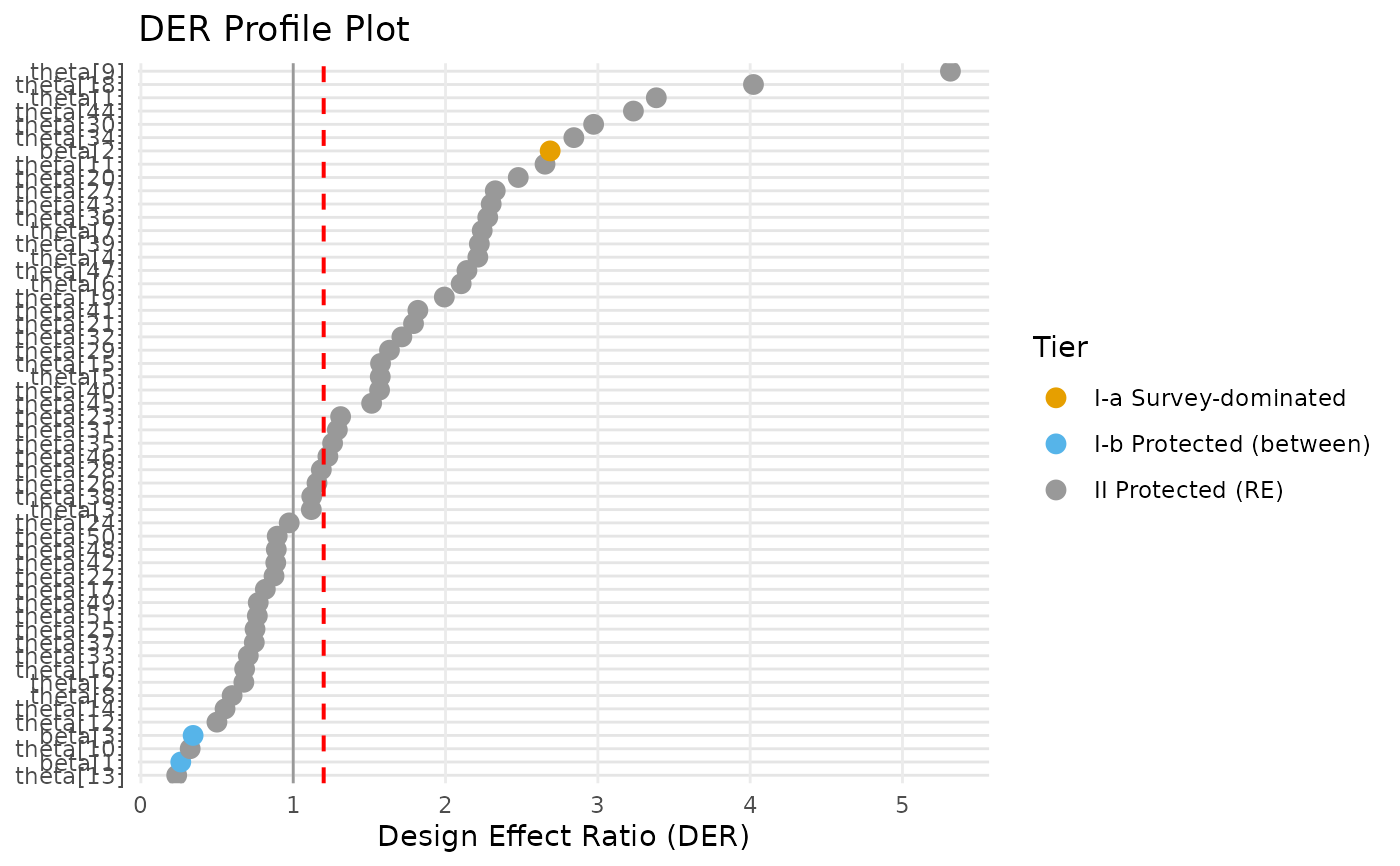
Provides the same functionality as plot.svyder() but
requires ggplot2 and always returns a ggplot object.
This is the preferred method when using ggplot2 directly.
Usage
autoplot.svyder(
  object,
  type = c("profile", "decomposition", "comparison"),
  ...
)References
Lee, J., Williams, M. R., & Savitsky, T. D. (2026). Design Effect Ratios for Bayesian Survey Models: A Diagnostic Framework for Identifying Survey-Sensitive Parameters. Journal of Survey Statistics and Methodology. Submitted.
See also
plot.svyder() for the generic plot method.
Other visualization:
plot.svyder()
Examples
data(nsece_demo)
result <- der_diagnose(
  nsece_demo$draws,
  y = nsece_demo$y, X = nsece_demo$X,
  group = nsece_demo$group, weights = nsece_demo$weights,
  cluster = nsece_demo$psu, family = "binomial",
  sigma_theta = nsece_demo$sigma_theta,
  param_types = nsece_demo$param_types
)
if (requireNamespace("ggplot2", quietly = TRUE)) {
  ggplot2::autoplot(result, type = "profile")
}