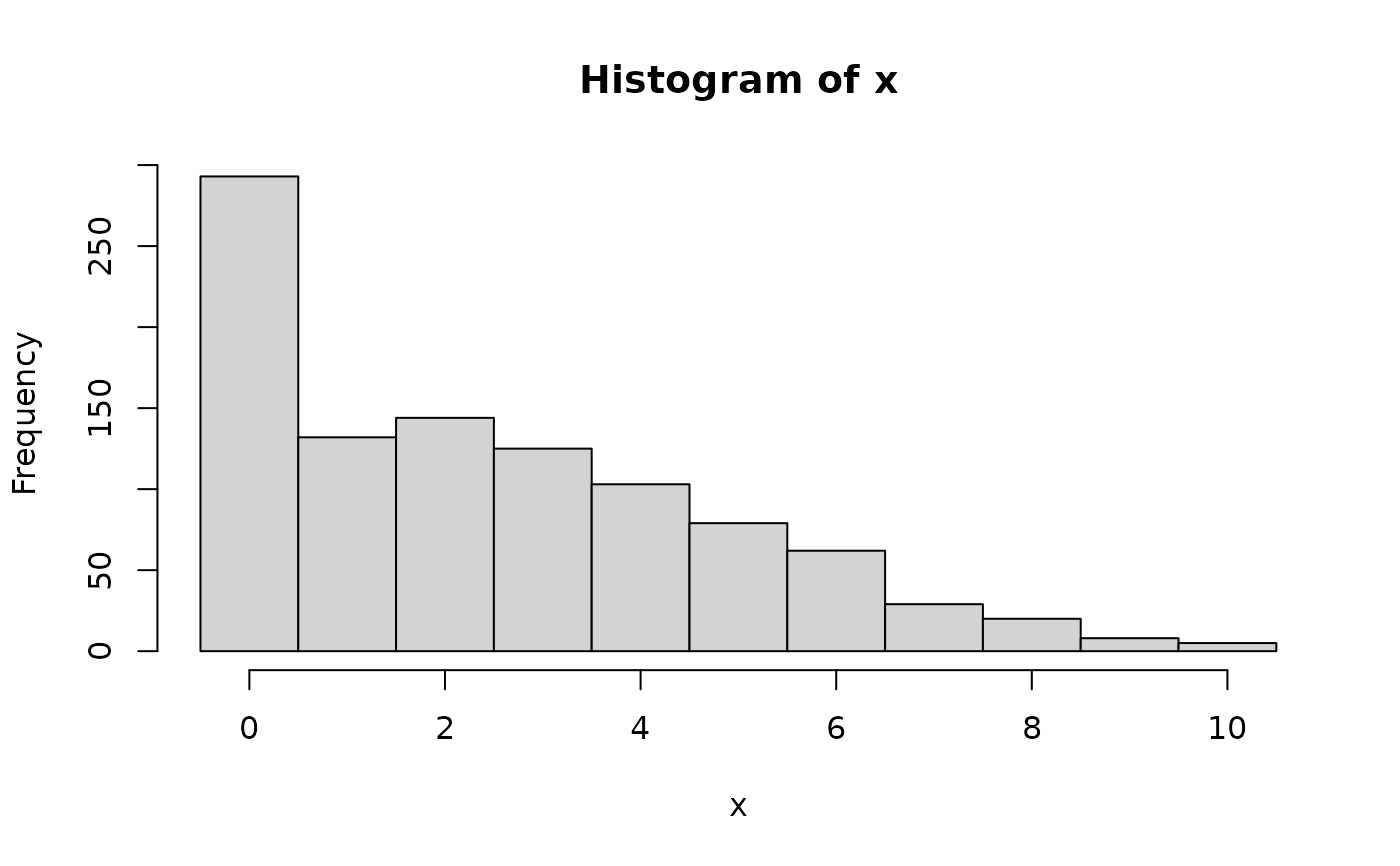
Generates random draws from the two-part hurdle model. First draws \(Z \sim \text{Bernoulli}(q)\), then for \(Z = 1\) draws \(Y \sim \text{ZT-BetaBin}(n, \mu, \kappa)\).
Details
All parameter vectors (n, q, mu, kappa)
are recycled to length nn. The function is fully vectorised.
References
Ghosal, S., Ghosh, S., and Moores, M. (2020). “Hierarchical beta-binomial models for batch effects in cytometry data.” Journal of the Royal Statistical Society: Series A, 183(4), 1579–1601.
See also
Other distributions:
compute_p0(),
compute_ztbb_mean(),
dbetabinom(),
dhurdle_betabinom(),
dztbetabinom(),
hurdle_mean(),
hurdle_variance(),
pbetabinom(),
rbetabinom(),
rztbetabinom()